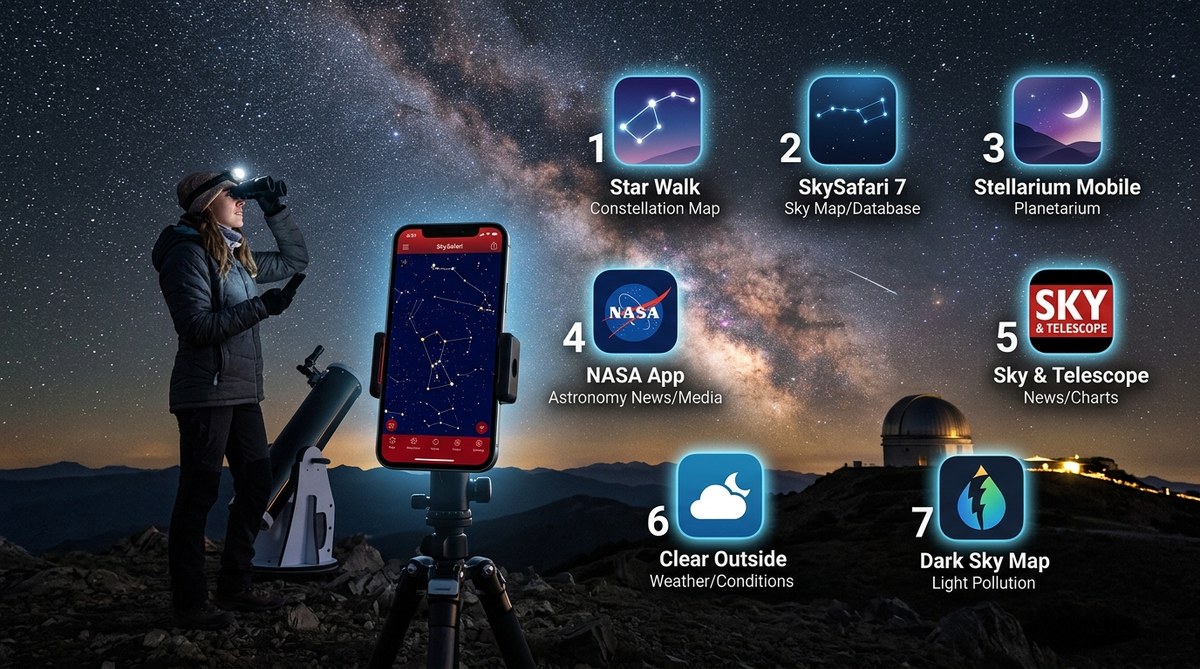
The night sky in 2026 has a lot to offer. From the total solar eclipse that swept across North America in April 2024 to the planetary alignments expected later this year, there is always something happening overhead. But knowing where to look requires more than just a telescope. You need the right software on your phone to guide you. The best astronomy apps 2026 can turn a confusing mess of stars into a recognizable map. They help you plan your evening, identify objects in real time, and even control your telescope. Whether you are a seasoned amateur or just starting out, these apps make the difference between a frustrating night and a magical one.
The best astronomy apps 2026 combine real-time sky maps, push notifications for celestial events, and weather-aware planning tools. Look for apps with dark mode, offline star charts, and satellite tracking. The top picks this year include SkySafari, Stellarium Mobile, and Nightshift, each offering unique features for different skill levels.
How to Pick the Right App for Your Stargazing Style
Not every app fits every observer. Before you download anything, think about how you plan to use it. Here is a simple process to narrow down your choices:
- Define your goal. Are you trying to identify a single bright planet? Or do you want to plan an entire night of deep-sky photography? Your goal determines which app features matter most.
- Check your hardware. Some apps work best with a push-to or go-to telescope mount. Others are purely visual tools for the naked eye or binoculars. Make sure the app supports your gear.
- Test the interface in the dark. A beautiful app is useless if it blinds you with a white screen at night. Look for a true red-light dark mode.
- Look for offline capability. Cell service is often weak at a good dark-sky site. The best apps let you download star charts ahead of time.
For a deeper look at the fundamentals of reading the sky, check out our guide on understanding the night sky a beginners guide to astronomy fundamentals.
The 7 Essential Astronomy Apps for 2026
After testing dozens of apps against the 2026 night sky, these seven stand out for their accuracy, ease of use, and unique features.
1. SkySafari 7 Pro
This is the gold standard for serious amateurs. SkySafari 7 Pro includes a database of over 100 million stars and 40,000 deep-sky objects. It connects wirelessly to most modern telescopes, allowing you to tap an object on your screen and have your mount slew to it automatically. The app also includes an observing list feature that tracks what you have seen and what is still visible tonight.
2. Stellarium Mobile Plus
Stellarium is famous for its desktop planetarium software, and the mobile version is just as good. The graphics are stunning, showing realistic Milky Way bands and star colors. The “Plus” version adds eyepiece simulation, which shows you exactly what a given object will look like through your specific telescope and eyepiece combination. This is invaluable for planning.
3. Nightshift
Nightshift is a newer app that focuses on light pollution and weather forecasting. It uses real-time satellite data to show you the best observing window for your exact location. It overlays light pollution maps, cloud cover predictions, and seeing conditions on a single timeline. If you only have one hour to observe, Nightshift tells you exactly when to go outside.
4. ISS Detector
Spotting the International Space Station is a thrill for any stargazer. ISS Detector sends you a push notification a few minutes before a visible pass. It shows an augmented reality arrow on your screen so you can point your phone in the right direction. The app also tracks other bright satellites, including the Chinese Tiangong space station.
5. PhotoPills
While primarily a photography planning tool, PhotoPills is essential for anyone who wants to capture the night sky. It calculates the exact time and direction of moonrise, moonset, and the golden hour. It also includes a augmented reality viewfinder that overlays the sun or moon’s path onto your camera’s live view. If you want to plan a shot of the Milky Way arching over a landmark, this is the app.
6. Heavens-Above
Heavens-Above has been a web-based resource for years, and its mobile app is just as reliable. It specializes in predicting passes of the ISS, iridium flares, and bright comets. The interface is simple but the data is precise. It is the go-to app for anyone who wants to catch a specific satellite or a flare event.
7. NASA App
The official NASA app is more of a news and media hub, but it deserves a spot on your phone. It streams live NASA TV, gives you access to the latest images from the James Webb Space Telescope, and sends alerts for breaking space news. It also includes a simple “What’s Up” feature that highlights visible planets and the moon phase for the current week.
Features That Matter Most in 2026
The market for astronomy apps is crowded. Here is a breakdown of what to look for and what to avoid.
| Feature | Why It Matters | Common Mistake to Avoid |
|---|---|---|
| Dark Mode (Red) | Preserves your night vision. | Using apps with a white background that ruins your dark adaptation for 30 minutes. |
| Offline Star Charts | Works at remote dark-sky sites with no cell signal. | Assuming the app will cache data. Always download charts before you leave home. |
| Push Notifications | Alerts you to ISS passes, eclipses, and meteor showers. | Ignoring notification settings. Set them up in advance for major events. |
| Telescope Control | Lets you use your phone as a hand controller for go-to mounts. | Buying an app that does not support your mount brand. Check the compatibility list first. |
| Light Pollution Overlay | Shows you where to drive for darker skies. | Relying on a single overlay. Cross-check with a local weather radar for cloud cover. |
Expert advice from a long-time observer: “Do not download every app on the list at once. Start with one planetarium app, like SkySafari or Stellarium, and learn it inside and out. Add a satellite tracker only after you are comfortable navigating the sky. Too many apps at once just lead to screen fatigue.”
Common Mistakes New Users Make
Even the best astronomy apps 2026 can let you down if you use them wrong. Here are the most frequent errors people make during their first stargazing sessions.
- Forgetting to update the location. Your phone’s GPS might be off. Always manually confirm your observing site in the app’s settings. If you drive 50 miles to a dark site, the app needs to know your new coordinates.
- Using the app during a meteor shower. Looking at your phone screen during a shower kills your night vision. Instead, plan your viewing window using the app before you go outside, then put the phone away.
- Trusting the sky map in bright moonlight. The moon washes out fainter stars. Many apps will still show them on the screen, but you will not see them in the eyepiece. Use the app’s magnitude filter to show only objects visible under current conditions.
- Ignoring the time zone setting. Daylight saving time changes can throw off your observing plan by a full hour. Double check that the app matches your local time.
For more tips on avoiding frustration, read our article on 5 common mistakes new astronomers make and how to avoid them.
Planning Your 2026 Stargazing Sessions with These Apps
The year 2026 includes several can’t-miss events. Here is how to use your apps to prepare for each one.
- Perseid Meteor Shower (August 11-13): Use Nightshift to find a night with clear skies and a moon that sets before midnight. Use ISS Detector to plan a break during the peak to watch for satellites.
- Partial Lunar Eclipse (August 28): Use PhotoPills to find the exact time of maximum eclipse for your time zone. Use Stellarium to see how the shadow will cross the moon’s surface.
- Jupiter at Opposition (September 27): Use SkySafari to set an alert for the exact moment Jupiter rises. Use the telescope control feature to track the planet and its four largest moons all night.
If you are still building your gear setup, our guide on choosing the perfect telescope for beginners exploring the night sky will help you match an app to your hardware.
Putting Your Phone to Work Under the Stars
Your smartphone is already a powerful astronomy tool. The best astronomy apps 2026 turn it into a portable observatory. Download two or three of the apps listed above before your next session. Spend ten minutes setting them up at home. When you arrive at your dark site, you will already know exactly where to point your eyes or your telescope.
The sky does not wait for anyone. But with the right app, you will never miss a thing.