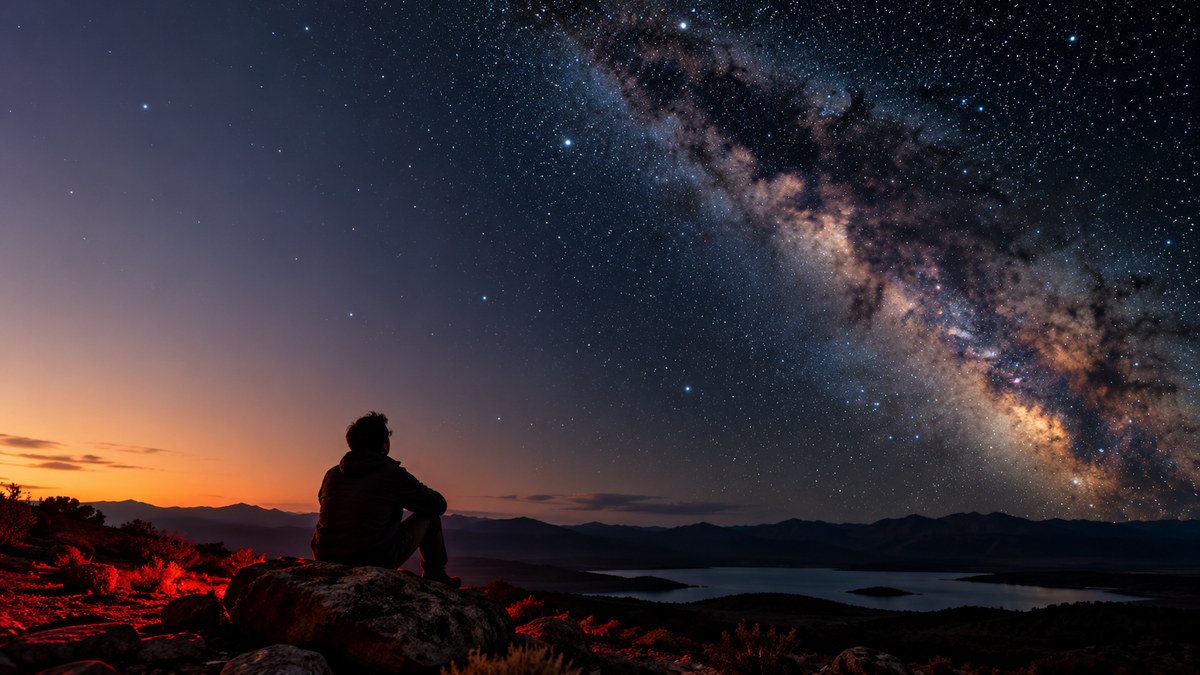
You step outside on a clear night, tilt your head back, and look up. At first, only the brightest stars punch through the darkness. A few minutes pass, and more appear. After a while, the Milky Way starts to reveal itself. This gradual shift is your eyes working hard behind the scenes. The question most beginners ask is simple: how long does it take for eyes to adjust to see stars? The answer is about 20 to 30 minutes for full dark adaptation, but your vision keeps improving for up to an hour in truly dark conditions.
Your eyes need at least 20 to 30 minutes to fully adapt to the dark and see the faintest stars. The process involves two stages: cone adaptation in the first 5 to 10 minutes, followed by rod adaptation that peaks around 30 minutes. Any exposure to white light resets the clock, so use red light and avoid phone screens for the best night vision.
Why your eyes need time to switch modes
Your eyes contain two types of photoreceptor cells: cones and rods. Cones handle color and detail in bright light. They adapt quickly, reaching about half their sensitivity within two minutes. Rods are the real night vision specialists. They are far more sensitive to dim light but take much longer to activate. Rods contain a pigment called rhodopsin, or visual purple, which gets bleached by bright light. In darkness, your eyes regenerate rhodopsin, and this rebuilding process dictates the timeline.
During the first five minutes in the dark, cones do most of the work. You can see bright stars and maybe a planet or two. But the faint fuzzy patches, the dim globular clusters, and the delicate glow of the Andromeda Galaxy remain invisible. After 10 minutes, rods begin to kick in. By the 20-minute mark, your sensitivity to light increases roughly 10,000 times compared to when you first stepped outside. Full adaptation takes about 30 minutes, and some studies show continued improvement up to 45 minutes or even an hour in pitch-black settings.
The two phases of dark adaptation
Understanding the phases helps you plan your stargazing session. Here is how the timeline breaks down:
-
Cone adaptation (0 to 10 minutes): Cones reach their maximum sensitivity in about 5 to 10 minutes. They let you see the brighter stars and navigate your surroundings, but they are not sensitive enough to pick out the faintest objects. Your color vision is also poor in low light, so everything looks grayish.
-
Rod adaptation (10 to 30+ minutes): Rods start to take over after about 10 minutes. Their sensitivity grows exponentially for the next 20 minutes. At 30 minutes, your eyes are about 100,000 times more sensitive than in full daylight. This is when you can spot the Milky Way, the Andromeda Galaxy, and the dimmest stars visible to the naked eye.
-
Extended adaptation (30 to 60 minutes): In very dark skies away from light pollution, your night vision continues to sharpen slightly beyond the 30-minute mark. The improvement is subtle but real. If you have the patience to wait a full hour, you will see details that were invisible at the 20-minute point.
Common mistakes that reset your night vision
Even a single second of bright light can destroy your dark adaptation. Here is a table showing the most common mistakes and how to avoid them.
| Mistake | Why it hurts your night vision | Better alternative |
|---|---|---|
| Checking your phone | Phone screens emit blue light that bleaches rhodopsin | Use a dedicated red-light flashlight or cover your phone screen with a red filter |
| Turning on a car headlight | Car headlights are many times brighter than the darkest sky | Park away from your observing site and use a dim red headlamp to walk |
| Using a white flashlight | White light contains all wavelengths and ruins rod adaptation | Switch to a flashlight with a red LED or a red film over the lens |
| Walking near house lights | Even indoor light spilling out a window can affect your eyes | Set up in the darkest part of your yard, far from windows and porch lights |
| Looking directly at the Moon | The Moon is surprisingly bright and can dazzle your rods | Look away from the Moon or use averted vision to keep rods active |
How to speed up and protect your night vision
You cannot force your eyes to adapt faster, but you can avoid sabotaging the process. Here are the most effective strategies:
- Wear red-tinted glasses for 20 minutes before you go outside. Red light does not bleach rhodopsin, so your eyes start adapting while you are still indoors.
- Use a red flashlight for reading star charts or adjusting equipment. Red light preserves your dark adaptation while still letting you see.
- Practice averted vision. Look slightly to the side of a faint object. The edge of your retina contains more rods, so dim objects appear brighter.
- Give yourself a full 30 minutes of uninterrupted darkness. Do not check your phone, look at a bright watch, or walk past a streetlight.
- Choose an observing site with minimal light pollution. Even distant city glow can reduce your ability to see the faintest stars.
“The best telescope in the world is useless if you ruin your dark adaptation. Give your eyes at least half an hour of pure darkness before you start observing. The difference between 10 minutes and 30 minutes is the difference between seeing a dozen stars and seeing a thousand.” — Adapted from advice shared by experienced amateur astronomers
What you can see at each stage of adaptation
Your night vision evolves in stages, and each stage reveals different objects. Here is what to expect:
- 0 to 5 minutes: You see the brightest stars like Sirius, Vega, and Arcturus. Planets like Jupiter and Venus are easy. The Moon looks brilliant. Faint stars are invisible.
- 5 to 10 minutes: More stars appear. You can make out the main stars of constellations like the Big Dipper and Orion. The Pleiades star cluster might start to show as a tiny blur.
- 10 to 20 minutes: The sky fills with stars. The Milky Way begins to appear as a faint band of light. You can spot the Andromeda Galaxy as a smudge on a very dark night. The Double Cluster in Perseus becomes visible.
- 20 to 30 minutes: Your vision is near its peak. The Milky Way looks textured and bright. You can see the Lagoon Nebula with the naked eye under dark skies. Faint satellites and shooting stars are easier to catch.
- 30 to 60 minutes: The subtlest details emerge. You might see the zodiacal light just after twilight or the gegenschein in the darkest locations. The difference is small but rewarding for dedicated observers.
Why age and health affect your adaptation time
Not everyone adapts at the same speed. Age plays a big role. Children and teenagers often adapt faster and see fainter stars than adults over 40. The lens of the eye yellows with age, which reduces the amount of light reaching the retina. Pupil size also shrinks. A 20-year-old might have a pupil diameter of 7 millimeters in the dark, while a 60-year-old might only reach 5 millimeters. That difference means the younger eye collects about twice as much light.
Health conditions like vitamin A deficiency, diabetes, and cataracts can also slow dark adaptation. If you notice your night vision is worse than it used to be, a checkup with an eye doctor can help. Simple changes like eating more dark leafy greens or taking a supplement recommended by your doctor might improve your results.
A practical checklist for your next stargazing session
Before you head out, run through this list. It takes less than a minute and can save you 30 minutes of wasted adaptation time.
- [ ] Put on red-tinted glasses 20 minutes before going outside
- [ ] Charge your red flashlight and keep it in your pocket
- [ ] Turn off all outdoor lights at your observing spot
- [ ] Set your phone to night mode with a red filter app
- [ ] Park your car away from your viewing area
- [ ] Bring a comfortable chair so you can sit still and relax
- [ ] Cover any glowing electronics with tape or cloth
How to recover night vision after a mistake
If you accidentally look at a bright light, do not panic. Your adaptation is not completely gone. Here is what to do:
- Close one eye immediately. This protects the adaptation in that eye while the other eye recovers.
- Turn away from the light source. Cover your face with your hands if needed.
- Wait 5 to 10 minutes for partial recovery. Full recovery from a brief flash takes about 20 minutes.
- Use averted vision with your closed eye to check if rods are still working.
This technique is especially useful if you are observing with a friend who accidentally shines a white light in your direction. Keep one eye closed at all times when bright lights are nearby. Many experienced observers keep a patch over one eye while walking to their observing site.
The science behind the 30-minute rule
Rhodopsin regeneration follows a predictable curve. When you first enter darkness, your eyes contain very little active rhodopsin. The regeneration rate is fastest in the first 10 minutes, then slows as it approaches maximum. After 30 minutes, about 95 percent of your rhodopsin has been regenerated. The last 5 percent takes much longer, which is why full adaptation can take up to an hour.
The process is also affected by your previous light exposure. If you spent the afternoon at the beach in bright sunlight, your rhodopsin is heavily bleached. If you were indoors under dim lamps, adaptation starts from a better baseline. That is why experienced astronomers often spend the evening in dim light before heading outside.
Your eyes are your most powerful astronomy tool
No telescope or binoculars can replace the natural sensitivity of your dark-adapted eyes. A good telescope shows you details, but your eyes are the first instrument in the chain. If you rush outside and start looking through a telescope after only five minutes, you are missing most of what the night sky has to offer. The faintest galaxies, the dimmest nebulae, and the delicate glow of the Milky Way are all waiting for you. They just need your eyes to be ready.
Give yourself the full 30 minutes. Sit back, relax, and let the stars come to you. You will see more, enjoy the experience more, and understand why patience is the most important skill in amateur astronomy. For more guidance on what to look for once your eyes are ready, check out our guide to what you can see with the naked eye tonight and our tips for training your eyes for better night sky observation.
Make dark adaptation part of your stargazing routine
The 30-minute wait might feel long at first, especially if you are eager to start observing. But once you see the difference, you will never skip it again. The sky that appears after full dark adaptation is a completely different place from the one you saw when you first walked outside. It is richer, deeper, and filled with subtle beauty. Next time you plan a night under the stars, arrive 30 minutes early. Sit in the dark, let your eyes adjust, and watch the sky come alive. That quiet half hour might become your favorite part of the whole session.