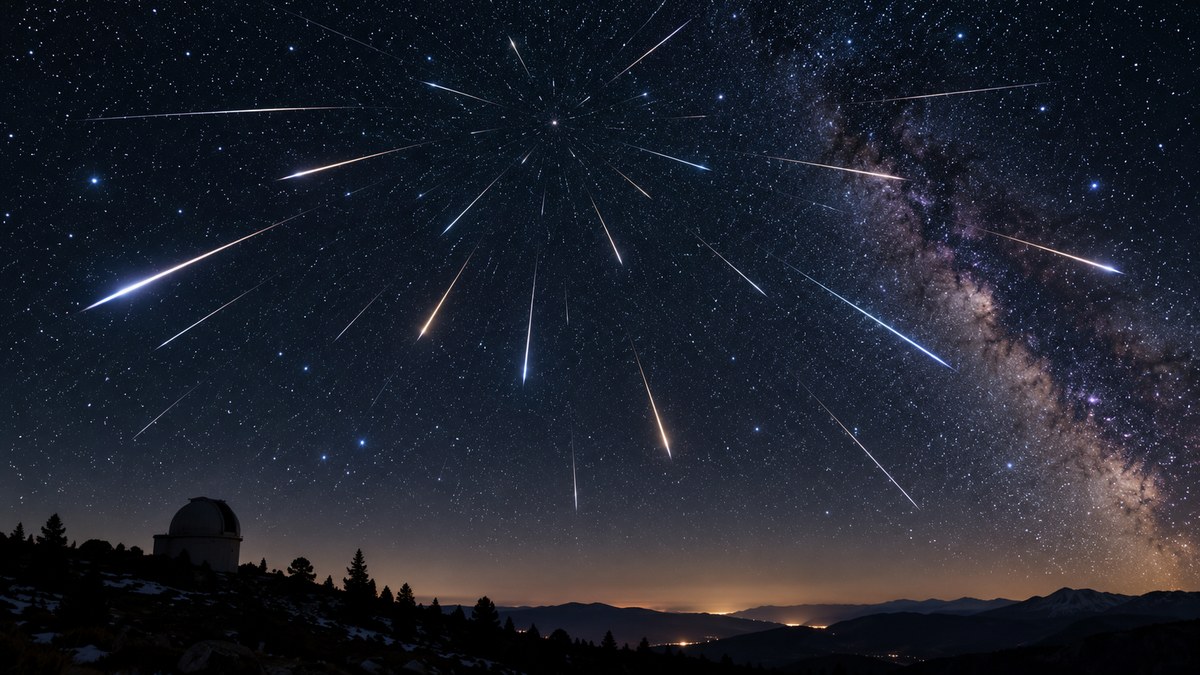
You look up at a dark country sky and see a streak of light race across the stars. It lasts only a second. Maybe you make a wish. That flash is a meteor, and when you see a bunch of them in one night, you are watching a meteor shower. But what is a meteor shower exactly? It is not a bunch of stars falling down. It is something much smaller and more fascinating. Let us break down the science behind those shooting stars and the mysterious point in the sky they all seem to come from.
A meteor shower happens when Earth passes through a trail of dusty debris left behind by a comet or asteroid. Those specks of dust burn up in our atmosphere at high speed, creating streaks of light called meteors. All the meteors in a shower appear to fly away from a single spot in the sky known as the radiant point. You do not need a telescope to enjoy the show.
What Is a Meteor Shower Made Of?
A meteor shower is not a shower of stars. It is a shower of space dust. Comets and some asteroids leave trails of debris behind them as they orbit the Sun. Think of a comet like a dirty snowball. Every time it gets close to the Sun, some of its ice and dust melts off. That dust spreads out along the comet’s orbit path.
Earth crosses these orbital paths at the same time every year. When our planet plows through that field of debris, the tiny particles hit our upper atmosphere at speeds between 25,000 and 160,000 miles per hour. They are moving so fast that they compress the air in front of them. That compression heats the air and the particle itself until it glows. That glowing trail is the meteor you see.
Most of these particles are smaller than a grain of sand. They never reach the ground. If a piece is large enough to survive the trip and hit the ground, it is called a meteorite. But during a typical shower, you are just watching dust burn up harmlessly about 50 to 75 miles above your head.
The Three Names of a Shooting Star
The terminology can get confusing. Here is a simple breakdown of what to call each stage of the process.
- Meteoroid: The piece of rock or dust while it is still floating in space.
- Meteor: The bright streak of light it creates as it burns up in Earth’s atmosphere. This is the “shooting star.”
- Meteorite: The fragment that survives the fiery trip and lands on the ground.
So when you ask “what is a meteor shower,” you are really asking about a time when many meteoroids hit our atmosphere at once, creating many meteors.
Understanding the Radiant Point
If you watch a meteor shower for a while, you will notice something strange. All the meteors seem to stream away from one single area of the sky. That area is called the radiant point. It is the most confusing part of understanding what is a meteor shower for most beginners.
The radiant is an illusion of perspective. Imagine you are driving a car through a tunnel of falling snow. The snowflakes ahead of you seem to fly outward from a single point in the distance. They are actually falling straight down, but your forward motion makes them appear to radiate away from that central spot.
Meteors work the same way. The dust particles are all traveling on parallel paths through space. Earth is moving forward into that river of debris. From our perspective, the meteors appear to diverge from a point in the sky directly ahead of us along Earth’s orbital path. That point is the radiant.
Each major meteor shower has a different radiant point. Astronomers name showers after the constellation where the radiant appears. The Perseids radiate from the constellation Perseus. The Geminids come from Gemini. The Leonids appear to come from Leo.
“Do not stare directly at the radiant point. Meteors near the radiant look short and stubby because you are seeing them head on. The best meteors, the long bright ones with impressive tails, appear far away from the radiant. Let your eyes wander about 45 to 90 degrees away from that spot.” — Experienced observer tip
How to Watch a Meteor Shower
You do not need expensive gear to enjoy a meteor shower. In fact, your eyes are the best tool for the job. Telescopes have too narrow a field of view. You want to see as much sky as possible.
Here are the steps to set yourself up for a great night of watching.
-
Find a dark location. Get away from city lights. Light pollution is the number one enemy. A state park, a rural field, or even a dark patch of your backyard works. Check a light pollution map online to find the darkest spot near you.
-
Let your eyes adjust. Give your eyes at least 20 to 30 minutes to adapt to the dark. Do not look at your phone. A single glance at a bright screen ruins your night vision for another 20 minutes. If you need light, use a red flashlight or a headlamp with a red mode.
-
Bring comfort items. Lie flat on a reclining chair or a thick blanket on the ground. Look straight up. Dress warmly, even in summer. A thermos of coffee or hot chocolate helps on cooler nights.
-
Be patient. Do not expect a constant firework show. There will be lulls. Some showers produce 10 to 20 meteors per hour. Major showers like the Perseids or Geminids can produce 50 to 100 per hour under perfect conditions.
-
Check the Moon phase. A bright Moon washes out fainter meteors. Plan your viewing around a new Moon or a Moon that sets before midnight.
Common Mistakes and How to Fix Them
Many beginners make the same errors when they try to see what is a meteor shower. Here is a table to help you avoid the most common pitfalls.
| Mistake | Why It Hurts Your View | The Fix |
|---|---|---|
| Staring at the radiant point | You miss the longest, brightest meteors | Look 45 to 90 degrees away from the radiant |
| Using a telescope or binoculars | You see a tiny patch of sky instead of the whole thing | Use only your naked eyes |
| Checking your phone constantly | You ruin your dark adaptation | Put your phone away or use a red filter |
| Staying indoors until peak time | You miss the early activity | Go out an hour before the predicted peak and stay for a few hours |
| Watching from a bright city | You see only the brightest 5% of meteors | Drive to darker skies or find a local astronomy club’s dark site |
What is a meteor shower without the radiant point? It is just random streaks of light. The radiant is the key that turns random streaks into a true shower.
Why Some Showers Are Better Than Others
Not all meteor showers are created equal. The number of meteors you see depends on a few factors.
The density of the debris trail matters. Some comets leave a thick, clumpy trail. Others leave a thin, sparse one. The shower you get depends on which part of the trail Earth passes through that year.
The speed of the particles also changes the show. Faster meteors tend to be brighter because they have more energy. The Leonids hit the atmosphere at about 44 miles per second. They are tiny but incredibly fast, which makes them bright. The Geminids are slower, around 22 miles per second, but their particles are denser, so they also produce nice displays.
The time of year matters too. Summer showers like the Perseids are popular because the weather is warm and people are outside. Winter showers like the Geminids can be spectacular but require you to bundle up and brave the cold.
For a deeper look at what else you can spot in the night sky, read our guide on understanding the night sky. It will help you identify the constellations that host these radiant points.
A Simple Way to Explain It to a Friend
If someone asks you “what is a meteor shower,” here is the short version you can tell them.
A meteor shower is Earth driving through a cloud of dust left by a comet. The dust burns up in our atmosphere and makes streaks of light. All those streaks seem to come from one point in the sky because of perspective, like snowflakes spreading out from the center of your windshield. You do not need a telescope. Just find a dark spot, look up, and wait.
How to Prepare for Your First Shower
You have the knowledge. Now you need a plan. Here is a checklist you can use before heading out.
- Check the date of the next major shower. The Perseids peak in August. The Geminids peak in December.
- Look up the Moon phase for that night.
- Choose a dark location away from city lights.
- Pack a blanket or reclining chair.
- Bring warm clothes and snacks.
- Download a stargazing app to help you find the radiant constellation, but use it only in red light mode.
- Tell a friend where you are going if you head to a remote spot.
If you want to learn how to identify the stars and planets that share the sky during a shower, check out our guide to mastering astronomy basics. It pairs perfectly with a meteor watching night.
The Magic of a Shared Sky
There is something special about lying under a dark sky with friends or family, watching tiny pieces of a comet burn up 50 miles above you. You are seeing the same sky that humans have watched for thousands of years. The science of what is a meteor shower makes it even more amazing. Those little flecks of dust are traveling through the solar system. They have been orbiting the Sun for centuries. And right now, at this moment, your planet runs into them.
So pick a clear night, find a dark spot, and look up. The universe is putting on a show, and you have a front row seat.