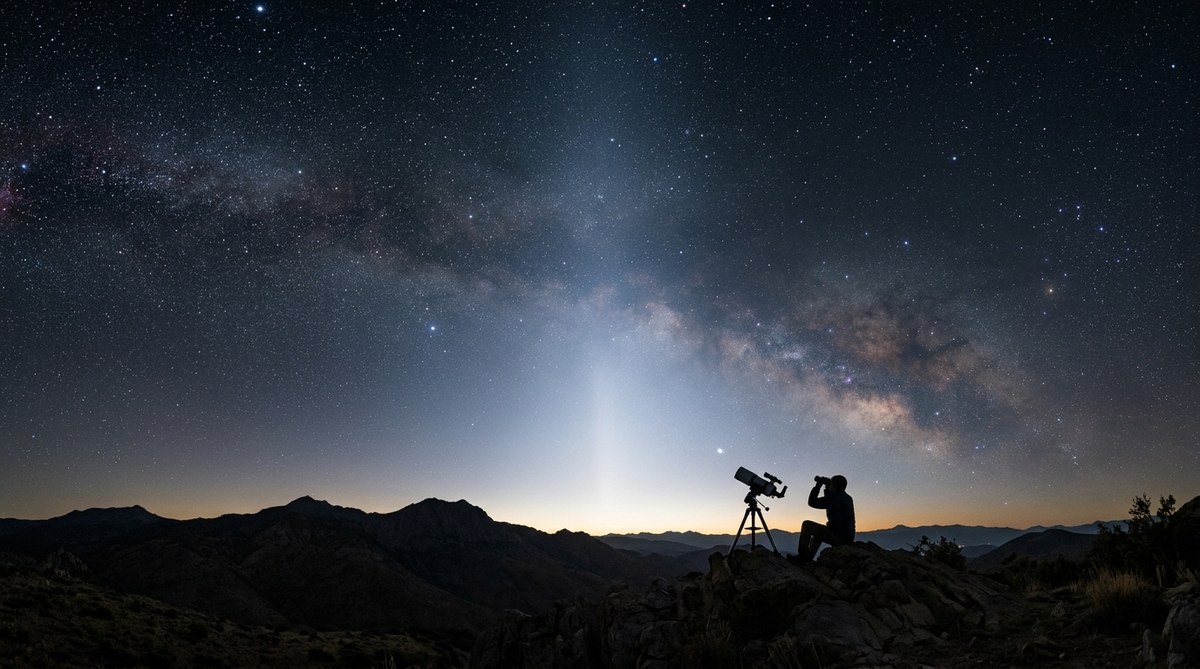
Picture a cold March morning. You are standing outside before sunrise. The sky is still dark, but a faint, soft pyramid of light rises from the eastern horizon. It looks like the first glow of sunrise, but the Sun is still an hour away. That ghostly beam is the zodiacal light. For centuries, observers called it the “false dawn” because it tricks the eye into thinking morning is closer than it really is.
The zodiacal light is sunlight scattering off dust grains that orbit the Sun in the same plane as the planets. You can see it with your naked eye from a dark location. The best viewing windows are during spring and autumn equinoxes. No telescope or special gear is needed, just a clear sky and patience.
What Is Zodiacal Light Made Of?
The zodiacal light is not a trick of the atmosphere. It is real, physical light reflecting off tiny particles of dust. These grains are leftovers from the formation of the solar system. Comets and asteroid collisions also add fresh material to this cloud. The dust spreads out in a flat disk that matches the plane where all planets orbit, called the ecliptic.
When you look toward the horizon and see that glowing triangle, you are seeing sunlight bouncing off billions of microscopic dust specks. The effect is similar to seeing a car headlight cut through fog. The fog itself is not glowing, but the light scatters off the water droplets. In this case, the dust acts like those droplets.
This dust cloud extends all the way from the Sun past the orbit of Mars. Some of it reaches out to Jupiter. Because the dust is spread so thin, the light is faint. You need a truly dark sky to notice it.
Why Does It Look Like a Triangle?
The shape of the zodiacal light comes from perspective. You are looking edge-on into a flat disk of dust. Imagine holding a dinner plate at eye level. The far edge of the plate looks thin, but the near edge looks wide. That is exactly what happens when you view the dust disk from Earth.
The wide base of the triangle sits on the horizon. The narrow tip points upward along the ecliptic path. During certain times of the year, the angle of the ecliptic relative to the horizon is steep. That steep tilt makes the zodiacal light appear taller and easier to spot.
When Is the Best Time to See the False Dawn?
Timing is everything. The zodiacal light is visible twice a year for most observers in the Northern Hemisphere.
- Spring evenings (February through April): Look west after evening twilight ends. The ecliptic tilts high in the sky, lifting the dust glow above the horizon haze.
- Autumn mornings (September through November): Look east before morning twilight begins. The same steep tilt happens before sunrise.
For the Southern Hemisphere, the seasons are reversed. Autumn evenings and spring mornings work best.
The Moon is your biggest enemy. Even a crescent Moon adds enough skyglow to wash out the zodiacal light. Plan your viewing around the new Moon phase.
How to Find the Zodiacal Light in Your Sky
You do not need a telescope. You do not need binoculars. You just need your eyes and a good viewing spot. Follow these steps:
- Check the Moon phase. Choose a night within three days of the new Moon.
- Find a dark location. Drive at least 30 minutes away from city lights. State parks, rural roads, and high elevation lookouts work well.
- Let your eyes adjust. Give yourself 20 minutes in complete darkness. Do not look at your phone.
- Face the right direction. In spring, look west after evening twilight. In autumn, look east before morning twilight.
- Scan the horizon. Look for a hazy, cone-shaped glow rising from the horizon. It will look like a smudge of light.
- Use averted vision. Look slightly to the side of where you think the glow is. Your peripheral vision is more sensitive to faint light.
Common Mistakes That Ruin the View
Many beginners try to see the zodiacal light and fail. Here are the typical errors and how to fix them.
| Mistake | Why It Fails | How to Fix It |
|---|---|---|
| Looking too late in spring | The sky becomes too bright | Start looking 90 minutes after sunset |
| Looking too early in autumn | The Moon is still up | Wait for moonset or pick a new Moon week |
| Staying near city lights | Light pollution drowns the glow | Drive to a Bortle 3 or darker site |
| Using binoculars or a telescope | The field of view is too narrow | Use only your naked eyes |
| Checking a phone for time | Phone light ruins night vision | Use a red flashlight or cover the screen |
“The zodiacal light is one of the few celestial sights that rewards the patient observer more than the well equipped one. Your best tool is a dark sky, not a fancy eyepiece.” – Thrush Observatory field notes
What the False Dawn Is Not
Some people confuse the zodiacal light with other sky phenomena. Here are the differences.
- Aurora borealis: The northern lights are caused by charged particles from the Sun hitting the atmosphere. They ripple and move. The zodiacal light is steady and does not dance.
- Milky Way: The Milky Way is a band of stars from our galaxy. It is made of starlight, not scattered sunlight. It also appears much brighter and wider.
- Light pollution: City glow comes from ground level and spreads upward. The zodiacal light comes from above the horizon and follows the ecliptic path.
- Twilight: True twilight is caused by sunlight scattering in the upper atmosphere. The zodiacal light appears after twilight ends and before it begins again.
Why Is It Called the False Dawn?
The name “false dawn” dates back to ancient times. Observers in the Middle East and Mediterranean noticed a glow that preceded the real dawn. Some thought it was a sign of changing weather. Others wove it into folklore.
The term stuck because the effect is genuinely misleading. If you are not familiar with the zodiacal light, you might mistake it for the first signs of sunrise. The pyramid of light grows brighter as it rises, mimicking the way the sky brightens before the Sun crests the horizon. Only after watching for a while do you realize the Sun is still hidden.
In some older texts, you will also see the term “zodiacal glow” or “zodiacal band.” These refer to the same phenomenon. The band is a fainter extension of the light that wraps all the way around the sky.
Can You Photograph the Zodiacal Light?
Yes, but it takes some planning. A modern smartphone with a manual mode can capture it, but a mirrorless camera or DSLR will do better.
- Use a wide angle lens with a fast aperture (f/2.8 or wider).
- Set the ISO between 1600 and 3200.
- Use a shutter speed of 15 to 30 seconds.
- Focus manually on a bright star.
- Use a tripod. Do not try to hold the camera by hand.
The zodiacal light looks best in photos when the sky is extremely dark and the air is dry. Humidity and haze reduce contrast.
How the Zodiacal Light Connects to Your Night Sky Journey
Once you learn what is zodiacal light, you start noticing other subtle sky features. The same dust cloud that creates the false dawn also causes the gegenschein, a faint glow opposite the Sun in the sky. The gegenschein is even harder to see, but it proves the dust disk surrounds us completely.
If you are just starting out with stargazing, the zodiacal light is a perfect target. It requires no equipment. It teaches you to pay attention to sky conditions, Moon phases, and seasonal changes. These skills transfer directly to finding galaxies, nebulae, and planets.
For more help building your night sky knowledge, check out our guide on understanding the night sky. It covers the basics of star motion, constellations, and how to plan your sessions.
The Best Locations to See It in the United States
Some of the best zodiacal light viewing happens in the American West, where dark skies are still common.
- Great Basin National Park, Nevada: Elevation over 7,000 feet and very low light pollution.
- Cherry Springs State Park, Pennsylvania: One of the darkest spots on the East Coast.
- Kitt Peak National Observatory, Arizona: High desert air and minimal humidity.
- Big Bend National Park, Texas: Remote location with vast open horizons.
- Acadia National Park, Maine: Good spring evening views over the Atlantic.
If you cannot travel, try a local astronomy club. Many clubs hold dark sky parties during equinox weeks. They know the best local spots.
What to Bring for a Successful Viewing Session
A short checklist makes your outing easier.
- Red flashlight (or a headlamp with a red mode)
- Warm clothing, even in spring. Nights stay cold.
- A reclining chair or blanket to sit on
- A star chart or app set to night mode
- Snacks and hot drink
- No white light sources
Why the False Dawn Matters for Science
The zodiacal light is not just a pretty sight. Astronomers study it to understand the distribution of dust in the inner solar system. The dust affects how we measure the brightness of stars and galaxies. It also provides clues about how planets form.
Space missions like NASA’s Parker Solar Probe have measured zodiacal dust at close range. The data helps refine models of the solar system’s early history. Every time you see the false dawn, you are looking at the raw material that built the planets.
One Last Tip for Beginners
The zodiacal light rewards patience. You might not see it on your first try. That is normal. The glow is subtle. It does not jump out like a firework. It sits quietly on the horizon, waiting for your eyes to adapt.
Do not give up after one attempt. Try again on a different night. Move to a darker location. Check the Moon phase. Once you finally see that soft pyramid rising, you will understand why ancient skywatchers gave it a name that has lasted thousands of years.
The false dawn is a reminder that the sky holds wonders you do not need a telescope to enjoy. All you need is darkness, time, and a little bit of curiosity.