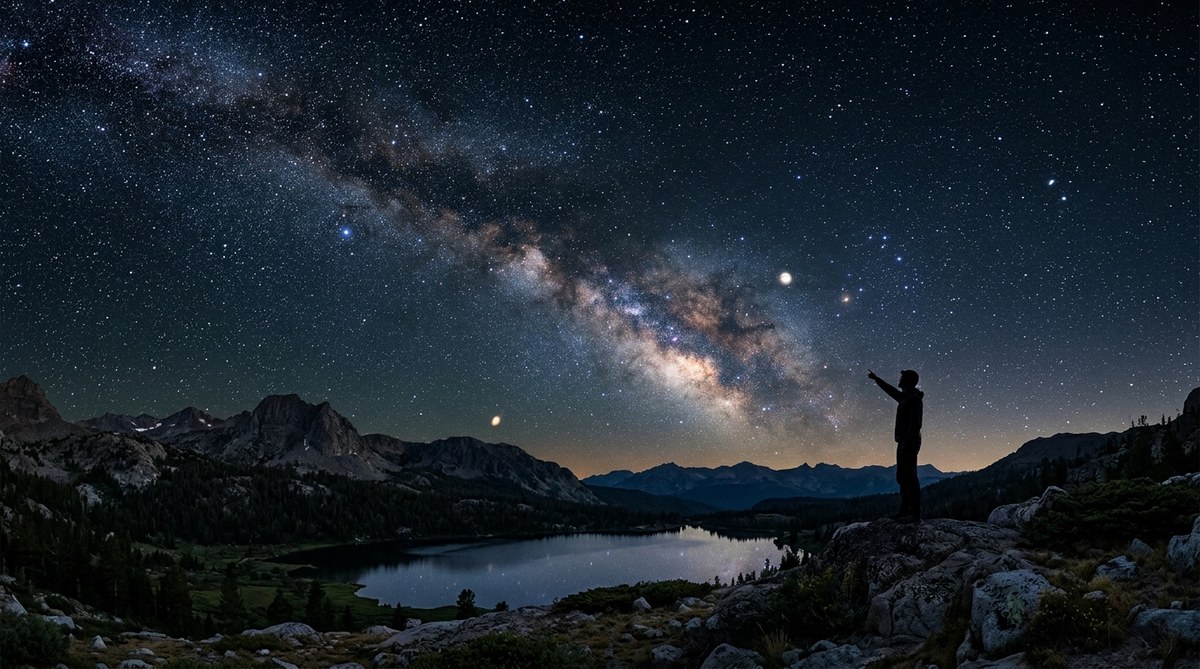
Stepping outside on a clear night, you look up and wonder: what am I seeing? Some of the brightest points of light aren’t stars at all. They’re planets. And tonight, several of them are putting on a show that requires nothing more than your own two eyes. Whether you’re in a city backyard or a dark country field, this guide will help you identify which planets are visible tonight with the naked eye and exactly where to look. No telescope, no experience, just a clear horizon and a little patience.
Five planets are regularly visible to the naked eye: Mercury, Venus, Mars, Jupiter, and Saturn. Tonight, depending on your location and time, you can spot at least two or three of them without any gear. The key steps: check the sunset/sunrise time, look in the right direction, and know how to tell a planet from a star. This guide gives you tonight’s best targets and a simple method to start stargazing right now.
Which Planets Can You See With the Naked Eye Tonight?
The five classical planets have been known since ancient times because they are bright enough to see without a telescope. Their visibility changes throughout the year as they orbit the Sun. Right now, in 2026, the typical evening or morning sky usually shows two to four of them. Here’s what to expect tonight.
- Venus (the Evening Star or Morning Star): The brightest planet by far. It appears low in the west after sunset or low in the east before sunrise, depending on its current apparition.
- Jupiter: The second brightest planet. It shines with a steady, golden-white light. Often found higher in the sky than Venus.
- Mars: Recognizable by its distinct orange-red hue. It can be dimmer than Jupiter but still obvious when it’s above the horizon.
- Saturn: Faintest of the five, but still visible to the naked eye. It looks like a steady, pale yellow star. You need a dark sky to see it easily.
- Mercury: The trickiest to spot because it never gets far from the Sun. It appears very low in the twilight shortly after sunset or before sunrise, for only a few weeks at a time.
How to Tell a Planet from a Star
A common beginner mistake is confusing a bright planet for a star. Here’s how to tell the difference without any equipment.
- Twinkle test: Stars twinkle because their light passes through turbulent air. Planets do not twinkle noticeably. They shine with a steady, calm glow. If a bright “star” stays rock-steady, it’s likely a planet.
- Brightness: The planets Venus and Jupiter are often much brighter than any star in the sky. Saturn and Mars may be as bright as a first-magnitude star, but they still lack the twinkle.
- Color: Venus is white or slightly yellowish. Jupiter is a warm cream color. Mars has a distinct rusty orange tint. Stars also come in colors, but planets’ colors are softer and more consistent.
- Movement: Over several nights, planets drift against the background stars. If you look at the same bright spot on consecutive nights and it has shifted relative to nearby stars, it’s a planet.
Best Times to Look: Evening vs Morning
The timing depends on which planet you want to see. Use this simple numbered process to plan your observation tonight.
- Check your local sunset time on your phone’s weather app. Most planets become visible 20 to 40 minutes after sunset.
- Look west in that early twilight window for Venus, Jupiter, or Mercury. Venus and Jupiter often appear together during certain months.
- If you’re up before sunrise, look east about 45 minutes before sunrise. Mars and Saturn are often morning objects during parts of 2026.
- Use a sky map or an app to confirm exactly where each planet will be. Many free apps show you a live view of the sky based on your location. (For a deeper understanding, check our guide on understanding the night sky.)
- Allow your eyes to adapt to the dark. Give yourself at least 10 minutes away from bright lights before trying to spot fainter planets like Saturn.
Tonight’s Planet Visibility Table
Use the table below as a general reference. Visibility changes by season, but this gives you an idea of what to look for on a typical night in 2026.
| Planet | Visibility Window (Typical 2026) | Best Time to Look | Direction | Naked Eye Difficulty |
|---|---|---|---|---|
| Venus | Evening or morning (alternates) | 30 minutes after sunset | West | Very easy |
| Jupiter | Evening or late night | First few hours after dark | Southwest to west | Easy |
| Mars | Varies; often morning | Early morning before dawn | East | Moderate (needs dark sky) |
| Saturn | Morning or late evening | Late evening or predawn | Southeast to south | Moderate to hard |
| Mercury | Brief windows near elongation | 20 to 30 minutes after sunset | West | Hard (low horizon so clears needed) |
Expert tip: If you’re not sure whether that faint dot is Saturn or just a star, try holding your hand at arm’s length. Steady the view by bracing against a tree or wall. Then check if the object shows the steady light we described. With a little practice, you’ll never mistake a planet for a star again.
Common Mistakes Beginners Make (And How to Avoid Them)
- Looking too early or too late. Twilight is the best time for bright planets. Once the sky is fully dark, planets near the horizon may have set or be hidden by trees.
- Forgetting about light pollution. In a bright city, only Venus and Jupiter are reliably visible. For Saturn and Mars, drive to a park with less glare.
- Confusing an airplane with a planet. Airplanes move and flash. Planets are stationary and steady. If it blinks or moves, it’s not a planet.
- Not using a reference point. The Moon often passes near planets. This makes them easier to identify. Check an almanac for “Moon near Venus” dates.
How the Season Affects What You See Tonight
Earth’s orbit changes which planets are in the evening or morning sky. In early 2026, Venus dominated the evening sky after sunset. By mid-year, Jupiter becomes a prominent evening object, and Mars shifts to the morning. Saturn trails behind, visible in the late night hours.
For a complete overview of identifying all celestial objects, read about mastering astronomy basics. If you want to start reading printed maps, our guide to star charts will get you oriented.
Your First Naked Eye Planet Hunt: A Simple Three Step Routine
You don’t need a complicated plan. Here’s a routine you can follow tonight.
- Before sunset, note the local sunset time and the weather forecast. Clear skies are essential.
- Go outside about 30 minutes after sunset. Face the western sky. Look for the brightest point of light. That is likely Venus.
- Stare at it for a few seconds. Notice it doesn’t twinkle. If you see a second bright object nearby, that might be Jupiter or a bright star like Arcturus. Use a sky app to confirm.
Repeat the same process in the morning (before dawn) for Mars and Saturn. With practice, you’ll learn the dance of the planets and feel a deep connection to the cosmos.
A Warm Word for Tonight’s Skywatcher
You already have everything you need to start observing the planets visible tonight with the naked eye. Your eyes, the sky, and a little curiosity are enough. Tonight, step outside, give your eyes a few minutes of darkness, and scan the western sky. The planets have been waiting for you. If you want to go further, explore our essential tips for identifying celestial objects in 2026. Clear skies and happy stargazing.