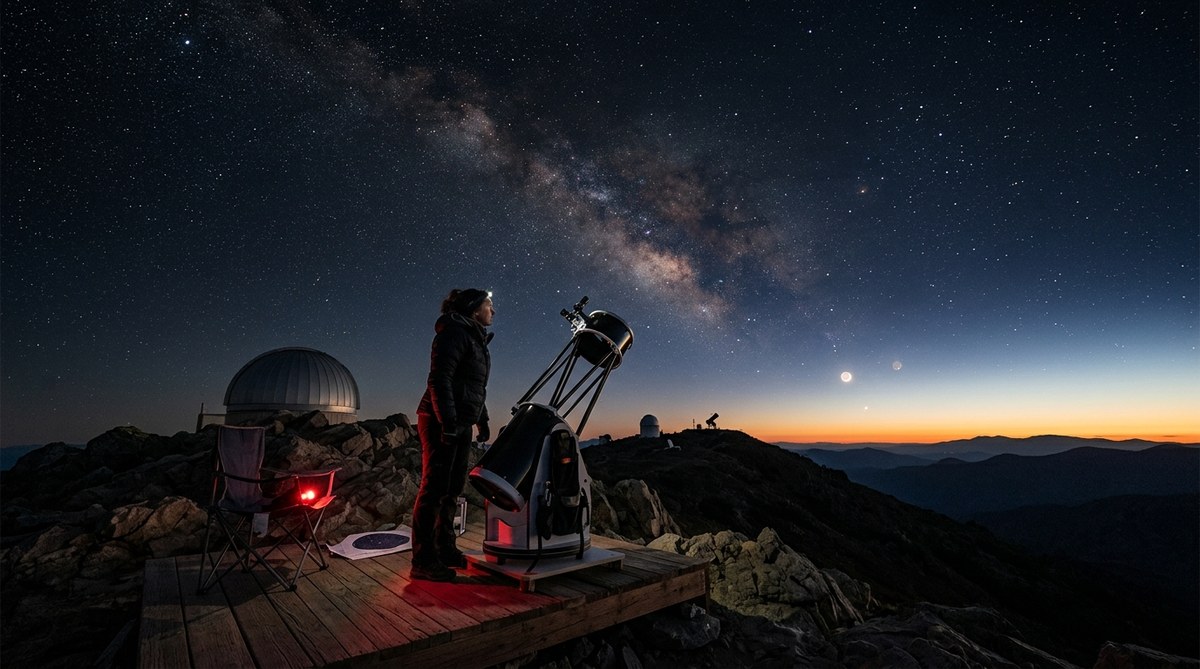
Most people assume midnight is the peak hour for stargazing. They picture a dark, silent sky with stars scattered like diamonds. But if you have ever stayed up past 2 a.m. or dragged yourself out of bed at 4 a.m., you may have noticed something surprising. The sky before dawn often looks clearer, sharper, and more alive than at any other time of night. There is a solid scientific reason for that. Earth’s rotation, the position of the sun below the horizon, and the behavior of our atmosphere all work together to make the pre-dawn window the best time to stargaze for anyone who wants the most rewarding view.
The best time to stargaze is during the two hours before dawn, also called astronomical twilight. At that point, the part of Earth you are on has rotated so the Milky Way and deep-sky objects are high overhead. The moon is often below the horizon or set for the night, and the air has cooled down, reducing turbulence. You get darker skies and steadier views than at any other hour.
Why the Pre-Dawn Sky Wins Every Time
The main reason the best time to stargaze happens before sunrise comes down to one word: rotation. Earth spins on its axis, and as it turns, different parts of the sky come into view. At midnight, you are looking toward the outer edge of the solar system. By 4 a.m., you are facing the direction of the galactic center. That is where the Milky Way is thickest and where you will find star clusters, nebulae, and distant galaxies.
There is also less interference from human activity. By 3 or 4 a.m., most people are asleep. Cars are off the roads. Streetlights may still be on, but the overall light pollution drops. The ground has had hours to cool down, which means less heat rising into the atmosphere. Warm air creates turbulence that makes stars twinkle wildly and blurs details in a telescope. Cooler, calmer air gives you steady, sharp images.
How the Moon Phase Affects Your Viewing Window
The moon is the biggest factor in determining the best time to stargaze on any given night. A full moon floods the sky with light and washes out faint stars, galaxies, and nebulae. Even a half moon can reduce how many stars you can see by a large margin.
The table below shows how different moon phases affect your stargazing window and what you should expect to see.
| Moon Phase | Best Viewing Window | What You Will See |
|---|---|---|
| New moon | All night, especially after midnight | Faint galaxies, star clusters, Milky Way |
| Waxing crescent | Late evening to dawn | Good for planets and bright stars |
| First quarter | Midnight to dawn | Medium brightness deep-sky objects |
| Waxing gibbous | Early morning only (after moonset) | Planets and brighter nebulae |
| Full moon | Very limited; try pre-dawn after moonset | Moon itself, bright planets, double stars |
If you want the best time to stargaze for deep-sky observation, aim for a new moon and schedule your session for the hours just before dawn. Even during a full moon, you can still have a good session if you wait for the moon to set. That often happens in the early morning hours, leaving you with a dark sky right before sunrise.
The Three Types of Twilight and What They Mean for You
Twilight is the period between full darkness and sunrise. It has three stages, and each one offers a different experience.
- Astronomical twilight is the darkest stage. The sun is between 12 and 18 degrees below the horizon. The sky is black enough to see faint galaxies and nebulae with the naked eye. This is the best time to stargaze if you want deep-sky objects.
- Nautical twilight happens when the sun is 6 to 12 degrees below the horizon. The horizon becomes visible, but the sky is still dark enough for most stargazing. You can still see bright stars and planets clearly.
- Civil twilight starts when the sun is less than 6 degrees below the horizon. The sky brightens noticeably. Only the brightest stars and planets remain visible.
For the clearest view, plan to be outside during astronomical twilight. That window typically lasts one to two hours before sunrise, depending on your latitude and the season.
What You Can See in the Pre-Dawn Sky
If you choose the best time to stargaze, you will be rewarded with some of the most spectacular objects in the night sky. Here are a few things you can expect to see during the pre-dawn hours.
- The Milky Way core rises in the summer and fall months. It is visible as a glowing band of light stretching across the sky.
- Planets like Jupiter and Saturn are often high in the sky before dawn, especially during certain months of the year.
- The Andromeda Galaxy is visible to the naked eye from dark locations. It appears as a faint smudge of light.
- Meteor showers are often best after midnight because Earth is rotating into the stream of debris. The Perseids and Geminids peak in the early morning hours.
- Star clusters like the Pleiades and the Beehive Cluster are easy targets for binoculars or a small telescope.
If you are new to identifying objects in the sky, check out our guide on mastering astronomy basics to identify stars, planets, and constellations. It will help you make the most of your pre-dawn sessions.
Common Mistakes That Ruin a Pre-Dawn Session
Many beginners make the same errors when they try to stargaze before dawn. Avoid these pitfalls to get the best results.
- Checking the wrong time. Sunrise times change daily. Use a reliable astronomy app or website to find the exact time for your location.
- Not checking the moon phase. A bright moon can ruin your view even if you go out at the right hour. Always check the moon phase and its set time.
- Looking at your phone. A bright white screen destroys your night vision for 20 minutes or more. Use a red light or a red filter app to preserve your dark adaptation.
- Dressing too lightly. Pre-dawn temperatures are often the coldest of the night. Wear layers, gloves, and a hat. Bring a thermos of coffee or tea.
- Forgetting to let your eyes adjust. It takes about 30 minutes for your eyes to fully adapt to the dark. Do not expect to see faint objects right away.
For a complete checklist to prepare for your next outing, read our ultimate 2026 checklist for your first night under the stars.
How to Plan a Pre-Dawn Stargazing Session in 2026
Planning ahead makes the difference between a frustrating night and a magical one. Follow these steps to set yourself up for success.
- Check the moon phase and set time. Use an app like Stellarium or Time and Date to find when the moon will set on your chosen night. Aim for a new moon or a night when the moon sets before 2 a.m.
- Find your sunrise time. Once you know sunrise, subtract two hours. That is your target start time for the best time to stargaze.
- Pick a dark location. Get away from city lights. Use a light pollution map to find a Bortle class 3 or darker site near you. Our guide on choosing the perfect observatory site for clear night sky viewing can help you find the right spot.
- Prepare your gear. Set up your telescope or binoculars the night before if possible. Let them cool to the outside temperature to avoid thermal distortion.
- Dress warmly and bring supplies. A blanket, hot drink, and a red flashlight are essential. A folding chair makes long sessions more comfortable.
- Arrive early. Give yourself 15 minutes to set up and 30 minutes for your eyes to adjust. Then start observing.
“The darkest hour is just before dawn. But for astronomers, that hour is also the clearest. The air has settled, the moon has often set, and the Milky Way is rising right overhead.” — David H. Levy, amateur astronomer and discoverer of multiple comets.
Why the Best Time to Stargaze Changes with the Seasons
The best time to stargaze also shifts depending on the time of year. In winter, the nights are longer, and the sky gets dark earlier. You can start your pre-dawn session as early as 3 a.m. and still have two hours of good darkness. In summer, the nights are shorter, and the sun rises earlier. You may need to start at 4 a.m. or even 3:30 a.m. to catch the darkest sky.
Here is a seasonal breakdown of what to expect.
- Winter (December to February): Long nights, cold air, and steady seeing. Orion and Taurus dominate the sky. The Milky Way is faint but visible in dark locations.
- Spring (March to May): Nights get shorter. Galaxies like the Whirlpool and the Sombrero are high in the sky. The pre-dawn window shrinks but still offers good views.
- Summer (June to August): Short nights. The Milky Way core is at its best. Start your session early, around 3 a.m., to catch the darkest sky before civil twilight.
- Fall (September to November): Nights lengthen again. The Andromeda Galaxy is visible all night. Pre-dawn sessions offer excellent views of Jupiter and Saturn.
If you want to track celestial events throughout the year, take a look at our top 10 celestial phenomena every amateur astronomer should know.
Tools That Make Pre-Dawn Stargazing Easier
You do not need expensive equipment to enjoy the best time to stargaze. But a few tools can make your sessions more productive and comfortable.
- A red LED headlamp. Keeps your hands free and protects your night vision.
- A star chart or astronomy app. Helps you identify objects and plan your session. We recommend 7 essential astronomy apps for your 2026 stargazing sessions.
- A pair of binoculars. Even a basic 10×50 pair will show you star clusters, the Andromeda Galaxy, and the moons of Jupiter.
- A reclining chair. Looking straight up for an hour strains your neck. A chair lets you relax and enjoy the view.
- A weather app. Check cloud cover and transparency forecasts before you head out. Our guide on 7 simple ways to predict the best stargazing weather for tonight will help you avoid wasted trips.
Put This Knowledge into Practice Tonight
The best time to stargaze is not a secret. It is a simple fact of astronomy. The pre-dawn hours offer the darkest sky, the steadiest air, and the best position to see the heart of our galaxy. Next time you want to see the Milky Way, catch a meteor shower, or spot a faint galaxy, set your alarm for a few hours before sunrise. Grab your gear, find a dark spot, and let your eyes adjust. You will see more stars than you ever thought possible from a single location. And once you experience that quiet, clear sky just before the world wakes up, you will understand why so many astronomers call it their favorite time of night.