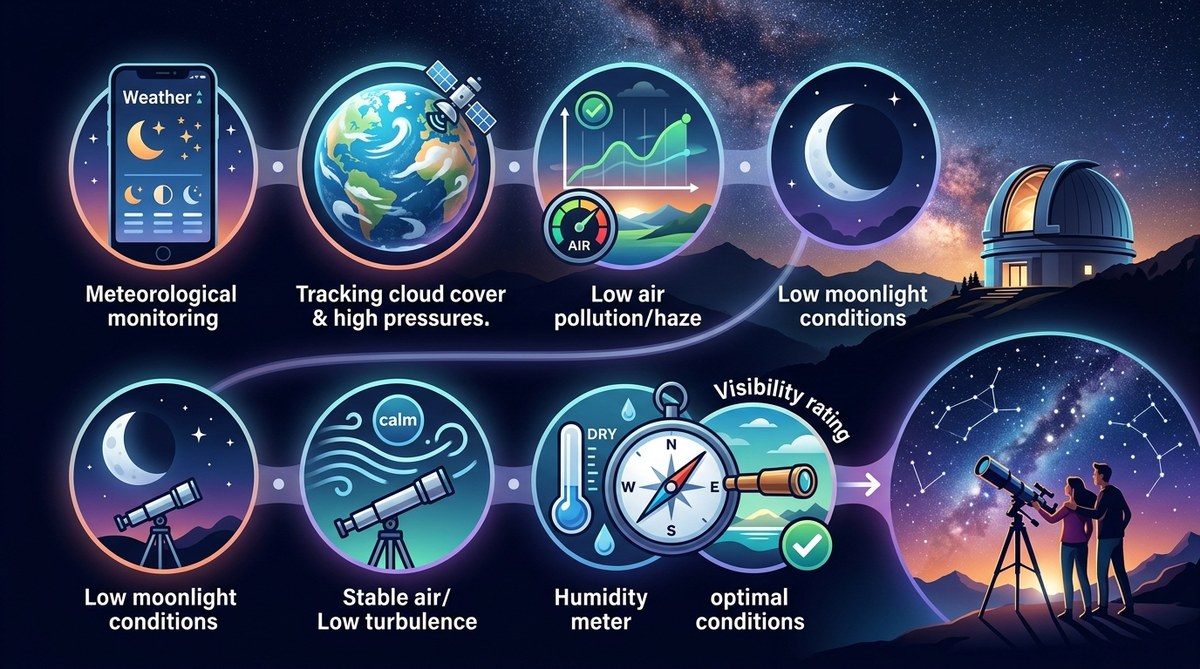
You pull your telescope out of the garage, set it up in the backyard, and wait for darkness. An hour later, the clouds roll in. That familiar sinking feeling hits. You packed up gear, drove to a dark site, or skipped sleep for nothing. The problem is not your telescope. It is not your location. The problem is not knowing how to read a stargazing weather forecast. Most beginners check the general weather app on their phone. That app tells you if it will rain, but it does not tell you if the sky will be clear enough to see the Andromeda Galaxy. This guide changes that. By the end, you will know exactly which tools to use, what numbers to look for, and how to plan your night with confidence.
A stargazing weather forecast is different from a regular weather report. You need to check cloud cover percentage, atmospheric transparency, seeing conditions, and wind speed at your specific location. Use a dedicated astronomy forecast site like Clear Sky Chart or a mobile app like Astrospheric. Check the forecast at sunset and again two hours before your session. Look for cloud cover below 20 percent and seeing ratings of 3 out of 5 or higher. Pair that data with a live satellite cloud map to confirm conditions in real time.
Why a Regular Weather App Fails You
Your phone weather app shows temperature and a rain icon. That is not enough for astronomy. A stargazing weather forecast needs to answer three specific questions.
First, how much of the sky will be covered by clouds? A 40 percent chance of rain does not tell you if the clouds will thin out after midnight. Second, how steady is the air? Turbulence in the atmosphere makes stars twinkle wildly. That destroys fine detail on Jupiter or Saturn. Third, how transparent is the sky? High humidity or dust scatters light and reduces contrast on faint objects like nebulae.
General weather apps combine all these factors into a single “partly cloudy” label. That is useless. You need a forecast built for astronomers.
The 3 Numbers That Matter Most in a Stargazing Weather Forecast
When you open a dedicated astronomy forecast, you will see a grid of numbers. Ignore the temperature. Focus on these three metrics.
Cloud Cover
This is the most obvious factor. Look for a percentage. Anything under 20 percent is good. Under 10 percent is excellent. If the number is above 30 percent, expect patches of clouds to interfere with your session.
Seeing
Seeing measures how steady the air is. It is usually rated on a scale of 1 to 5. A rating of 1 means the atmosphere is boiling. Stars look like blurry blobs. A rating of 5 means the air is glass calm. You can push your telescope to high magnification and see fine details on planets. For most nights, a seeing rating of 3 or higher is acceptable for casual observing. If you want to do planetary photography, wait for a 4 or 5.
Transparency
Transparency tells you how much light from deep space makes it to your eye. It is affected by humidity, smoke, and dust. A high transparency rating means faint objects like the Andromeda Galaxy or the Orion Nebula will pop. Low transparency means those objects will look washed out or invisible. Look for a transparency rating of 3 or higher.
| Forecast Element | What It Measures | Why It Matters | What to Look For |
|---|---|---|---|
| Cloud cover | Percentage of sky obscured | Determines if you can see anything | Under 20% |
| Seeing | Atmospheric turbulence | Affects detail on planets and double stars | 3 out of 5 or higher |
| Transparency | Clarity of the air | Affects visibility of faint deep-sky objects | 3 out of 5 or higher |
| Wind speed | Surface wind | Shakes your telescope and makes you cold | Under 10 mph |
The Best Tools for a Stargazing Weather Forecast
You do not need to pay for a subscription. The best tools are free and built by astronomers.
Clear Sky Chart
This is the gold standard for amateur astronomers in North America. The website looks like it was built in 1998. That is fine. The data is excellent. It pulls from the Canadian Meteorological Centre and shows a color-coded grid for the next 48 hours. Dark blue means clear. White means cloudy. Green means good seeing. Red means poor seeing. Find your observatory site on the map and bookmark it.
Astrospheric
This is a modern alternative with a cleaner interface. It works well on a phone. It shows cloud cover, seeing, transparency, and wind speed in an easy to read layout. It also includes a jet stream map. High altitude wind can ruin seeing even if the surface is calm.
Satellite Cloud Maps
A forecast is a prediction. A satellite cloud map shows what is happening right now. Use the GOES satellite viewer for the United States. It updates every few minutes. If the satellite shows a clear patch moving toward your location, you have a window. If it shows a solid wall of clouds, cancel your plans.
“The best stargazing weather forecast is the one you check twice. Once in the afternoon to plan, and once at sunset to confirm. Conditions can change fast. Never trust a forecast made more than six hours ahead.” – Experienced observer from the Astronomical League
How to Plan Your Session Using a Stargazing Weather Forecast
Follow this process to avoid wasted nights.
-
Check the long range trend three days before your planned session. You want a stable high pressure system. Low pressure systems bring clouds and wind.
-
The day before, open your Clear Sky Chart or Astrospheric. Look at the cloud cover row for the hours after sunset. If it shows dark blue for at least four consecutive hours, mark that night as promising.
-
Two hours before sunset, check the forecast again. Look at the seeing and transparency ratings. If both are 3 or higher, proceed with your plan.
-
At sunset, open a satellite cloud map. Confirm that no unexpected cloud bands are approaching. If the satellite shows a clear sky over your county, you are good to go.
-
Set up your gear. Keep an eye on the wind. If gusts exceed 10 mph, your telescope will vibrate and your view will wobble.
Common Mistakes Beginners Make
- Checking the forecast only once. Weather changes. A forecast from noon is not reliable at 10 PM.
- Ignoring the moon phase. A 90 percent illuminated moon washes out the sky. Even a perfect stargazing weather forecast cannot fix that. Check the moon phase before you plan. You can learn more about this in our guide on 7 must-know moon phases for better stargazing.
- Using a city forecast. Your local airport weather station might be 20 miles away. Microclimates matter. Use a tool that lets you click on your exact observing spot.
- Forgetting about dew. Clear skies often mean rapid cooling. That leads to dew on your telescope lens or corrector plate. Bring a dew heater or a lens cap.
What to Do When the Forecast Looks Marginal
Sometimes the cloud cover shows 30 percent. The seeing is a 2. You are tempted to stay home. Do not give up too fast. A marginal forecast can still produce a good hour of observing.
Look for a window. The grid might show a two hour block of dark blue at 11 PM. Set an alarm. Go out for that window. Even if the rest of the night is cloudy, those two hours can be rewarding.
Also consider what you want to observe. If you only want to look at the Moon or bright planets, you can tolerate more clouds and worse seeing. If you are hunting for a faint galaxy, wait for a perfect forecast. For a guide on what to look for with the naked eye, read what can you see with the naked eye tonight.
How to Read a Clear Sky Chart in 30 Seconds
If you have never used a Clear Sky Chart, it can look intimidating. Here is the cheat sheet.
The chart has rows. Each row is a weather factor. The top row is cloud cover. The second row is transparency. The third row is seeing. The columns are hours of the night. Each cell is a colored square.
- Dark blue or black: Excellent conditions.
- Light blue: Good.
- Green: Fair.
- Yellow or orange: Poor.
- Red or white: Bad. Stay inside.
Scan the cloud cover row first. Find a column with dark blue. Then check the seeing and transparency rows in the same column. If all three are dark blue or light blue, that is your target hour.
The Role of Light Pollution in Your Forecast
A perfect stargazing weather forecast does not fix light pollution. You can have zero clouds, perfect seeing, and still see almost nothing if you are in the middle of a city. Light pollution scatters in humid air. Even a small amount of haze can make a suburban sky look washed out.
If you live in a bright area, drive to a darker location. Use a light pollution map to find a spot within an hour of your home. Combine that with a good forecast, and you will have a spectacular night. For more on this, see our article on is light pollution ruining your view? here’s how to adapt.
Tools You Already Have at Home
You do not need a weather station. You can make a rough stargazing weather forecast with your own eyes.
Look at the sky during the day. If you see high, thin cirrus clouds, expect a hazy night. If the sky is deep blue and the air feels dry, conditions will be good.
Check the wind. If trees are swaying, the atmosphere is turbulent. That means poor seeing.
Watch the sunset. If the horizon is sharp and the sun sets as a clear orange disk, the air is stable. If the sun looks distorted or flattened, the atmosphere is full of turbulence.
These signs are not as accurate as a computer model, but they are better than nothing. For a full list of low tech tools, check out 7 essential skywatching tools you already have at home.
Putting It All Together for Your Next Night Out
You now have a system. Check the long range trend. Use a dedicated astronomy forecast. Confirm with a satellite map. Look at cloud cover, seeing, and transparency. Plan around the moon phase. Adjust for your local light pollution.
The difference between a frustrating night and a magical night is often just a few percentage points of cloud cover. Do not rely on luck. Use the stargazing weather forecast tools that professionals use. Your telescope deserves clear skies. You deserve a night of wonder.
Start tonight. Open Astrospheric or find your Clear Sky Chart. Pick a target for the coming weekend. When the conditions align, go outside and look up. The universe is waiting.