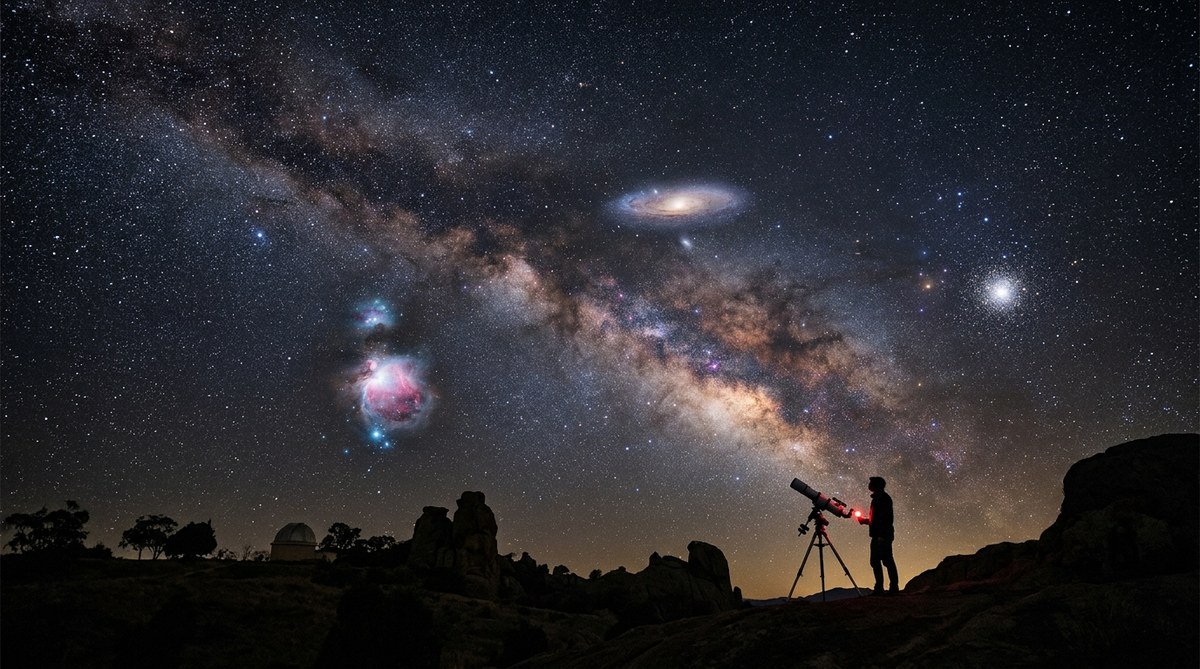
You step outside on a clear night, away from the porch light, and let your eyes adjust. The bright stars are easy to pick out. But then you notice them. Small, hazy smudges that look like someone smeared a bit of chalk across the velvet darkness. They are not stars. They do not twinkle. They just sit there, glowing softly. Those faint patches of light in the sky are some of the most rewarding targets for any amateur stargazer. This guide will help you figure out exactly what you are looking at.
Most faint patches of light in the sky belong to one of three categories: a star cluster (a group of stars born together), a nebula (a cloud of gas and dust), or a galaxy (a massive system of billions of stars). You can tell them apart by their shape, size, and position relative to the constellations. With a simple process and a few tools, you can identify nearly any patch you see tonight.
The Three Main Culprits Behind Those Hazy Smudges
When you spot a faint patch of light in the sky, you are usually looking at one of three types of deep-sky objects. Each has a distinct look.
Star clusters are groups of stars that formed from the same giant cloud. Open clusters like the Pleiades look like a tiny scoop of glitter. Globular clusters, such as M13 in Hercules, appear as a round, fuzzy ball of light because their stars are packed so tightly together.
Nebulae are clouds of gas and dust. Some glow because nearby stars energize the gas. Others are dark and block the light behind them. The Orion Nebula looks like a faint, hazy star in the middle of Orion’s sword.
Galaxies are entire islands of stars, gas, and dust millions of light-years away. The Andromeda Galaxy looks like a small, elongated smudge near the constellation Cassiopeia. Its core is the brightest part, fading out toward the edges.
| Object Type | What It Looks Like | Common Example |
|---|---|---|
| Open Star Cluster | A tight group of tiny stars, like a diamond dusting | Pleiades (M45) |
| Globular Cluster | A round, dense, fuzzy ball | M13 in Hercules |
| Nebula | A hazy patch, sometimes with a hint of color | Orion Nebula (M42) |
| Galaxy | An elongated, milky smudge, often angled | Andromeda Galaxy (M31) |
A Simple Process to Identify Any Faint Patch
You can identify a faint patch of light in the sky in just a few steps. Do not worry about having a telescope for this. Many of these objects are visible with binoculars or even the naked eye from a dark site.
- Find your location in the sky. Note which constellation the patch is near. Use a star chart or an astronomy app on your phone. Knowing the constellation is half the battle.
- Check the shape. Is it round? Is it elongated like a cigar? Is it irregular and wispy? A round, fuzzy ball is probably a globular cluster. An elongated smudge is likely a galaxy.
- Look for a central brightness. Does the patch have a brighter core with a softer edge? That is a classic galaxy signature. If it is uniformly fuzzy, it might be a nebula.
- Use a reference tool. Open a free planetarium app like Stellarium or SkySafari. Point your phone at the patch. The app will tell you exactly what it is. This is the fastest way to learn.
“The night sky is a library of light. Each faint patch is a book with a story about the life of stars or the scale of the universe. Learning to read those patches is one of the great joys of astronomy.” — Dr. Elena Rossi, Thrush Observatory
Mistaking a Planet for a Patch
Sometimes a bright planet like Jupiter or Saturn can appear as a steady, non-twinkling light. It does not look like a fuzzy patch, but it can confuse a new observer. A planet will be a bright, round disk of light. A faint patch will always look soft and hazy in comparison. If the light is very bright and doesn’t twinkle, it is a planet. If it is dim and fuzzy, it is a deep-sky object.
What About the Gegenschein?
There is one more faint patch of light in the sky that often surprises people. It is called the gegenschein. It is a very faint, oval-shaped glow that appears directly opposite the sun in the night sky. It is caused by sunlight reflecting off interplanetary dust particles. It is extremely hard to see. You need a moonless night, far from city lights, and excellent eyesight. Most amateurs spend years looking for it. If you think you have spotted it, you are probably seeing the zodiacal light, which is a similar phenomenon that appears as a cone of light near the horizon after sunset or before sunrise. For more on this, read our guide on what the zodiacal light is.
Tools That Help You See More
You do not need expensive gear to start identifying these patches. A good pair of binoculars is often better than a cheap telescope for this task. Binoculars give you a wider field of view, which makes it easier to find faint objects.
- Binoculars: Look for 7×50 or 10×50 models. They gather enough light to show star clusters and bright nebulae clearly.
- A star chart: A printed planisphere or a simple app helps you know where to look.
- A red flashlight: This preserves your night vision so you can read your chart without ruining your dark adaptation.
If you want to step up your game, you might consider a telescope. Check out our guide on choosing the perfect beginner telescope for recommendations.
Common Mistakes New Observers Make
It is easy to get frustrated when you first start. Here are a few things that trip people up.
- Expecting color. Most nebulae and galaxies look gray or white through binoculars. Your eyes are not sensitive enough to see color in dim light. The beautiful red and blue photos you see online come from long-exposure cameras.
- Looking directly at the object. The center of your eye has fewer light-sensitive cells. Try looking slightly to the side of the patch. This is called averted vision, and it lets you see fainter details.
- Giving up too soon. Your eyes need time to adjust. Spend at least 20 minutes in the dark before you start searching. Avoid looking at your phone screen. It ruins your night vision instantly.
Your Next Step Under the Stars
The next time you are outside and notice one of those faint patches of light in the sky, you will know exactly what to do. Grab a pair of binoculars, find the nearest constellation, and use an app to confirm your guess. With practice, you will start recognizing the Pleiades, the Andromeda Galaxy, and the Orion Nebula on sight. Each one is a window into a different part of our universe. For a broader look at what you can spot tonight, read our article on 10 night sky phenomena you can see without a telescope in 2026. The sky is full of these quiet, glowing secrets. All you have to do is look up and ask, “What is that?”