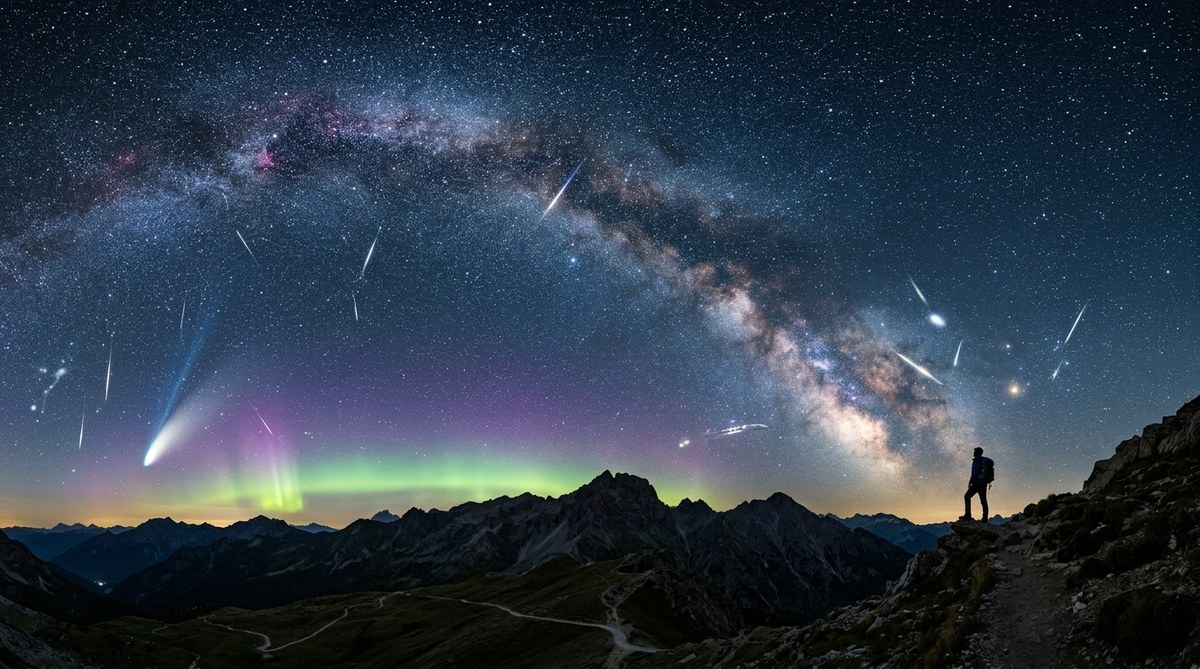
The year 2026 has a packed calendar of celestial events that you can enjoy without any special gear. No telescope. No binoculars. Just your eyes, a clear sky, and a little planning. Whether you live in a bright city or a dark rural area, these ten phenomena are accessible to everyone. Some happen every year, but a few are rare treats you won’t want to miss.
In 2026, the night sky puts on a free show for anyone willing to look up. You can see meteor showers, bright planets, the Milky Way, and even the Northern Lights without a telescope. The best part? You only need dark skies, patience, and the right timing. This guide covers the ten most rewarding phenomena you can spot with your naked eye this year.
The Perseid Meteor Shower Peaks in August
The Perseids are the most popular meteor shower of the year, and 2026 should be a good one. The peak happens around August 12, when the moon is in a crescent phase, meaning it sets early and leaves a dark sky. You can expect to see 50 to 75 meteors per hour under ideal conditions.
Find a spot away from streetlights. Lie flat on your back. Look toward the constellation Perseus in the northeast. The meteors will appear to radiate from that area, but they can streak across any part of the sky. Give your eyes at least 20 minutes to adjust to the darkness.
A Total Lunar Eclipse in March
On March 14, 2026, the moon will pass completely through Earth’s shadow. This total lunar eclipse will be visible across North America. The entire event lasts about five hours, but totality (when the moon is fully in shadow) runs for roughly 65 minutes. The moon will take on a deep red or coppery hue, often called a blood moon.
You do not need any equipment. Just step outside and look up. The eclipse happens in the early morning hours, so set an alarm. Unlike a solar eclipse, a lunar eclipse is completely safe to watch with your naked eyes.
Venus Shines at Its Brightest in April
Venus is already easy to spot as the evening star, but it reaches its peak brilliance in April 2026. For a few weeks, it will be the brightest object in the night sky after the moon. You can see it low in the west after sunset.
This is a great time to show kids or beginners how bright a planet can appear. Venus looks like a dazzling white diamond. If you have binoculars, you might even notice it has a crescent shape, but it is stunning without them too.
The Quadrantid Meteor Shower in January
The Quadrantids kick off the year with a short but intense peak on January 3. This shower can produce over 100 meteors per hour, but the window is narrow. The peak lasts only a few hours.
In 2026, the moon will be nearly full, which will wash out some of the fainter meteors. Still, the brighter ones will cut through. Look toward the constellation Bootes in the early morning hours. Dress warmly. January nights are cold, but the reward is worth it.
A Partial Solar Eclipse in August
On August 12, 2026, a partial solar eclipse will sweep across parts of North America. The moon will cover a portion of the sun, creating a crescent shape in the sky. The exact coverage depends on your location, but many major cities will see a noticeable bite taken out of the sun.
Important: Never look directly at the sun without proper eye protection. Use certified eclipse glasses or a solar filter. Regular sunglasses will not protect your eyes.
The Milky Way Arch in Summer
From June through August, the core of the Milky Way rises high in the southern sky. You can see it as a hazy band of light stretching from horizon to horizon. It looks like a glowing river of stars.
To see it well, you need a dark sky. Drive at least 30 minutes away from city lights. The best time is around midnight during a new moon. In 2026, the new moons in June, July, and August are your best windows. Let your eyes adjust for 30 minutes, and the Milky Way will reveal itself in stunning detail.
Jupiter and Saturn Align in the Evening Sky
In late 2026, Jupiter and Saturn will appear close together in the evening sky. This is not a once in a lifetime event, but it is still a lovely sight. The two largest planets in our solar system will sit within a few degrees of each other.
Look to the southwest after sunset. Jupiter will be the brighter of the two. Saturn will have a steady, golden glow. You can see them with the naked eye, but even a basic pair of binoculars will show Saturn’s rings and Jupiter’s moons.
The Orionid Meteor Shower in October
The Orionids are a reliable meteor shower that peaks around October 21. They are debris from Halley’s Comet. You can expect 15 to 20 meteors per hour, with some leaving persistent trails.
Look toward the constellation Orion, which rises in the east after midnight. The moon will be in a waning gibbous phase in 2026, so it will interfere a bit. Still, the brighter meteors will be visible. This shower is known for producing fireballs, so keep watching even after you see a few.
Northern Lights in High Latitude Regions
The sun is approaching the peak of its 11 year activity cycle in 2026. That means more solar storms and more aurora borealis displays. While the Northern Lights are usually reserved for places like Alaska, Canada, and the northernmost states, a strong storm can push them further south.
If you live in the northern United States, keep an eye on space weather forecasts. Apps and websites can send alerts when a storm is incoming. Find a dark location with a clear view of the northern horizon. The lights can appear as green curtains, red arcs, or even purple pillars.
The Geminid Meteor Shower in December
The Geminids are often the best meteor shower of the year. They peak on December 14, and in 2026, the moon will be a thin crescent, setting early. That means dark skies for the entire show.
You can see 100 to 120 meteors per hour at the peak. The Geminids are unusual because they come from an asteroid, not a comet. Their meteors are bright, slow, and colorful, often appearing yellow or green. Look toward the constellation Gemini, which rises in the east after sunset. Bundle up and bring a warm drink.
How to Prepare for a Night of Naked Eye Stargazing
You do not need a telescope, but a little preparation goes a long way. Here is a simple checklist to follow before heading outside.
- Check the weather. Clouds ruin everything. Look for a forecast with less than 20 percent cloud cover.
- Find a dark location. Use a light pollution map to find a spot with Bortle class 4 or darker.
- Let your eyes adjust. Avoid looking at your phone for at least 20 minutes. Even a quick glance at a screen resets your night vision.
- Dress for the temperature. Nights can be cold even in summer. Bring layers, a hat, and gloves.
- Bring a red flashlight. Red light preserves your night vision. You can buy one or put red tape over a regular flashlight.
Common Mistakes New Stargazers Make
Even experienced observers slip up sometimes. Here are the most common errors and how to avoid them.
| Mistake | Why It Happens | How to Fix It |
|---|---|---|
| Looking at your phone | Phone screens destroy dark adaptation | Use red light mode or keep phone in a bag |
| Staying in the city | Light pollution hides faint objects | Drive 20 to 30 minutes to darker skies |
| Not checking moon phase | A bright moon washes out meteors and stars | Plan around new moon or crescent phases |
| Giving up too early | Eyes need 20 to 30 minutes to fully adjust | Be patient. Sit still and wait. |
| Forgetting to dress warmly | Cold distracts you and cuts the session short | Wear thermal layers and bring hand warmers |
What You Can See Without a Telescope
If you are new to astronomy, you might wonder what is actually visible without magnification. The answer is a lot.
- Planets: Venus, Mars, Jupiter, and Saturn are all bright enough to see with the naked eye. Mercury is harder but possible.
- Meteor showers: Most major showers produce dozens of meteors per hour at their peak.
- The moon: You can see its phases, maria (dark plains), and even some large craters without help.
- The Milky Way: In dark skies, it looks like a cloudy band across the sky.
- Satellites: The International Space Station and many others are visible as moving lights.
- Aurora: The Northern Lights are a naked eye phenomenon when they are active.
“The night sky is not just for astronomers. It belongs to everyone. You do not need a degree or expensive gear to feel connected to the universe. Just look up.” – Dr. Sarah Martinez, astrophysicist and public educator
Your Year of Naked Eye Astronomy
2026 is a fantastic year to start watching the sky. You have a total lunar eclipse, multiple meteor showers, bright planets, and even a chance at the Northern Lights. None of these require a telescope. None of them cost money. All you need is curiosity and a willingness to step outside.
Start with one event. Mark it on your calendar. Tell a friend or family member to join you. The first time you see a meteor streak across the sky or watch the moon turn red, you will understand why people have been looking up for thousands of years.
For more help getting started, check out our guide on how to start your night sky observation journey. If you want to learn the basics of identifying stars and planets, our article on mastering astronomy basics is a great next step.
The sky is waiting. Go see it.