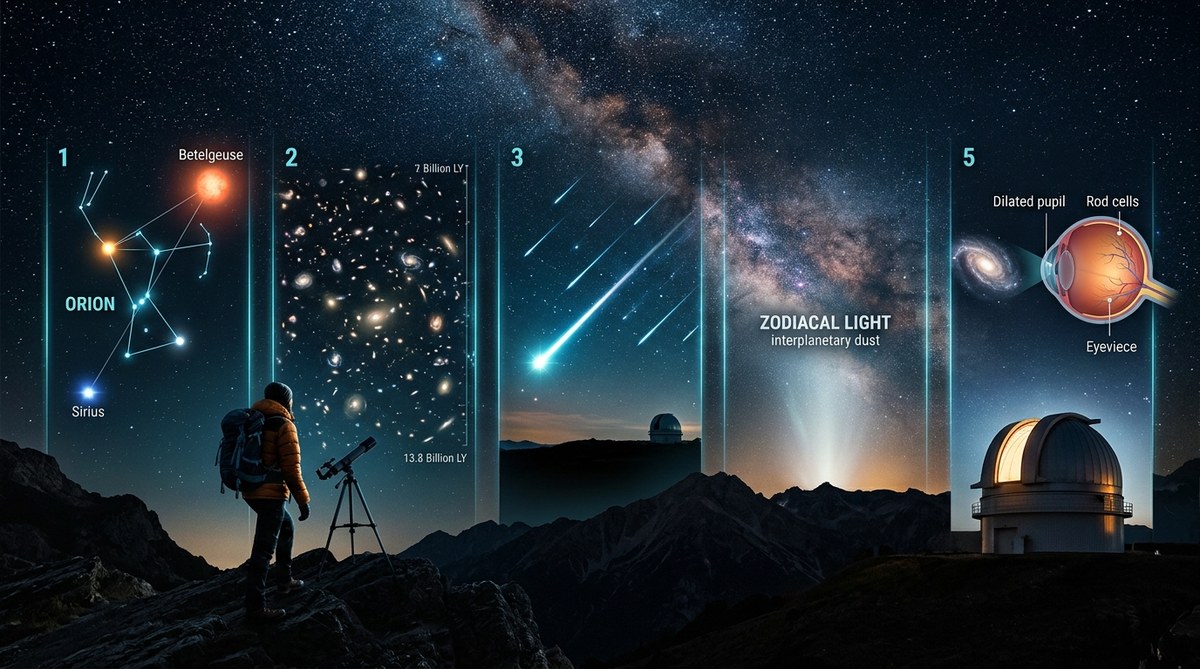
You step outside on a clear evening, tilt your head back, and see the same stars that guided sailors, inspired poets, and sparked scientific revolutions. But what if the sky you are looking at holds secrets that most people never notice? The night sky is far stranger and more wonderful than it first appears. Some of the most surprising night sky facts can change how you see the entire universe. Let us look at five truths that will make your next stargazing session unforgettable.
The night sky holds secrets that can transform a casual glance into a deep appreciation of the cosmos. From the true nature of star twinkling to the hidden light of the zodiac, these facts reveal that our universe is dynamic, vast, and full of surprises. You do not need expensive gear to experience them. A clear night, a bit of patience, and this guide will change how you see the stars forever.
The Stars You See Are Ghosts of the Past
When you look at the night sky, you are not seeing the present. You are seeing history. Light travels at about 186,000 miles per second, but space is so vast that even that speed feels slow. The star Alpha Centauri, one of our closest neighbors, is about 4.4 light years away. That means the light hitting your eye left that star 4.4 years ago. You are seeing it as it was during the early months of 2022.
Consider this: if that star had exploded yesterday, we would not know for another 4.4 years. The night sky is essentially a time machine. Those faint pinpricks of light could be from stars that no longer exist. When you look at the Andromeda Galaxy, you are seeing light that started its journey 2.5 million years ago, long before modern humans walked the Earth.
This is one of those surprising night sky facts that puts our place in the universe into perspective. To learn more about how to identify individual stars and planets, check out our guide on mastering astronomy basics.
Most of the Stars You See Are Actually Binary Systems
When you look up and see a single point of light, your brain assumes it is one star. But the truth is more complex. More than half of all stars in our galaxy are part of multiple star systems. They travel through space in pairs, trios, or even larger groups. Our own Sun is unusual because it is a solo act.
The star Mizar in the Big Dipper is a great example. With just a pair of binoculars, you can see it has a companion called Alcor. Through a telescope, Mizar itself splits into two stars. And here is the real kicker: each of those two stars is itself a binary system. You are looking at four stars bound together by gravity, all appearing as a single dot to your naked eye.
This changes the way you see the sky. Those lonely points of light are often cosmic families. When you are ready to see them for yourself, 7 easy night sky targets for your first telescope can help you get started.
The Sky Is Full of Satellites You Can See
A common belief is that you need a radio dish or a NASA app to spot human made objects in space. That is wrong. On any given night, you can see dozens of satellites with your naked eyes. They look like stars moving slowly across the sky in a straight line. No blinking lights. No sound. Just a steady glide.
The International Space Station is the brightest and easiest to spot. It can outshine every star in the sky when conditions are right. You can also see fleets of Starlink satellites shortly after sunset or before sunrise. They appear as a string of pearls marching across the heavens.
Here is a simple process to start spotting them tonight:
- Check a satellite tracking app or website for your location.
- Go outside about 10 minutes before the predicted pass time.
- Let your eyes adjust to the dark for at least 5 minutes.
- Look toward the part of the sky where the satellite will appear.
- Watch for a steady, non blinking point of light moving across the stars.
For a deeper look at how to catch the ISS, read our guide on how to spot the International Space Station in your night sky.
Why Stars Twinkle and Planets Do Not
You have probably heard the nursery rhyme about twinkling stars. But do you know why it happens? The answer is not in the stars themselves. It is in our atmosphere. As starlight passes through layers of turbulent air, it gets bent and scattered. That constant shifting makes the star appear to flicker and dance.
Planets like Jupiter, Venus, and Mars do not twinkle as much. They are closer and appear as tiny disks rather than points of light. The disk of light is large enough that the atmospheric distortion averages out. Instead of flickering, planets shine with a steady, calm glow.
This difference is one of the most practical surprising night sky facts for beginners. It helps you tell a planet from a star instantly. If it twinkles, it is a star. If it shines steady, it is probably a planet. For a full list of what to look for, check out how to find planets in the night sky without a telescope.
You Can See the Milky Way with Your Own Eyes
Many people think the Milky Way is something you can only see in photographs from dark desert observatories. That is not true. On a moonless night, far from city lights, the Milky Way appears as a brilliant band of milky white light stretching across the sky. It is made of hundreds of billions of stars too faint to see individually, but together they create a river of light.
Even if you live in a suburban area, you can catch a glimpse of it. The trick is to find the darkest spot you can, wait for a new moon, and let your eyes adapt for at least 20 minutes. After that, the ghostly glow of our galaxy becomes visible.
“The Milky Way is not a distant object. It is our home. When you look at it, you are looking sideways through the disk of our own galaxy. Every star you see in that band is a neighbor.”
Here are the best conditions for seeing the Milky Way:
- A new moon or a night when the moon has set.
- Clear skies with low humidity.
- A location far from city lights, ideally a dark sky park.
- No clouds and no haze.
- At least 30 minutes of dark adaptation.
To plan your session, read how to spot the Milky Way in your backyard this season.
Common Mistakes and How to Avoid Them
Even experienced stargazers make errors that can ruin a night of observation. Here is a table that outlines the most frequent mistakes and what to do instead.
| Mistake | Why It Hurts Your View | The Fix |
|---|---|---|
| Using a bright flashlight | Destroys night vision for 20 minutes | Use a red LED flashlight or cover a white light with red cellophane |
| Looking directly at a faint object | The most sensitive part of your eye is the center | Use averted vision: look slightly to the side of the object |
| Stargazing right after sunset | The sky is still too bright | Wait until at least 90 minutes after sunset |
| Choosing a night with a full moon | Moonlight washes out faint stars | Plan sessions around the new moon or crescent phases |
| Rushing outside without letting eyes adjust | Your eyes need 20 to 30 minutes to fully adapt | Spend time in complete darkness before starting |
Avoiding these pitfalls will transform your experience. For more advice, see 5 common mistakes new astronomers make and how to avoid them.
Tools That Make a Difference
You do not need a telescope to enjoy the night sky. In fact, many of the best observations can be made with just your eyes. But a few simple tools can help.
- A red flashlight to preserve night vision.
- A star chart or a smartphone app in night mode.
- A comfortable reclining chair to avoid neck strain.
- A pair of binoculars for a closer look at the moon and star clusters.
Binoculars are often a better first purchase than a telescope. They are portable, easy to use, and show you wide fields of the sky. If you are ready to step up, our guide on choosing the perfect telescope for beginners will help you pick the right one.
How to Start Tonight
You do not need a degree in astronomy to enjoy these surprising night sky facts. Here is a simple checklist for your first session.
- Check the weather for clear skies.
- Find a dark spot away from streetlights.
- Turn off all white lights for 20 minutes.
- Look up and let your eyes wander.
- Identify one planet using the steady glow test.
- Try to spot a satellite moving across the sky.
- If the moon is out, look at its craters through binoculars.
- End the session by finding the Big Dipper and tracing its shape.
For a more detailed plan, see how to plan your first stargazing session in 2026.
A New Way to See the Stars
These surprising night sky facts are not just trivia. They are invitations to look deeper. The next time you step outside at night, remember that you are looking at light from the past, that many of those points are multiple stars, and that the steady glow of a planet is a different kind of wonder. The sky is not a static painting. It is a living, moving, and deeply strange place.
Let this knowledge change your view. Go outside tonight. Look up. And see the sky not as a ceiling, but as a window into a universe far stranger and more beautiful than you ever imagined.