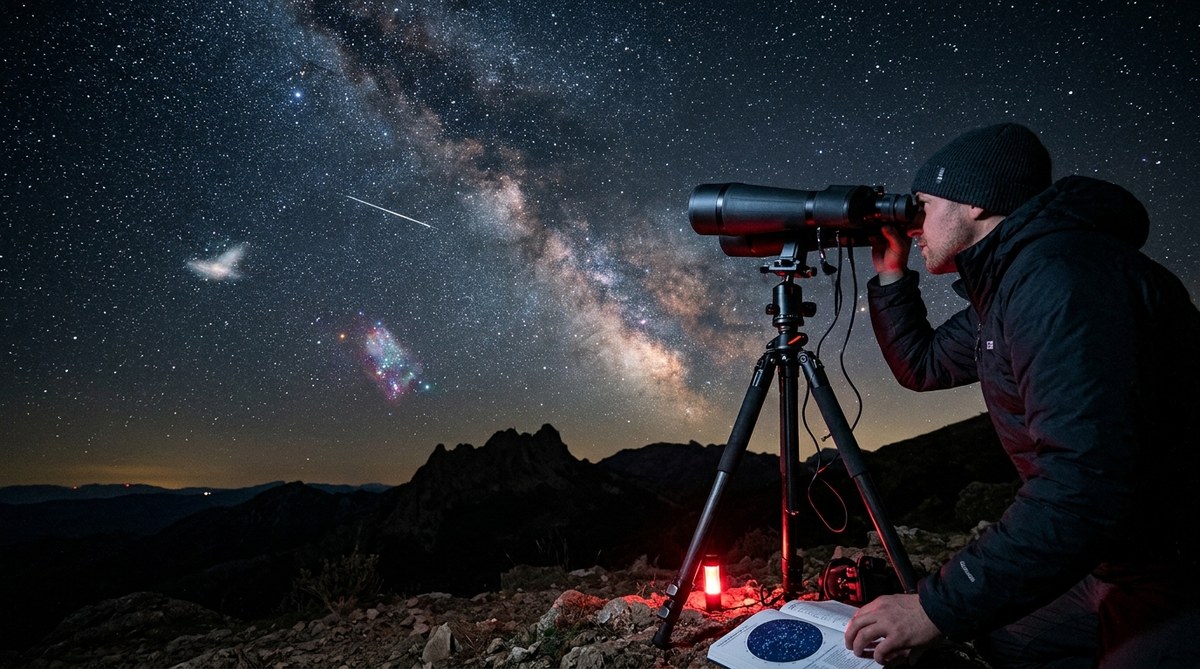
You do not need a giant telescope to see the universe. Your binoculars can already do more than you think. With the right setup, they become a sky scanning powerhouse. The trick is knowing where to point them and how to adapt your eyes to the dark. In 2026, the night sky is packed with surprises that look incredible through a good pair of binoculars. This guide will show you five unexpected sights and explain how to get the most out of your gear.
Standard binoculars can reveal dozens of deep sky objects. The secret is using night vision binoculars for stargazing to boost contrast and gather more light. In 2026, focus on the Andromeda Galaxy, the Orion Nebula, the Pleiades cluster, the Hercules Globular Cluster, and the Veil Nebula. Each target offers a unique reward for patient observers.
Why Binoculars Beat Telescopes for Beginners
Many people think a telescope is the only way to see the stars. That is not true. Binoculars have a wider field of view. This makes it easier to find objects. They are also lighter and cheaper. You can grab them and walk outside. No setup time. No heavy mount.
Night vision binoculars for stargazing add a special advantage. They collect more light than your eyes alone. They also stabilize the image. Your hands shake less with both hands holding the binoculars. This gives you a clearer view of faint objects.
If you are just starting out, binoculars are the perfect tool. They help you learn the sky. You can see star clusters, nebulae, and even galaxies. The best part? You probably already own a pair.
5 Unexpected Night Sights for 2026
The 2026 sky has some special treats. These five objects are not the usual Moon and planets. They are deeper. They require a bit of patience. But they reward you with views that feel like a secret.
1. The Andromeda Galaxy (M31)
Andromeda is the closest major galaxy to our own. It is 2.5 million light years away. Through binoculars, it looks like a faint, fuzzy patch of light. But that patch is a trillion stars.
To find it, locate the constellation Andromeda. Use a star chart or an app. Point your binoculars at the area between the stars Mirach and Mu Andromedae. You will see a smudge. That is the galaxy.
Night vision binoculars for stargazing make this smudge more visible. The extra light gathering shows the galaxy’s oval shape. Try to look for the bright core. It is the most distant thing you can see with your eyes.
2. The Orion Nebula (M42)
The Orion Nebula is a stellar nursery. New stars are born there. It is visible in the winter sky. Find the constellation Orion. Look below the three stars of the belt. You will see a fuzzy spot. That is the nebula.
Through binoculars, the nebula looks like a small, glowing cloud. With good night vision binoculars for stargazing, you might see four stars inside. Those are the Trapezium cluster. They are heating the gas around them.
This object is best seen from a dark location. City lights wash it out. But even from a suburban backyard, you can spot it.
3. The Pleiades Cluster (M45)
The Pleiades are also called the Seven Sisters. They are an open star cluster. It looks like a small dipper shape. To the naked eye, you might see six or seven stars. Through binoculars, you see dozens.
This cluster is in the constellation Taurus. It is easy to find. Look for the V shape of Taurus. The Pleiades are at the tip of the V. They are a beautiful sight. The stars are young and blue.
Night vision binoculars for stargazing show the cluster’s true richness. You can see the stars spread out. It feels like looking at a handful of diamonds.
4. The Hercules Globular Cluster (M13)
Globular clusters are balls of ancient stars. They orbit the Milky Way. M13 in Hercules is one of the best. It is about 25,000 light years away. Through binoculars, it looks like a round, fuzzy ball.
To find it, locate the constellation Hercules. It is between Vega and Arcturus. The cluster is on the western side of the keystone shape. It is faint, so you need dark skies.
With patience, you can see that the edges are not perfectly round. They look a little ragged. That is because you are seeing individual stars at the edge. This is a true test of your night vision binoculars for stargazing.
5. The Veil Nebula (NGC 6992)
The Veil Nebula is a supernova remnant. It is the remains of a star that exploded thousands of years ago. It is very faint. It requires dark skies and good binoculars.
The nebula is in the constellation Cygnus. It is near the star 52 Cygni. Look for a faint, wispy arc of light. It looks like a ghostly ribbon.
This is a challenging target. But it is incredibly rewarding. Seeing the remains of a dead star is a powerful experience. Night vision binoculars for stargazing with a wide field of view are best for this.
How to Set Up Your Binoculars for Night Sky Viewing
Getting the best view takes more than just pointing and looking. Follow these steps.
- Dark adapt your eyes. This takes about 30 minutes. Avoid looking at any white light. Use a red flashlight if you need to see.
- Find a dark spot. Get away from streetlights. Even your backyard is better than nothing. But a rural location is best.
- Stabilize your binoculars. Rest your elbows on a table. Or use a tripod adapter. This makes a huge difference.
- Focus carefully. Turn the focus wheel until the stars are sharp points. Do not rush this step.
- Use averted vision. Look slightly to the side of the object. Your peripheral vision is more sensitive to faint light.
Common Mistakes and How to Fix Them
| Mistake | Why It Hurts | The Fix |
|---|---|---|
| Looking at your phone | Destroys night vision for 20 minutes | Use a red filter or keep brightness low |
| Using too much magnification | Makes the image shaky and narrow | Stick to 7x or 10x binoculars |
| Not dark adapting | Misses faint objects | Wait 30 minutes in the dark |
| Pointing at the Moon | Washes out everything else | Save the Moon for last |
| Forgetting to clean lenses | Reduces light transmission | Use a microfiber cloth before you go out |
“The best binoculars for stargazing are the ones you actually use. A simple pair of 10x50s will show you more than a telescope that stays in the closet.” – John Dobson, amateur astronomer and author
Choosing the Right Night Vision Binoculars for Stargazing
Not all binoculars are the same. For night sky work, look for these features.
- Objective lens size: 50mm or larger. This gathers more light.
- Magnification: 7x to 10x. Higher than that is hard to hold steady.
- Coated optics: Look for “fully multi coated” on the lens. This reduces glare.
- Porro prism design: Often gives better image quality for the price.
- Waterproof and fog proof: Dew forms quickly on cold nights.
If you are shopping in 2026, many brands make dedicated astronomy binoculars. They often have a tripod adapter built in. This is a good sign.
For more on choosing your first optical tool, check out our guide on choosing the perfect telescope for beginners exploring the night sky. Even if you stick with binoculars, the principles are the same.
What to Do When the Moon Is Too Bright
A full moon ruins deep sky viewing. The sky glows. Faint objects disappear. But you can still use your binoculars.
- Look at the Moon itself. You can see craters, mountains, and seas. The terminator line (where light meets dark) shows the most detail.
- Look at planets. Jupiter and Saturn are bright enough to see through moonlight. You can even see Jupiter’s four largest moons.
- Look at double stars. Many stars are actually two. Binoculars can split them. Try Albireo in Cygnus. It is gold and blue.
- Look at star clusters. Open clusters like the Pleiades are bright enough to handle moonlight.
If you want to learn more about how light pollution affects your view, read our article on 7 ways light pollution steals your night sky and how to fight back.
Practical Processes for Better Stargazing
Here is a simple routine to follow.
- Check the weather. Clear skies are essential.
- Check the moon phase. A new moon is best.
- Gather your gear. Binoculars, red flashlight, star chart, chair.
- Go outside 30 minutes before you plan to observe. Start your dark adaptation.
- Start with easy targets. The Moon or a bright planet.
- Move to fainter objects. Use your star chart.
- Take notes. Write down what you see. This helps you improve.
Equipment Checklist
- Binoculars (10×50 or similar)
- Tripod adapter (optional but helpful)
- Red flashlight
- Star chart or astronomy app
- Comfortable chair
- Warm clothes
- Notebook and pen
Your 2026 Night Sky Calendar
The best nights for stargazing are around the new moon. In 2026, these dates are perfect.
- January 9
- February 7
- March 9
- April 8
- May 7
- June 6
- July 5
- August 4
- September 2
- October 2
- November 1
- December 30
Mark these on your calendar. Plan a night out. Even an hour of viewing is worth it.
For a full list of celestial events, see our 7 cosmic calendar events you can’t miss in 2026.
Turning Your Binoculars Into a Habit
The hardest part is getting started. Once you do, it gets easier. Set a goal. See all five objects in this guide. Then try to find the Andromeda Galaxy. Then try the Veil Nebula.
Each success builds confidence. You will start noticing the sky more. You will see the Milky Way on a clear night. You will recognize constellations.
Night vision binoculars for stargazing are not a toy. They are a tool. They connect you to the universe. And they cost a fraction of a telescope.
Try This Tonight
Go outside right now. Look up. Find the brightest star. Point your binoculars at it. Focus. Now look at the stars around it. You will see more stars than you could with your eyes alone.
That is the power of binoculars. That is the start of your journey.
If you want to identify what you are seeing, read our guide on mastering astronomy basics: how to identify stars, planets, and constellations.
Your Next Step in the Sky
The universe is waiting. Your binoculars are ready. The only thing missing is you. Pick a clear night. Use the steps above. Look at one of the five targets. See it for yourself.
That moment of discovery is priceless. It is why we look up. And with night vision binoculars for stargazing, you can have that moment again and again.
So grab your binoculars. Step outside. Start scanning. The sky is yours.