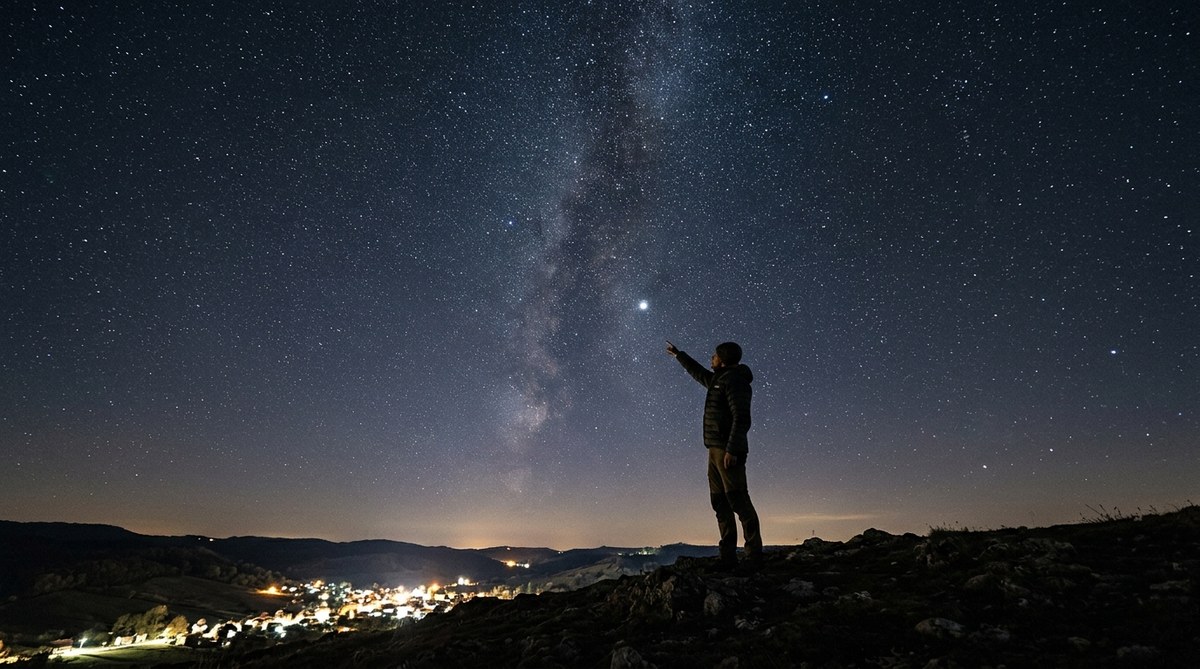
You look up on a clear night and see a bright point of light that just doesn’t twinkle like the others. That steady glow is your first clue. With no telescope, no binoculars, just your own two eyes, you can spot Jupiter, Saturn, Mars, and even Venus with ease. The sky holds a simple map that has guided travelers for centuries. Once you learn to read it, the planets reveal themselves night after night. This guide shows you exactly how to find planets without a telescope, even if you have never tried before.
You can find Mercury, Venus, Mars, Jupiter, and Saturn with your naked eye. The trick is knowing where the planets travel along a line called the ecliptic. Look for steady, non-twinkling lights among the stars. Use the moon as a guide when it is near. Check a monthly star chart or a sky app to learn which planets are visible tonight from your backyard.
Why Naked Eye Planet Spotting Works
Five of our solar system’s planets are bright enough to see without any optical aid. Mercury and Venus appear near the Sun, so you catch them just after sunset or before sunrise. Mars glows with a distinct reddish hue. Jupiter outshines everything in the night sky except the Moon and Venus. Saturn is softer but still visible as a pale yellow point. Uranus and Neptune are too dim for the naked eye, but the five classical planets have been watched since ancient times.
The key is that planets shine with steady light. Stars twinkle because their light passes through layers of our turbulent atmosphere. Planets are closer and their light comes from a small disk, not a single point, so the twinkling is far less noticeable. Once you know that rule, you will start picking out planets on any clear night.
The Secret Path: The Ecliptic
All the planets orbit the Sun in roughly the same plane. From Earth, that plane looks like a curved line across the sky called the ecliptic. The Sun, Moon, and planets always stay close to this invisible path. If you learn to recognize the ecliptic, you will always know where to look for planets.
Find the ecliptic by looking at where the Sun sets. An hour after sunset, the path of the Sun is still traced across the sky. You can also use bright stars like those in Orion or the Summer Triangle as seasonal markers. The easiest way is to spot the Moon. The Moon is always within a few degrees of the ecliptic, and when a planet is near it, they form a beautiful pair.
A Step by Step Process to Find a Planet Tonight
Follow these numbered steps to locate any naked eye planet this evening.
-
Check visibility for the current month. Use a reliable source like NASA’s skywatching page or a free astronomy app to see which planets are up tonight. For example, in early 2026, Venus is a brilliant evening star, and Jupiter rides high in the winter sky. This takes 30 seconds.
-
Go outside 30 to 45 minutes after sunset. You want the sky dark enough to see stars but still bright enough to spot planets near the horizon. Mercury and Venus are best seen in twilight. Jupiter and Saturn rise later and stay up longer.
-
Face the direction of the planet. Look west for evening planets, east for morning planets. If you are unsure, hold your phone flat and open a sky map app like Stellarium or SkyView. It will show you exactly where each planet is.
-
Scan the sky along the ecliptic.
- For planets near the horizon, look for the brightest points of light.
- Compare brightness and color. Venus is dazzling white, Mars is orange, Jupiter is pale yellow.
-
Use the twinkle test. If it twinkles, it is a star. If it holds steady, you have found a planet.
-
Confirm with a fist measurement. Hold your arm out and use your fist to measure degrees. The width of your fist covers about 10 degrees. The ecliptic line is about 18 degrees wide. Move your fist along that band to find the planet you saw in step 1.
-
Enjoy the view. Once you spot it, watch it for a minute. Notice its color and steadiness. Over the following nights you will see it shift slowly against the stars, something stars never do.
How to Tell a Planet from a Star
This table sums up the main differences that help beginners identify planets without a telescope.
| Feature | Planet | Star |
|---|---|---|
| Twinkle | Steady glow, little to no twinkling | Rapid twinkle, especially near horizon |
| Brightness change over weeks | Moves against background stars | Fixed position relative to other stars |
| Color | Venus white, Mars red, Jupiter pale, Saturn yellow | White or slightly blue, some reddish giants |
| Visibility in twilight | Often the first points to appear | Become visible later as sky darkens |
| Orbital path | Always near the ecliptic | Spread across whole sky |
Common Mistakes That Trip Up Beginners
Here are the biggest errors people make when learning how to find planets without a telescope. Avoid them and your success rate jumps.
- Confusing Venus with an airplane. Venus is incredibly bright and can appear just after sunset. Airplanes have blinking lights and move fast. Venus does not move at all against the stars. If the light stays still, it is Venus.
- Thinking the Moon is a planet. The Moon is our Moon, not a planet. It is easy to mistake a bright planet near the Moon as part of the Moon. The Moon moves quickly eastward each night.
- Looking too early or too late. Planets are only visible during certain windows. Check a 2026 planet calendar to know when each one rises and sets.
- Expecting planets to be huge. Without a telescope, planets look like points of light, not disks. Only Jupiter and Venus appear as small, non-point shapes if you look carefully, but they are still tiny.
- Giving up after one cloudy night. Clouds happen. Planets stay in the same region for weeks. If you miss it tonight, try again tomorrow.
For more pitfalls and fixes, read up on 5 Common Mistakes New Astronomers Make and How to Avoid Them.
When and Where to Look Throughout 2026
The planets rotate through the sky on a schedule. Here is a general guide for the rest of 2026.
Mercury shows up briefly in the evening sky about three times a year. Best times are March, July, and November. Look low in the west after sunset.
Venus is the brightest planet and will dominate the evening sky from January through August 2026. It then moves to the morning sky after September.
Mars appears red and bright in the summer of 2026, reaching opposition in August. That means it rises at sunset and stays up all night.
Jupiter is prominent in the early months of 2026, visible in the evening sky. By late summer it becomes a morning object.
Saturn is best seen in August and September when it is up all night. Its rings are not visible without a telescope, but you can see its pale glow.
Always check a current sky map. The exact dates vary slightly each year.
Use Apps and Star Charts to Learn Faster
You do not need a telescope, but a simple star chart or a smartphone app makes finding planets much easier. Apps like SkySafari or Stellarium use your phone’s sensors to show a live map of exactly what is above you. Point your phone up and it labels every planet and star.
If you prefer paper, learn how to read a printed star chart. Our guide Learn How to Read Star Charts for Beginners walks you through the process.
For a broader list of objects visible without any optics, check What Can You See with the Naked Eye Tonight?.
Expert Advice for New Planet Spotters
“The single best tip I give to beginners is to use your own fist as a measuring tool. Hold it at arm’s length. The width of your fist covers about 10 degrees of sky. The ecliptic is only about 18 degrees wide. If you know where the ecliptic is and you scan that band with your fist, you will find any planet that is up. Practice that skill and you will never need an app again.”
— Julie Morin, amateur astronomer and author of Sky Without Limits
Turn Planet Spotting into a Weekly Routine
The more you look, the easier it becomes. Start tonight. Step outside, find a dark spot away from streetlights, and give your eyes 10 minutes to adjust. Look along the path where the Sun set. If you see a bright light that does not twinkle, you have likely found a planet. Check your app or star chart to confirm. Then the next night, see if it moved. That tiny shift across the stars is what makes planets special. They are not fixed like the stars. They are travelers in our own solar system, visible to anyone who bothers to look up.