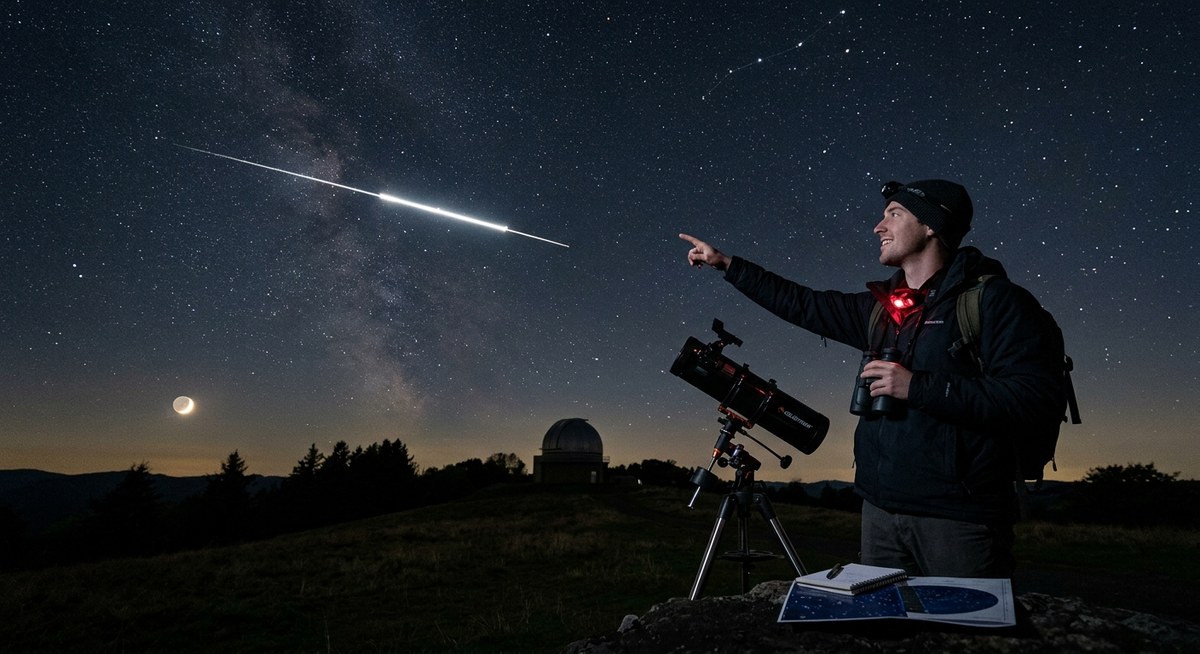
The International Space Station is the third brightest object in the sky after the Sun and the Moon. You do not need a telescope, binoculars, or any special gear to see it. You just need to know when and where to look. On a clear night, the ISS glides overhead as a steady, bright light moving faster than any airplane. It does not blink. It does not change course. It simply sails across the stars in about four to six minutes. For anyone who has ever looked up and wondered what that moving light might be, the answer is often right above you. And once you learn the pattern, you can spot it again and again.
Spotting the ISS is simpler than most people think. You need a clear sky, the right time of evening or morning, and a reliable tracking tool. The station appears as a fast moving, non blinking light that travels from west to east. Use NASA’s Spot the Station alerts or a tracker app to get precise pass times for your location. No telescope required. Just look up at the right moment and enjoy the view.
Why the ISS Is So Easy to See
The International Space Station orbits Earth at roughly 250 miles above the surface. It moves at about 17,500 miles per hour. That speed, combined with its massive solar arrays, makes it highly reflective. When the Sun hits those panels just right, the station shines like a brilliant star. It often outshines Venus, which is normally the brightest planet in the night sky.
The best part is that you do not need to live in a dark rural area. The ISS is bright enough to cut through moderate light pollution. A suburban backyard or even a city park with a reasonably open view will work fine. You just need to look toward the right part of the sky at the right minute.
When to Look for the ISS
Flyovers happen in two windows each day. One occurs in the evening, shortly after sunset. The other happens in the morning, just before sunrise. During those times, the Sun is below your horizon but still hitting the station high overhead. That contrast makes the ISS glow against a darker sky.
Passes can last anywhere from one minute to six minutes. The longest passes happen when the station travels almost directly overhead. Shorter passes occur when it skims the horizon. You might see one pass tonight and another one tomorrow morning. The schedule changes because the station’s orbit shifts slightly each day.
How Pass Times Change Throughout the Year
Seasonal shifts affect visibility. In summer, evening passes tend to be lower and shorter. In winter, the station often climbs higher in the sky during evening hours. Morning passes follow a similar pattern. If you check a tracker for a week, you will notice a rhythm. Some weeks give you a pass every single night. Other weeks offer only one or two chances.
How to Spot the International Space Station: A Step by Step Plan
Follow these steps to catch your first flyover. After you do it once, the process becomes second nature.
-
Find your local pass time. Open NASA’s Spot the Station website or a tracker app like ISS Detector. Enter your city or coordinates. The tool will show the next visible passes with start time, direction, and elevation. Evening passes are usually the most convenient for beginners.
-
Go outside five minutes early. This gives your eyes time to adjust to the dark. It also helps you get oriented. Bring a jacket if it is cool. Stand in a spot where you have a wide view of the sky, especially toward the west or southwest, where most passes begin.
-
Face the right direction. Most passes start in the west or southwest and move east. The tracker will tell you the exact compass direction and the elevation angle. Elevation is measured in degrees where 0 means the horizon and 90 means directly overhead. A pass that starts at 10 degrees west and climbs to 70 degrees will cross most of the sky.
-
Watch for a steady, non blinking light. Airplanes flash and have colored lights. The ISS looks like a single white point of light that does not flicker. It moves at a steady, noticeable speed. Once you see it, follow it with your eyes. It will travel across the sky until it fades near the eastern horizon or enters Earth’s shadow.
-
Time your observation. Most passes last between three and five minutes. If the station passes close to overhead, you might get a full six minutes. Shorter passes near the horizon last only one or two minutes. Stay focused on the path and watch until the end.
What You Need to Get Started
You already have everything required. But a few extras can make the experience smoother.
- A clear sky with no heavy clouds
- A smartphone or computer to check pass times
- A compass app or a mental map of north, south, east, and west
- A comfortable chair or blanket if you plan to watch multiple passes
- Optional: binoculars for a closer look after you spot it with your eyes
Binoculars are not necessary for the initial sighting. The station is bright enough to see with the naked eye. But if you have a pair of 7×50 or 10×50 binoculars, you can sometimes make out the shape of the solar arrays and the main module. Hold them steady and track the station as it moves. It takes practice, but the payoff is worth it.
Common Mistakes and How to Avoid Them
Even experienced skywatchers miss a pass now and then. Here is a table of the most common errors and how to fix them.
| Mistake | Why It Happens | How to Fix It |
|---|---|---|
| Looking too late or too early | Pass times shift daily | Check the tracker within an hour of your planned observation |
| Confusing an airplane for the ISS | Airplanes flash and have blinking lights | Remember: the ISS is steady, white, and does not blink |
| Not checking the elevation angle | A 10 degree pass is easy to miss | Only go out for passes above 30 degrees if you are new |
| Standing under a streetlight | Light ruins night vision | Walk 20 feet away from any direct light source |
| Giving up after one miss | Clouds or timing errors happen | Try again the next night; most locations get multiple passes per week |
Expert Advice for Consistent Sightings
“The biggest mistake beginners make is thinking they need a telescope. You actually want to look at the ISS with your eyes first. It moves too fast for most telescopes to track easily. Once you spot it, you can try binoculars. But the naked eye view is already spectacular. The station is a tiny, brilliant dot racing across the sky. That is the whole magic of it.”
Catherine Nguyen, astronomy educator and former NASA Solar System Ambassador
Her advice rings true. Many people assume that a bigger instrument equals a better view. For the ISS, the opposite is often correct. The station crosses the sky so quickly that a telescope’s narrow field of view makes it hard to follow. Binoculars offer a wider field and are much easier to aim. But even binoculars require a steady hand and some practice.
Best Tools and Apps for 2026
Technology makes spotting the ISS almost foolproof. Here are the most reliable options available this year.
- NASA Spot the Station (website and mobile app) sends push alerts a few hours before a good pass. It uses your phone’s location automatically. The app is free and ad free.
- ISS Detector (Android) gives pass predictions for the ISS and other satellites. It includes a radar style view of the sky.
- Heavens Above (website and mobile friendly) offers detailed predictions for any location. It also shows the station’s current position on a sky map.
- Sky Tonight (iOS and Android) includes ISS passes alongside star charts and planet positions. It is a good all in one tool for anyone learning to read the night sky.
Each tool serves the same purpose but with slightly different interfaces. Try two of them and see which one fits your routine.
Tracking the ISS Without a Phone
If you prefer an analog approach, you can still predict passes with a little planning. Print a weekly pass chart from Heavens Above. Tape it to your fridge or keep it in your stargazing kit. The chart lists the date, start time, direction, and maximum elevation for every visible pass. This method works well for people who want to reduce screen time during their evening observation.
Another old school trick is to memorize the station’s orbit pattern. The ISS completes one orbit every 90 minutes. That means it passes over the same latitude roughly every 90 minutes, but Earth rotates underneath it. So the ground track shifts westward with each orbit. After a few weeks of watching, you will start to sense when a pass is likely.
Photographing the ISS
Once you have spotted the station a few times, you might want to capture it. Photographing the ISS is more technical than simply watching it, but it is doable with basic camera gear.
- Use a DSLR or mirrorless camera on a tripod.
- Set your lens to its widest focal length, around 18 to 24 millimeters.
- Use manual mode: start with ISO 800, f/2.8 or f/4, and a 15 to 30 second exposure.
- Pre focus on a bright star or a distant light. Autofocus will fail in the dark.
- Frame the shot to include a landmark like a tree or a rooftop. That gives the photo context.
- Take a test exposure before the pass. Adjust settings until the stars look sharp and the sky is not too bright.
The ISS will appear as a solid white streak across the frame. If you want a longer streak, use a wider lens and a longer exposure. For a shorter, brighter streak, use a faster shutter speed. Practice on a few passes before expecting magazine quality results.
How to Share Your Sighting
After you see the ISS, tell someone about it. Send a text to a friend. Post a photo on social media. The station has been continuously crewed since November 2000. That means every time you look up, there are astronauts inside that tiny point of light. Sharing that connection is part of the fun.
You can also log your sighting on websites like Heavens Above or the NASA Spot the Station page. Some amateur astronomy clubs keep informal logs of passes. If you are part of a local club, mention your observation at the next meeting.
A Final Look at Why This Works
The ISS is not a faint, hard to find object. It is a bright, predictable, man made star that circles Earth every hour and a half. Knowing how to spot the International Space Station turns a casual glance upward into a deliberate moment of connection. You are watching a laboratory where astronauts conduct experiments, repair equipment, and look down at the same planet you stand on.
The next time you see a weather forecast that promises a clear evening, pull out your phone, check the pass time, and step outside. Stand in the dark for a few minutes. Let your eyes adjust. Then look toward the western sky and wait. The station will arrive on schedule, moving silently across the stars. That brief crossing takes less than five minutes, but it will change the way you see the night sky forever.
For more guidance on reading the sky and identifying other objects, read our guide to understanding the night sky. If you want to combine ISS watching with other celestial targets, check out our list of top 10 celestial phenomena every amateur astronomer should know. And if you are thinking about upgrading your gear, our article on how to choose the perfect beginner telescope for your first night sky adventure will help you decide what to buy.