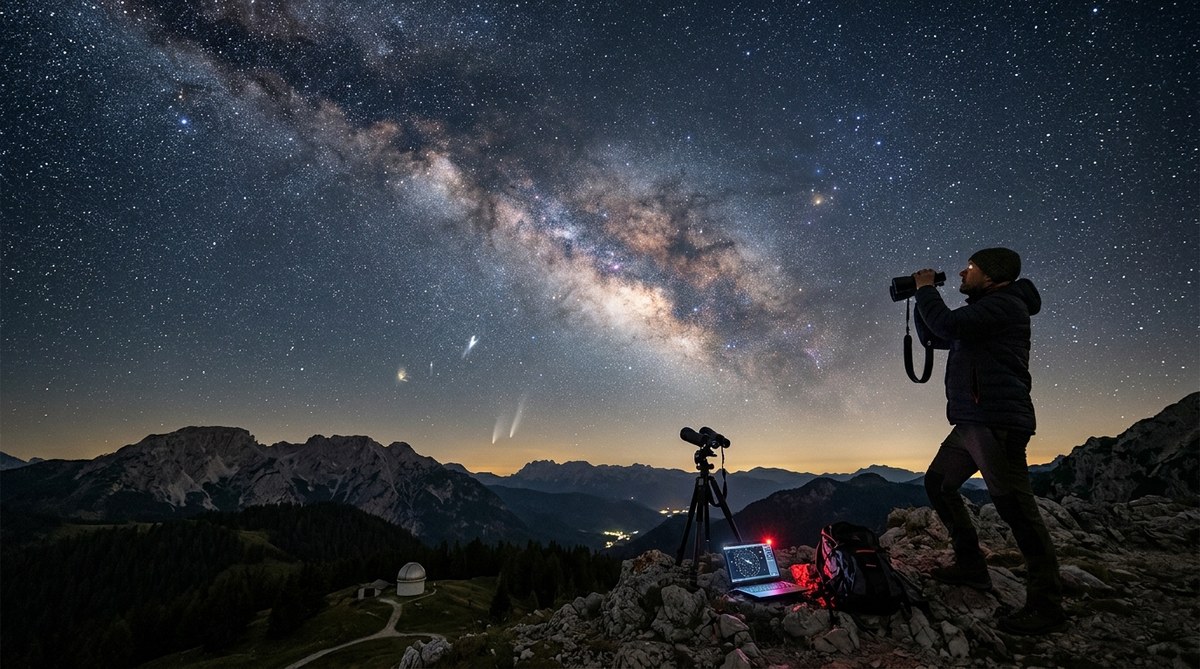
You don’t need a telescope to fall in love with the night sky. In fact, a simple pair of binoculars can reveal more celestial wonders than you might imagine. 2026 is a fantastic year to start, with bright planets lining up, meteor showers peaking, and deep-sky objects sitting right where your backyard view can find them. Whether you own a small 7×35 pair or a larger 10×50 set, the universe is ready to show off. Let us look at the best targets for your binoculars this year.
A good pair of binoculars is the most underrated tool for stargazing. In 2026, you can track Jupiter’s moons, resolve the rings of Saturn, scan the Andromeda Galaxy, and watch the Orion Nebula glow. The secret is steady hands, dark skies, and knowing where to look. This guide covers seven easy targets you can find tonight.
Why binoculars beat telescopes for beginners
A telescope can be intimidating. It needs setup, alignment, and a learning curve. Binoculars are ready to go. You grab them, walk outside, and look up. They give you a wider field of view, which makes finding objects much easier. Many beginners buy a telescope, use it once, and put it away. Binoculars stay in the car or by the back door.
For the night sky in 2026, binoculars are perfect for:
- Scanning the Milky Way on a summer night.
- Watching the Moon’s craters in sharp detail.
- Spotting the four largest moons of Jupiter.
- Seeing star clusters that look like handfuls of diamonds.
- Catching bright comets if any appear.
If you are serious about learning the sky, start with binoculars. You can always move to a telescope later. Read our guide on understanding the night sky for beginners to build your foundation.
The 7 best binocular targets for 2026
Here are the top objects to find with your binoculars this year. Each one is visible from most of the United States with minimal light pollution.
1. The moon in all its glory
The Moon is the most obvious target. But do not just glance at it. Use your binoculars to scan the terminator line, where day meets night. That is where shadows make craters pop. Look for the Sea of Tranquility and the bright ray systems around young craters like Tycho and Copernicus.
Best time to look: any night between first quarter and full moon. The week after new moon is also excellent.
2. Jupiter and its four moons
Jupiter shines brighter than any star. In binoculars, you will see the planet as a small, bright disk. If you hold steady, you can spot its four largest moons: Io, Europa, Ganymede, and Callisto. They look like tiny stars lined up next to the planet. Watch them change position from night to night.
Jupiter reaches opposition in August 2026. That means it will be visible all night long and at its biggest. For more on planetary viewing, check out our article on how to find planets in the night sky without a telescope.
3. Saturn’s rings
Saturn is a bit harder than Jupiter. It looks like a small, yellowish oval. But with good binoculars and a steady mount, you can make out the rings. They appear as bumps on either side of the planet. You will not see the Cassini Division, but you will know you are looking at the ringed world.
Saturn is best viewed in the evening sky during the summer of 2026. Use a tripod or brace your arms against a wall for the steadiest view.
4. The Orion Nebula (M42)
This is a stellar nursery. It looks like a fuzzy star in the sword of Orion. Binoculars reveal a glowing cloud of gas and dust. You can even see the four bright stars of the Trapezium cluster embedded inside. The nebula is visible from late fall through early spring.
Find the three stars of Orion’s belt. Hang down from them, and you will see the sword. The middle “star” is the nebula.
5. The Andromeda Galaxy (M31)
Andromeda is the closest major galaxy to our own. It is a faint, elongated smudge in the constellation of the same name. With binoculars, you can see its bright core and a hint of its spiral arms on a dark night.
Find the Great Square of Pegasus. Follow the chain of stars leading away from it. Andromeda is the second faint patch you will see. It is a staggering 2.5 million light years away. Read our guide on how to see the Andromeda galaxy with your bare eyes in 2026 for more tips.
6. The Pleiades star cluster (M45)
The Pleiades look like a tiny dipper to the naked eye. Through binoculars, they explode into dozens of blue-white stars. This open cluster is young, only about 100 million years old. It is easy to find in the winter sky near the constellation Taurus.
Best viewed from November through March. The cluster is large enough to fit comfortably in a standard binocular field of view.
7. The Double Cluster in Perseus
This is a hidden gem. Two star clusters sit side by side: NGC 869 and NGC 884. Through binoculars, they appear as a dense patch of stars. On a clear night, you can resolve dozens of individual points. It is a stunning sight.
Find the constellation Cassiopeia. The Double Cluster lies between Cassiopeia and Perseus. Use a star chart or an app to pinpoint it.
A simple process for your first session
Do not just walk outside and hope for the best. Follow these steps for a rewarding night.
- Check the weather. You want clear skies with no clouds. Avoid nights with a full moon if you are looking for faint objects.
- Let your eyes adapt. Stay away from white light for at least 20 minutes. Use a red flashlight to read charts.
- Start with the Moon. It is bright and easy. It will teach you how to focus your binoculars.
- Find a bright star. Focus on it until the star is a sharp point.
- Sweep slowly. Move your binoculars in a slow, steady arc. Stop when something catches your eye.
- Use a tripod. Even a cheap camera tripod with a binocular adapter makes a huge difference.
- Keep a log. Write down what you saw and the date. It helps you track your progress.
For a deeper look at planning, see our guide on how to plan your first stargazing session in 2026.
Common mistakes and how to avoid them
Even experienced observers make errors. Here is a table of the most common pitfalls and their fixes.
| Mistake | Why it happens | How to fix it |
|---|---|---|
| Blurry image | Out of focus or moving binoculars | Focus on a bright star first. Brace your arms. |
| Can’t find an object | Too much scanning | Use a star chart or app. Start from a bright star. |
| Eyes get tired | Too much light exposure | Use a red light. Take breaks. Close your eyes for a minute. |
| Objects look small | Wrong magnification | 7x to 10x is ideal for handheld. 15x needs a tripod. |
| Fogged lenses | Temperature change | Let binoculars sit outside for 15 minutes before using. |
Expert advice: “The best binoculars for stargazing are the ones you actually use. A 10×50 pair is the gold standard for beginners. It gathers enough light to show hundreds of objects without being too heavy to hold.” – Thrush Observatory staff
What to expect in 2026
This year offers some special events for binocular users.
- March 2026: Jupiter and Venus appear close together in the evening sky. Both fit in the same binocular field.
- August 2026: The Perseid meteor shower peaks under a new moon. Perfect for dark sky viewing.
- October 2026: Saturn is at opposition. It will be visible all night and at its brightest.
- December 2026: Mars reaches opposition. It will be a bright orange disk in binoculars.
For a full calendar, read our article on 7 cosmic calendar events you can’t miss in 2026.
A final note on equipment
You do not need expensive gear. A standard pair of 10×50 binoculars costs under $100 and will last for years. Look for models with fully multi-coated lenses for the brightest images. Avoid zoom binoculars. They often have lower image quality. Stick with fixed magnification.
If you wear glasses, look for binoculars with long eye relief (15mm or more). That lets you see the full field without removing your glasses.
For more on choosing gear, see our guide on how to choose the perfect beginner telescope for similar advice on optics.
Your first target tonight
Go outside tonight. Find the Moon or Jupiter if they are visible. Point your binoculars at them. Take a deep breath. Look at the craters or the tiny moons. That is the same view that Galileo saw 400 years ago. You are connected to centuries of discovery.
The night sky in 2026 is waiting for you. Start with these seven targets, and you will build confidence. Soon you will be finding galaxies, nebulae, and star clusters on your own. Keep looking up.