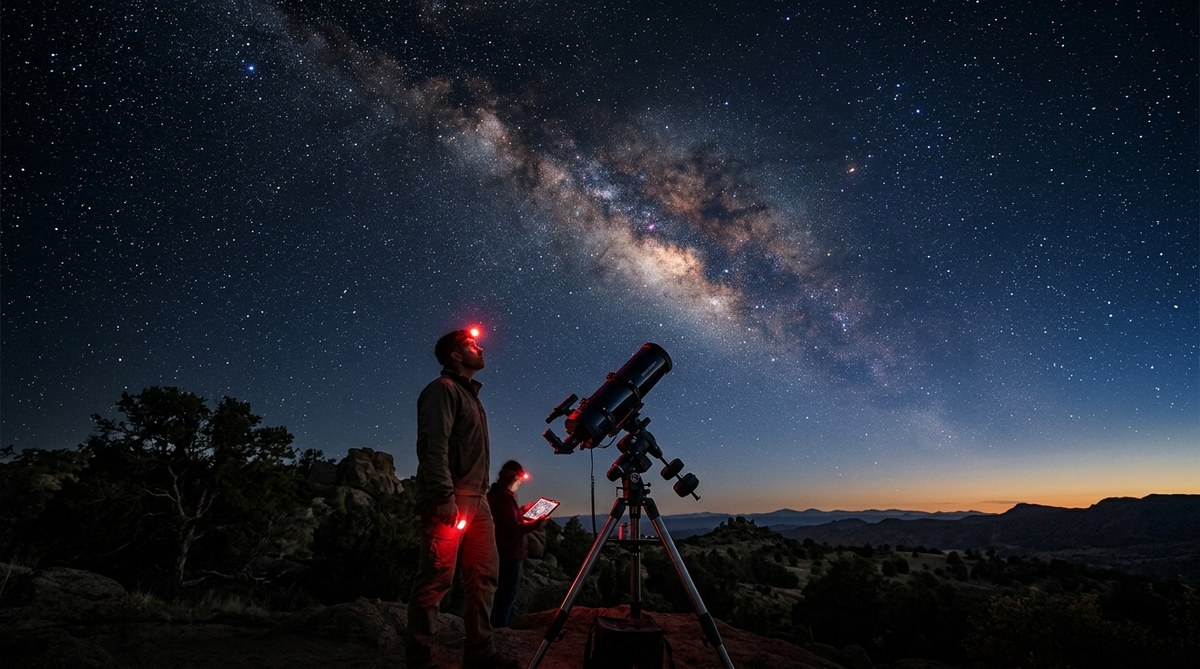
You have probably noticed it yourself. You step outside at 9 PM and the sky is a soft gray blue. The Moon might be up, or there is a faint glow near the horizon from a nearby town. You look up again at 2 AM and everything has changed. The sky is ink black. The Milky Way cuts across like a river of light. Stars you could not see before suddenly pop into view. This is not your imagination. The sky really does get darker after midnight, and understanding why can transform your stargazing sessions.
The sky gets darker after midnight because Earth rotates your location away from the Sun’s residual twilight glow, the Moon often sets, and artificial light pollution scatters less as atmospheric activity calms. This natural shift creates a window of true darkness ideal for seeing faint galaxies, nebulae, and meteor showers. Plan your observing sessions around this period for the best results.
The Simple Science of Earth’s Shadow
The main reason the sky darkens after midnight is surprisingly simple: you are rotating into Earth’s own shadow. Think of the planet as a giant ball. At sunset, your spot on the surface is turning away from the Sun. But the atmosphere above you still holds scattered sunlight. That glow is called twilight. It takes time for that leftover light to fade.
Around midnight, your location is on the side of Earth facing directly away from the Sun. You are in the deepest part of the planet’s shadow. There is no scattered sunlight left in the upper atmosphere. The sky reaches its maximum darkness. This period is called astronomical night. It is the time when the Sun is at least 18 degrees below the horizon.
For amateur stargazers, this is the golden window. It is when the faintest objects become visible with the naked eye or through a telescope.
How the Moon Changes the Game
The Moon is the second biggest factor in sky brightness. A full Moon can wash out the sky almost as much as city lights. But the Moon does not stay up all night. It rises and sets just like the Sun.
Here is a practical way to think about it:
- New Moon phase: The Moon is invisible. The sky is dark all night. This is the best time for deep sky observing.
- First quarter phase: The Moon sets around midnight. After it goes down, the sky darkens significantly.
- Full Moon phase: The Moon rises at sunset and sets at sunrise. The sky stays bright all night. Plan for planetary or lunar observing instead.
- Last quarter phase: The Moon rises around midnight. The early evening is dark, but the second half of the night gets brighter.
If you want the darkest sky, check the Moon phase before you go out. A moon phase calendar is a simple tool that pays off.
Light Pollution and the Late Night Lull
Artificial light pollution is a constant problem for backyard astronomers. But here is something many people miss: light pollution is often less intense after midnight.
Why? Because cities and suburbs go to sleep. Streetlights on timers may dim or turn off. Businesses close their signs. Neighbors turn off porch lights. Cars stop driving on the roads. The overall glow that hangs over a town decreases.
This is not true everywhere, but in many suburban areas, the difference is noticeable. If you live near a city, try comparing the sky brightness at 10 PM and 3 AM. You will see a real change.
Common Light Pollution Sources After Midnight
- Streetlights (some switch to lower output)
- Billboard and sign lighting (many turn off after 11 PM)
- Residential outdoor lights (porch lights, security lights)
- Vehicle headlights (traffic drops sharply)
- Industrial facilities (some reduce exterior lighting)
Atmospheric Stillness and Seeing Conditions
There is another reason the sky looks darker after midnight. The air itself settles down. During the evening, the ground is still warm from the day. That warmth rises and creates turbulence in the atmosphere. This turbulence scatters light and makes stars twinkle more. It also makes the sky appear brighter.
After midnight, the ground has cooled. The air becomes more stable. There is less turbulence. Less scattering means a darker background sky. Astronomers call this “good seeing.” It is when planets and stars appear sharp and steady.
How Atmosphere Affects Your View
| Time of Night | Air Stability | Sky Darkness | Best For |
|---|---|---|---|
| Evening (8-10 PM) | Unstable, warm air rising | Moderate glow | Bright planets, Moon, double stars |
| Late evening (10 PM – midnight) | Cooling down, improving | Darkening steadily | Star clusters, brighter nebulae |
| After midnight (12-4 AM) | Stable, cool air | Maximum darkness | Galaxies, faint nebulae, meteor showers |
| Pre-dawn (4-6 AM) | Stable but twilight begins | Starting to brighten | Zodiacal light, morning planets |
The Milky Way Factor
The Milky Way is one of the most stunning sights in the night sky. But you cannot see it unless the sky is truly dark. In many parts of the United States, the Milky Way is invisible until after midnight because of twilight and moonlight.
During summer months, the core of the Milky Way is highest in the sky around 1 AM to 3 AM. That is when it passes directly overhead. If you are out at 10 PM, the core is still low near the horizon and harder to see through atmospheric haze. Waiting until after midnight gives you a much better view.
If you want to spot the Milky Way from your backyard, plan for a new Moon and stay up past midnight.
Practical Steps for Using the Midnight Window
You do not need to be an expert to take advantage of this natural phenomenon. Here is a numbered list of steps to follow for your next stargazing session:
- Check the Moon phase for your date. Aim for nights between new Moon and first quarter.
- Look up your local sunset time. Add about 90 minutes for the end of astronomical twilight.
- Identify the time when the Moon sets. This is often the moment the sky darkens.
- Plan your session to start around 11 PM or midnight. This gives you the best chance at true dark skies.
- Let your eyes adapt. Give yourself 20 to 30 minutes of darkness before expecting to see faint objects.
- Use a red light flashlight to preserve your night vision while reading charts.
- Dress warmly. The temperature drops after midnight, especially in fall and winter.
What You Can See After Midnight
The objects that benefit most from a truly dark sky are the faint ones. Here is a bulleted list of targets that become visible or much clearer after midnight:
- The Milky Way band in summer
- The Andromeda Galaxy (M31)
- The Orion Nebula (M42) in winter
- The Veil Nebula (a supernova remnant)
- Faint globular clusters like M15
- The zodiacal light in spring and fall
- Meteor showers (radiant is often highest after midnight)
- The gegenschein (a faint glow opposite the Sun)
“The difference between a 10 PM sky and a 2 AM sky is like the difference between a city park and a national park. The faint light from distant galaxies has been traveling for millions of years. Do not let a little twilight steal that moment from you.” – Thrush Observatory Field Notes
Common Mistakes New Astronomers Make
Many beginners assume the best time to stargaze is right after dinner. That is understandable. But it leads to frustration when faint objects are invisible. Here is a table of common mistakes and how to fix them.
| Mistake | Why It Happens | Better Approach |
|---|---|---|
| Going out too early | Twilight is still present | Wait at least 90 minutes after sunset |
| Ignoring Moon phase | Moon washes out faint objects | Check a lunar calendar before planning |
| Staying near house lights | Light pollution ruins night vision | Set up in the darkest part of your yard |
| Using white light | Destroys dark adaptation | Use a red light or cover your flashlight |
| Giving up too fast | Eyes need 20+ minutes to adapt | Commit to at least 30 minutes outside |
| Not checking weather | Clouds or humidity scatter light | Use a clear sky chart before heading out |
If you recognize any of these, do not worry. Most beginners make these same mistakes. The fix is usually just a matter of timing.
Seasonal Differences in Midnight Darkness
The time of year changes when the darkest hours occur. In summer, the Sun sets late and rises early. The period of true astronomical night is shorter. In winter, the opposite happens. The Sun sets early and stays down longer. That gives you more hours of deep darkness.
Summer stargazers should note that in northern states like Minnesota or Maine, astronomical twilight may not even end until after midnight during June. The sky never gets fully dark. That is why summer is better for bright objects like planets and the Moon. Fall and winter are better for deep sky observing.
Spring and fall offer a good balance. The nights are long enough for darkness, and the temperatures are moderate. If you are planning your first stargazing session, aim for a weekend in October or March.
Putting It All Together for Your Best Night Yet
The science behind why the sky gets darker after midnight is not complicated. You are rotating into Earth’s shadow. The Moon is setting. The air is settling. And the human world is winding down. All of these factors combine to create a window of deep, pure darkness that is perfect for seeing the universe.
You do not need expensive equipment to benefit from this knowledge. A pair of binoculars and a willingness to stay up late can show you things that most people never see. The Andromeda Galaxy looks like a faint smudge of light to the naked eye. Through binoculars, it becomes a real galaxy. After midnight, it is even clearer.
So the next time you plan a stargazing night, think about the clock. Set an alarm for 11 PM instead of 9 PM. Pack a thermos of coffee. Bring a comfortable chair. And give yourself the gift of a truly dark sky. Your eyes will thank you, and the universe will reveal itself in ways you did not expect.