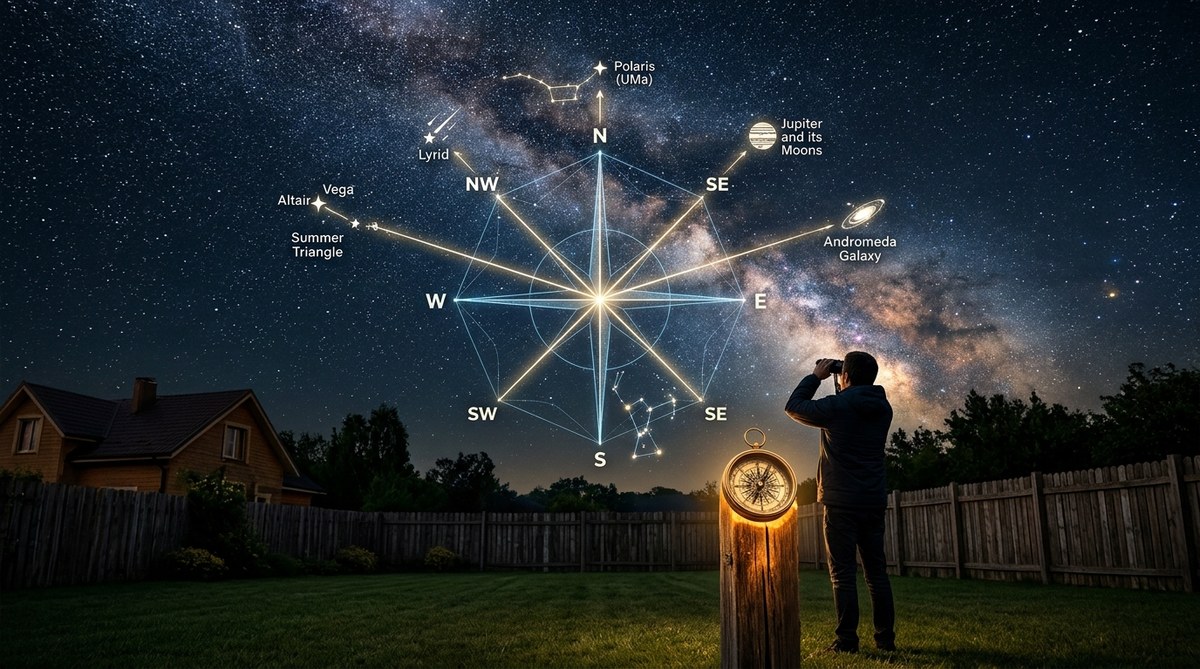
You have two powerful tools for navigating the night sky: your eyes and a simple compass. Most amateur stargazers grab a star chart or an app first. But a compass gives you something those tools cannot. It locks your orientation to the actual sky above your backyard. Once you understand how to pair magnetic north with the celestial sphere, the whole layout of the night sky clicks into place. You stop hunting randomly and start finding things on purpose.
A backyard compass is the cheapest and most reliable tool for learning the night sky. It reveals how the stars rotate around Polaris, helps you predict where planets will rise, and turns your yard into a personal observatory. In 2026, skip the complicated gear. Use a compass to find north, then let the sky teach you its hidden layout night by night.
Why Your Compass Is the Missing Link in Stargazing
Many beginners start by learning constellations like Orion or the Big Dipper. That works, but it is like learning a few street names without knowing the city layout. A compass gives you the cardinal directions. North, south, east, and west become your reference grid. When you know where north is, you can find Polaris, the North Star. Polaris sits almost directly above the true north pole. Once you find it, you have a fixed pivot point for the entire sky.
The stars appear to rotate counterclockwise around Polaris as Earth spins. If you face north and look up, you will see stars near Polaris moving in tight circles. Stars farther away trace wider arcs. This motion is predictable. Your compass tells you exactly which direction to face for any given hour.
How to Set Up Your Backyard Compass for Night Sky Navigation
You do not need a fancy marine compass. A basic liquid-filled compass works fine. Follow these steps to prepare for a session.
- Calibrate for magnetic declination. Magnetic north and true north differ by several degrees depending on where you live in the United States. Check your local declination using an online calculator. Adjust your compass or simply subtract the offset when aiming.
- Find a flat spot in your yard. Avoid metal objects, fences, or large electronics that could skew the needle. Place the compass on the ground or a low table.
- Align your body with the needle. Face the direction you want to observe. If you plan to watch the eastern horizon, stand with your left shoulder pointing north and your right shoulder pointing south.
- Wait for full night vision. Give your eyes at least 20 minutes to adapt. Red light helps preserve this adaptation. Do not look at your phone screen.
- Use the compass to verify Polaris. Once you think you have found the North Star, double check with your compass. Polaris should be within 1 degree of true north.
This setup takes less than five minutes. It saves you from guessing and second guessing your orientation all night.
The Seven Ways a Compass Reveals the Night Sky Layout
The article 7 Ways Your Backyard Compass Reveals the Night Sky’s Hidden Layout breaks each method into detail. Here is a summary of those approaches so you can start using them tonight.
- Find celestial north instantly. Your compass points to magnetic north. Adjust for declination and you have true north. Polaris sits there.
- Predict where planets rise. Planets follow the ecliptic path. If you know east from your compass, you can guess where Jupiter or Venus will appear each month.
- Measure star drift. Face north and watch how stars circle Polaris. Face south and notice how stars rise in the east and set in the west.
- Locate the meridian. The meridian is an imaginary line running from north to south directly overhead. Your compass helps you find this line so you can time when objects cross it.
- Track seasonal constellations. Orion dominates the winter sky in the south. Cygnus appears high in summer. Your compass tells you which direction to look each season.
- Avoid light pollution traps. If you know your yard faces a bright city to the south, you can rotate your observing chair to face north or east instead.
- Build a mental map of the sky. Over weeks, your brain learns the compass points and the stars attached to them. You stop needing the compass eventually.
Common Mistakes Beginners Make with a Compass
Even a simple tool can lead to errors. The table below shows the most frequent mistakes and how to fix them.
| Mistake | Why It Happens | How to Fix It |
|---|---|---|
| Using the compass near a metal patio chair | Metal deflects the needle | Move to an open grassy area |
| Forgetting magnetic declination | True north and magnetic north differ | Look up your local declination before going out |
| Holding the compass while walking | Body movement shakes the needle | Set the compass on a stable surface |
| Reading the compass under a white light | White light ruins night vision | Use a red light or a compass with glow in the dark markings |
| Confusing the orienting arrow with the needle | The orienting arrow is fixed; the needle moves | Practice rotating the bezel during daylight first |
“A compass is like a training wheel for the night sky. Once your brain learns the cardinal directions, the stars become a predictable map. You never have to guess again.” – Veteran amateur astronomer and Thrush Observatory contributor
When to Use Your Compass Versus an App
Apps like Stellarium or SkySafari are great for identifying specific stars. But they drain your battery and ruin your night vision with bright screens. A compass has no screen. It works in freezing weather, rain, or dusty conditions. It never runs out of power.
Use your compass for the big picture. Use an app for close up identification. For example, if you point your compass east and see a bright orange dot rising, you can guess it is Mars. Then check the app to confirm. This two step method builds your confidence faster than relying on a screen alone.
Combining Your Compass with Other Simple Tools
You do not need a telescope to enjoy the night sky. A compass plus a few household items creates a powerful observation kit.
- A red flashlight preserves night vision.
- A notebook helps you sketch star positions each week.
- A watch tells you when an object will cross the meridian.
- A lawn chair keeps you comfortable during long sessions.
If you want to take the next step, read our guide on how to read the sky like a map without a telescope. It pairs perfectly with the compass method.
What Your Backyard Compass Reveals About the Universe Tonight
Step outside tonight with your compass. Face north and find Polaris. Now look east. You will see stars rising just like the Sun does every morning. This happens because Earth rotates eastward. Your compass proves it. The stars are not moving. You are.
Face south. Look for the constellation that matches the current season. In winter 2026, Orion will be high in the southern sky. His belt points toward Sirius, the brightest star in the night sky. Your compass tells you that this whole scene shifts westward about 15 degrees every hour. By morning, Orion will be low in the west.
This rhythm is the hidden layout. Once you see it, you cannot unsee it. The sky becomes a clock and a calendar rolled into one.
Planning Your 2026 Stargazing Sessions with a Compass
The year 2026 has several events that are perfect for practicing your compass skills. Mark these dates.
- April 22 – Lyrid meteor shower. Face northeast before dawn.
- August 12 – Perseid meteor shower. Face northeast after midnight.
- December 13 – Geminid meteor shower. Face east around 2 a.m.
For each event, use your compass to find the radiant point. The radiant is the spot in the sky where the meteors appear to originate. For the Perseids, the radiant is in the constellation Perseus, which rises in the northeast. Your compass gets you pointed in the right direction without any guesswork.
If you are new to planning sessions, check out how to plan your first stargazing session in 2026. It covers timing, clothing, and backup plans for cloudy nights.
Why the Best Time to Practice Is Right Before Dawn
Most people stargaze in the evening. That works, but the hours before dawn offer a quieter sky. There is less light pollution from nearby towns. The air is usually steadier, which means stars twinkle less. Your compass works the same way at 4 a.m. as it does at 9 p.m. The only difference is which constellations are visible.
Set your alarm for 4 a.m. on a clear weekend. Grab your compass, a red light, and a warm jacket. Face east. You will see the summer constellations rising even in the middle of winter. It feels like time travel.
Your Compass Is the Key to Owning the Night Sky
A backyard compass night sky approach does not require expensive gear. It does not need a PhD in astronomy. It requires ten minutes of setup and a willingness to look up. The first time you find Polaris using only your compass, you will feel a shift. The random scatter of stars becomes a spinning dome with a fixed center.
Start tonight. Walk outside. Find north. Look up. The hidden layout of the night sky is waiting for you. And now you have the one tool that unlocks it all.