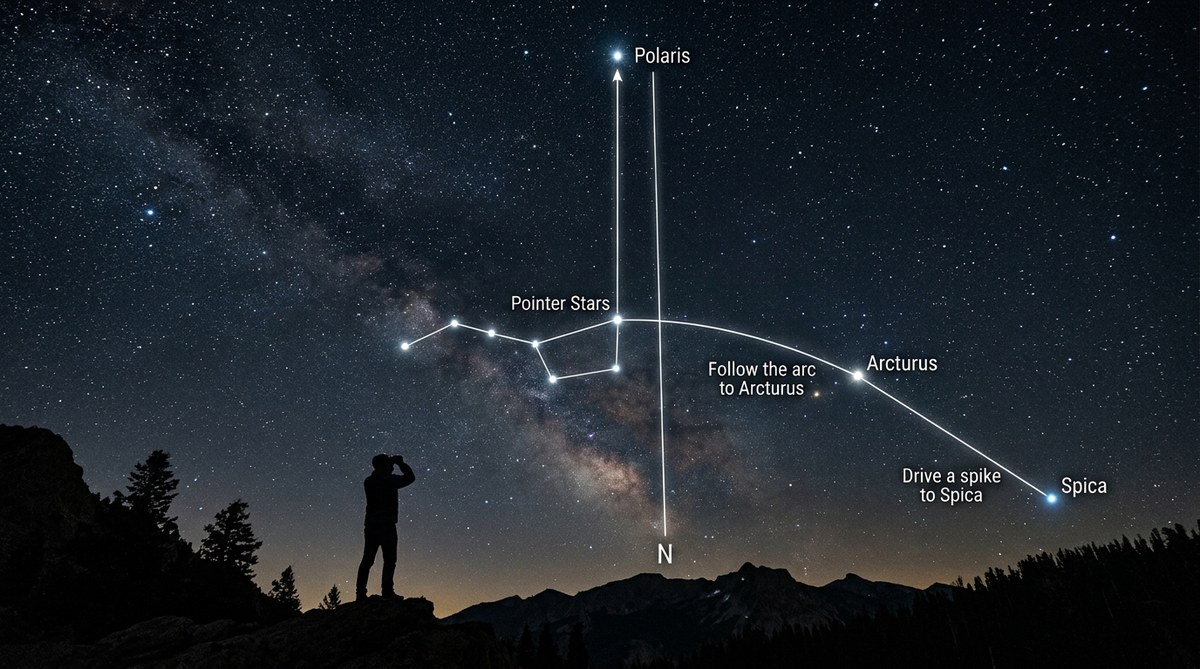
The Big Dipper is the easiest starting point for anyone who wants to learn the night sky. You do not need a telescope, a star chart, or any special gear. Just look north on a clear evening, and you will spot seven bright stars that form a shape most people recognize from childhood. That shape is your key to the entire sky.
The Big Dipper works as a sky map because two of its stars, Merak and Dubhe, always point directly to Polaris, the North Star. Once you find Polaris, you can locate the Little Dipper, navigate to bright stars like Arcturus and Spica, and identify seasonal constellations. This one pattern unlocks the whole northern sky for you.
Why the Big Dipper Works as Your Sky Map
The Big Dipper is not a constellation on its own. It is an asterism, a recognizable pattern of stars that sits inside the official constellation Ursa Major, the Great Bear. What makes it special is its location. The Big Dipper is circumpolar for most of the United States. That means it never sets below the horizon. You can see it every night of the year, no matter the season.
This reliability makes it the perfect anchor for Big Dipper navigation. Once you learn the two pointer stars at the front of the bowl, Merak and Dubhe, you have a direct line to the North Star. From there, the rest of the sky opens up.
The two pointer stars you need to know
Look at the bowl of the Big Dipper. The two stars farthest from the handle are Merak and Dubhe. Merak is the bottom one. Dubhe is the top one. Draw an imaginary line from Merak through Dubhe and extend it about five times the distance between them. That line lands directly on Polaris.
Polaris sits at the end of the Little Dipper handle. The Little Dipper is fainter than the Big Dipper, so you will not always see all seven stars. But if you can find Polaris, you have found the northern celestial pole. That is your reference point for everything else.
How to Find the North Star in Three Steps
Here is the simplest way to use Big Dipper navigation to locate Polaris.
- Find the Big Dipper in the northern sky. It looks like a large ladle with a curved handle. The bowl faces upward or downward depending on the season, but the shape is always the same.
- Identify Merak and Dubhe. These are the two stars that form the outer edge of the bowl, opposite the handle. Merak is the one closer to the horizon. Dubhe is above it.
- Trace a straight line from Merak through Dubhe. Keep going until you hit a moderately bright star that does not seem to move much. That is Polaris.
Polaris is not the brightest star in the sky. That is a common myth. It is about the 50th brightest star overall. But it stands out because the stars around it are much fainter, and it stays fixed while everything else rotates.
“The Big Dipper is the most useful tool for beginner stargazers because it is always there. Once you learn the pointer stars, you can find true north and orient yourself to the rest of the sky, even without a compass.”
Using the Big Dipper to Find Other Constellations
Once you have Polaris, you can start hopping to other stars and constellations. This technique is called star hopping, and it is how amateur astronomers learn the sky without a computer.
Arc to Arcturus, speed to Spica
This is the most famous mnemonic in amateur astronomy. Follow the curve of the Big Dipper handle away from the bowl. That curve arcs toward the bright orange star Arcturus. Keep the same arc going, and it points to the blue-white star Spica.
Arcturus is in the constellation Bootes. Spica is in Virgo. Both are easy to spot from most backyards in the spring and summer. If you can find the Big Dipper, you can find these two bright stars in under ten seconds.
From Polaris to Cassiopeia
Polaris sits at the center of the northern sky. On the opposite side of Polaris from the Big Dipper, you will find the W-shaped constellation Cassiopeia. The two constellations rotate around Polaris like the hands of a clock. When the Big Dipper is low in the sky, Cassiopeia is high, and vice versa. This relationship helps you stay oriented even when one constellation is partially hidden by trees or buildings.
Locating the Little Dipper
The Little Dipper is harder to see because its stars are dimmer. But if you have Polaris, you have the end of its handle. The bowl of the Little Dipper hangs below Polaris in the spring and above it in the fall. Use the two pointer stars from the Big Dipper to confirm you are looking at the right spot. If you are unsure, check your position against the table below.
Common Mistakes and How to Avoid Them
| Mistake | Why It Happens | How to Fix It |
|---|---|---|
| Confusing the Big Dipper with the Little Dipper | Both have a bowl and handle shape | The Big Dipper is much larger and brighter. The Little Dipper handle ends at Polaris. |
| Expecting Polaris to be blindingly bright | Pop culture makes it seem brighter | Polaris is average in brightness. Look for a star that does not move relative to the other stars. |
| Looking at the wrong time of year | The Big Dipper changes position | It is circumpolar, so it is always visible. But its orientation changes. In winter, the handle points down. In summer, the handle points up. |
| Using the wrong pointer stars | Using the two stars near the handle instead of the bowl | Only the two stars farthest from the handle point to Polaris. The other bowl stars point elsewhere. |
A Practical Night Sky Session Using the Big Dipper
You do not need a telescope for this. Your eyes are enough. Here is a 15 minute routine you can do from your backyard or a local park.
- Step outside about an hour after sunset. Let your eyes adjust for five minutes.
- Locate the Big Dipper in the northern sky. If you cannot find it, face north and look about halfway up the sky.
- Use the pointer stars to find Polaris.
- From Polaris, trace the Little Dipper handle backward to confirm you have the right star.
- Follow the arc of the Big Dipper handle to find Arcturus. Notice its orange color.
- Keep the arc going to find Spica. Notice the color difference between the two stars.
- Turn around and face south. You are now oriented relative to the rest of the sky.
This routine takes longer to read than to do. After two or three sessions, it becomes automatic. You can then use the same method to find more targets, like the 6 easy constellations to find tonight with just your eyes.
When the Big Dipper Is Hard to See
The Big Dipper is circumpolar, but it can be low on the horizon during certain months. In the late autumn, it sits close to the northern horizon for observers in the southern United States. Trees, hills, and city lights can block it.
If that happens, look for Cassiopeia instead. Cassiopeia is high in the sky when the Big Dipper is low. Once you find Cassiopeia, you can draw a line from its center star to Polaris. That gives you the same reference point. You can also use a star chart or an app to confirm your position. For more help, check out this guide on how to read the sky like a map without a telescope.
How to Teach Big Dipper Navigation to Kids or Beginners
If you are showing someone else how to do this, keep it simple. Point to the Big Dipper and ask them to count the stars. Seven is easy to remember. Then show them the two pointer stars. Tell them those stars are like an arrow that points to Polaris.
Let them trace the line with their finger. Once they find Polaris, show them the Little Dipper. They will feel a sense of accomplishment. That small win builds confidence.
You can also teach the arc to Arcturus trick. It is visual and easy to repeat. After that, they can start learning how to read star charts for beginners at their own pace.
The Big Dipper as a Seasonal Calendar
The position of the Big Dipper changes with the seasons. In the spring, it sits high in the sky with the handle pointing down. In the summer, the handle points up. In the fall, it is low and parallel to the horizon. In the winter, it stands almost vertical.
You can use this movement to tell time and season. If the Big Dipper is directly above Polaris, it is around midnight in the spring. If it is to the left of Polaris, it is around midnight in the summer. This is not precise, but it is a fun party trick and a good way to build awareness of the sky.
For a deeper look at how the sky changes, read about why the stars seem to move: understanding celestial motion for beginners.
Why This Skill Matters for Amateur Stargazers
Big Dipper navigation is the foundation for everything else in amateur astronomy. It teaches you to see the sky as a map. It builds your ability to find things without technology. And it works every single night.
Once you master this, you can move on to fainter objects. You can use binoculars to see the double star Mizar and Alcor in the Big Dipper handle. You can learn to measure the night sky with just your hands to estimate distances between stars. You can even plan your first stargazing session with confidence.
The Big Dipper is not just a pattern in the sky. It is a tool. And once you know how to use it, the night sky stops being a random scatter of lights and starts being a place you can navigate.
Your Next Step Under the Stars
Tonight, go outside and find the Big Dipper. Use the pointer stars to locate Polaris. Then follow the arc of the handle to Arcturus. That is all it takes to start building your skill. Repeat this three nights in a row, and you will never lose your way in the northern sky again. The more you practice, the more the sky will feel like home.