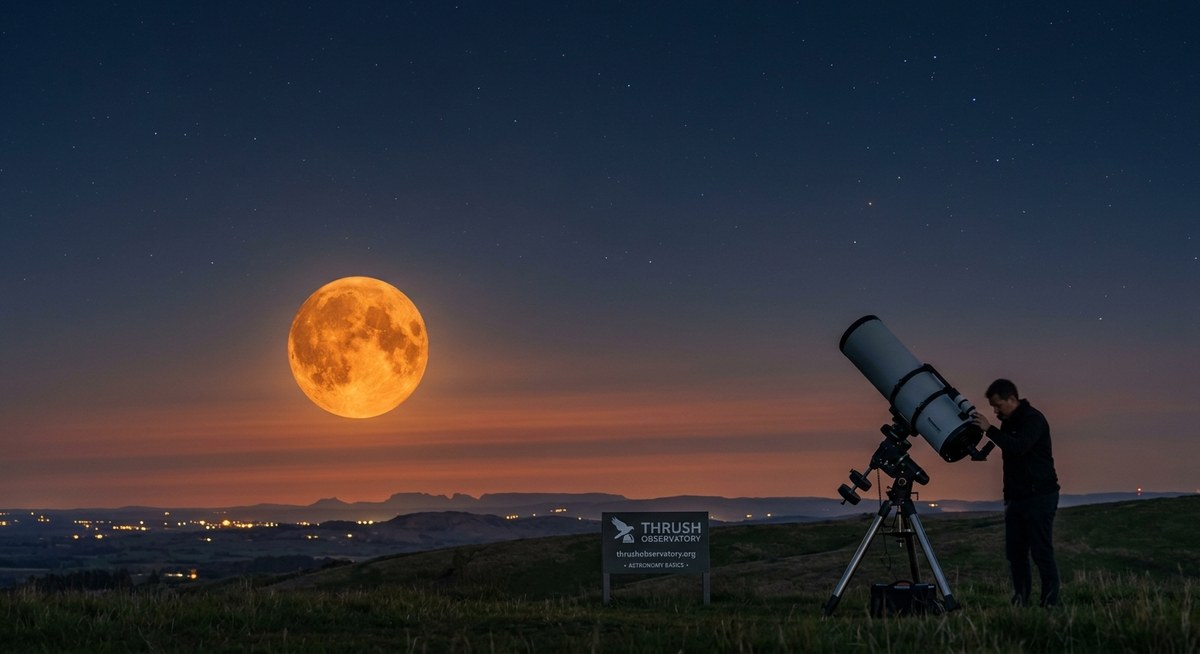
You step outside one evening, glance up at the sky, and freeze. The moon is glowing like a giant pumpkin. It looks almost surreal, like something from a science fiction movie. But what you are seeing is real. And it has a perfectly logical explanation. The moon itself has not changed color. It is still the same grey rock that has orbited Earth for billions of years. The orange hue is a trick of the light, a natural filter created by the very air you breathe.
When you see an orange moon, you are watching a natural light show caused by Earth’s atmosphere. Moonlight travels through more air when the moon is near the horizon. The air scatters blue light and lets orange and red light pass through. This same effect creates colorful sunsets. Smoke, dust, and pollution make the orange color stronger. The science behind this colorful sight is called Rayleigh scattering, and it explains why the moon changes color.
The Simple Reason the Moon Changes Color
The moon does not produce its own light. It reflects sunlight toward Earth. That reflected light has to travel through Earth’s atmosphere before it reaches your eyes. Think of the atmosphere as a giant filter. When the moon is high overhead, that filter is thin. The light passes through with very little change. But when the moon sits near the horizon, something different happens.
Near the horizon, you are looking through a much thicker slice of atmosphere. Imagine holding a clear glass of water flat and looking through the side. That is like looking at the moon overhead. Now imagine tipping that glass so you look through the full length of it. That is like looking at the moon near the horizon. The longer path through the glass means more water. The longer path through the atmosphere means more air, more particles, and more scattering.
Scattering is the key. It is the same reason the sky is blue during the day. Sunlight contains all colors. Blue light has a shorter wavelength. It bounces off air molecules much more easily. That scattered blue light fills the sky and makes it look blue. Orange and red light have longer wavelengths. They scatter much less. They travel in a straighter line.
When the moon is low, the thick atmosphere strips out the blue light. It scatters away before it reaches you. What is left? The warmer colors. Orange, red, and yellow. That is exactly what you see.
“The orange moon is a beautiful reminder that light is not just something we see. Light interacts with everything around it. The atmosphere is a living filter that changes with every sunset, every season, and every weather pattern.” – Dr. Helen Torres, atmospheric physicist
What Actually Happens Inside the Atmosphere
The official name for this process is Rayleigh scattering. It is named after the British physicist Lord Rayleigh, who first described it in the 1870s. The same physics explains why sunsets turn red and orange. When the sun dips low, its light also takes a longer path through the atmosphere. The blue scatters away, and the warm colors remain.
But Rayleigh scattering is not the only player. There are other particles in the air that affect the color. Here is a breakdown of the three main factors.
The Three Step Process That Creates an Orange Moon
-
Sunlight hits the moon. The moon reflects that light toward Earth. The light contains the full spectrum of colors, from violet to red.
-
The light enters Earth’s atmosphere. If the moon is high overhead, the path is short. The light arrives mostly white or pale yellow. If the moon is near the horizon, the path is long and the atmosphere is dense.
-
Shorter wavelengths scatter out. Blue, violet, and green light bounce off air molecules and particles. They scatter sideways and never reach your eyes. The longer wavelengths, orange and red, push through the atmosphere and land on your retina.
That is the entire process. It is simple physics. But the final color you see depends on what is in the air.
What Makes the Orange Color Even Stronger
You have probably noticed that some orange moons look deeper and richer than others. That is because the atmosphere is not a fixed filter. It changes from day to day and from place to place.
-
Wildfire smoke. Smoke particles are larger than air molecules. They scatter blue light even more effectively. In the summer of 2023, large parts of the United States saw deep orange and red moons because of Canadian wildfire smoke. The same can happen in 2026 during fire season.
-
Volcanic ash. Large volcanic eruptions send ash and sulfur particles high into the atmosphere. These particles can linger for months and cause vivid moon colors.
-
Dust and pollution. Urban areas with high levels of air pollution often produce more colorful moons. The extra particles in the air scatter more blue light and leave a stronger orange glow.
-
Humidity and fog. Water droplets in the air also scatter light. A humid evening can make the moon look soft and orange.
If you live in a city or near a region affected by seasonal fires, you will see more orange moons than someone in a remote, high altitude location. The cleaner the air, the whiter the moon.
When and Where You Will See an Orange Moon
The orange moon is not a rare event. It happens every single night, during a specific window of time. The key is the moon’s position relative to the horizon.
The best time to see an orange moon is right after moonrise. Check your local moonrise time for any given night. Go outside 10 to 15 minutes after that time. Look toward the eastern horizon. The moon will be low and large, and it will almost certainly have a warm orange glow. The same effect happens at moonset, when the moon sinks low in the western sky.
Here is a table to help you predict what color the moon will appear based on conditions.
| Condition | Typical Moon Color | Best Time to See It |
|---|---|---|
| Clear air, high altitude | White or pale yellow | Midnight, overhead |
| Clear air, moon near horizon | Soft orange to peach | Right after moonrise |
| Haze or light fog | Deep orange | Moonrise or moonset |
| Wildfire smoke | Reddish orange to deep red | Anytime the moon is low |
| Urban pollution | Orange with a dim glow | Evening moonrise |
| After a volcanic eruption | Brick red for weeks | Low on the horizon |
The moon also appears larger when it is near the horizon. That is a separate effect called the moon illusion. Your brain compares the moon to trees, buildings, and the curve of the horizon. It tricks you into thinking the moon is physically bigger. Combined with the orange color, it creates a dramatic visual that stops people in their tracks.
Common Misunderstandings About the Orange Moon
A lot of myths float around about why the moon turns orange. Some people think it has to do with the moon’s orbit. Others blame it on the seasons. Let me clear up a few of the most common ones.
| Myth | What Actually Happens |
|---|---|
| The moon is on fire or burning up. | The moon is cold and lifeless. The orange color comes from Earth’s atmosphere, not from the moon itself. |
| An orange moon means a full moon is coming. | The orange color has nothing to do with moon phases. It happens at any phase, as long as the moon is low on the horizon. |
| It only happens in autumn. | Autumn is a great time to see orange moons because the moon rises early in the evening. But it happens year round. |
| Blood moons and orange moons are the same thing. | A blood moon happens during a total lunar eclipse. The entire moon turns deep red. An orange moon is a regular, daily event caused by the atmosphere. |
| You need special equipment to see it. | You do not need a telescope or binoculars. An orange moon is easy to see with the naked eye. |
Understanding the difference between a regular orange moon and a lunar eclipse is important. A lunar eclipse happens when Earth lines up between the sun and the moon. Earth’s shadow falls on the moon. The only light that reaches the moon has traveled through Earth’s atmosphere, which filters out blue light. That is why the moon turns red during an eclipse. It is the same physics, but a much more dramatic version.
If you want to learn more about how the night sky works, take a look at this guide on understanding the night sky. It covers the basics of what you see overhead every night.
How to Watch and Photograph the Orange Moon
You do not need any fancy gear to enjoy an orange moon. Just step outside at the right time. But if you want to capture the moment, a few simple tricks will help.
For viewing with your eyes:
– Check the moonrise time for your location. Free apps like Time and Date or Stellarium give you exact times.
– Find a spot with a clear view of the eastern horizon. A hill, an open field, or a beach works best.
– Arrive 15 minutes early. The show starts the moment the moon peeks above the horizon.
– Watch for the next 30 to 45 minutes. The color shifts from deep orange to pale yellow as the moon rises higher.
For taking photos with your phone:
– Use the telephoto lens if your phone has one. It helps capture the size and color.
– Tap the screen and lower the exposure. A bright moon can wash out the orange color.
– Include something in the foreground. A tree, a building, or a mountain gives the photo scale and makes the orange color pop.
For using a telescope:
– A telescope is not needed to see the orange color. But if you have one, use a low power eyepiece. Higher magnification makes the moon too bright and washes out the color.
– Try a moon filter. It reduces glare and can enhance the warm tones.
If you are new to night sky observation and want to make a habit of it, this guide on how to plan your first stargazing session in 2026 will help you get started.
Why an Orange Moon Is a Sign You Should Look Up More Often
An orange moon is one of the easiest and most rewarding sights in the night sky. You do not need a textbook. You do not need a degree. You just need to step outside and look up. That single moment connects you to the same physics that makes the sky blue, that paints sunsets, and that creates rainbows.
The next time you see that warm orange glow, remember what is happening. Light is traveling 239,000 miles from the moon. It hits the top of Earth’s atmosphere. That atmosphere, the same one you breathe every day, acts like a gentle filter. It strips away the cold blue light and lets the warm colors through. It is simple. It is beautiful. And it happens every single day.
Keep a calendar reminder for the next full moon. Check your local moonrise time. Go outside with a friend or a family member. Watch the moon climb above the horizon. Watch it change from deep orange to pale yellow. Then explain to them what you just learned. That is how curiosity spreads.
If you want to continue building your night sky skills, consider reading about 7 must-know moon phases for better stargazing. It will help you predict when the moon will be visible and how its phase affects what you can see.
The sky is always there. It is always changing. And the orange moon is one of its friendliest invitations. Take it.