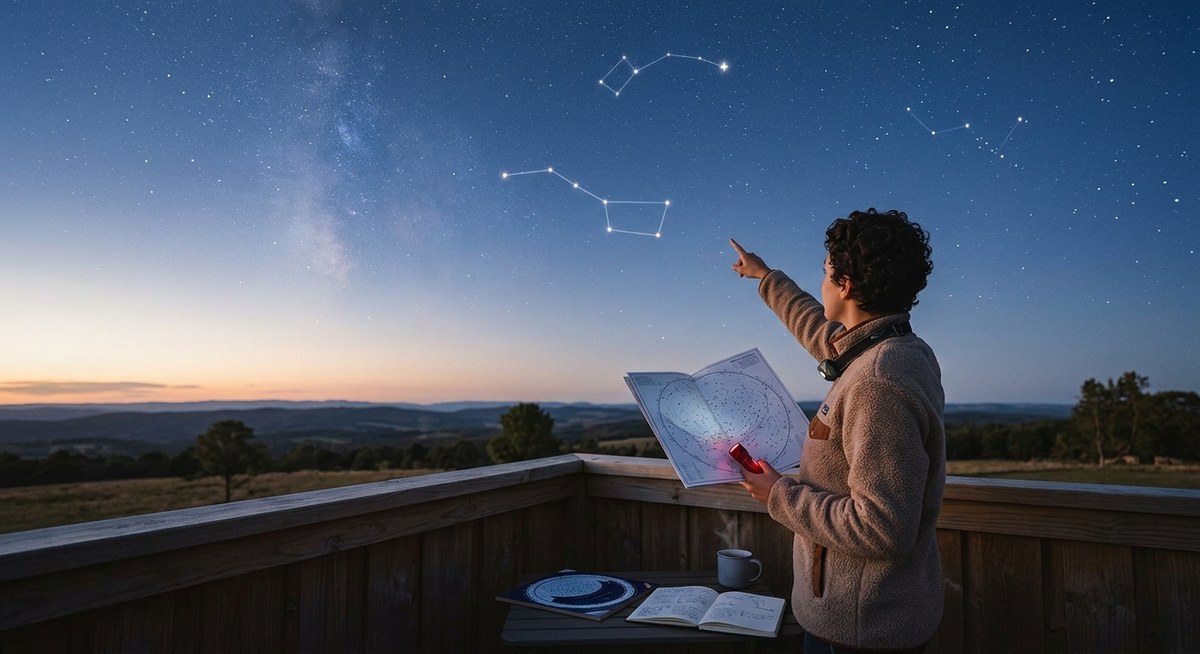
You step outside after sunset, tilt your head back, and the whole universe sprawls above you. No device between you and the stars. No screen glow to ruin your night vision. Just your eyes, the sky, and a quiet sense of wonder. Learning to read the night sky without a telescope is easier than you think. It’s a skill that connects you to ancient travelers, sailors, and storytellers who used the same stars to navigate and make sense of their world. And the best part? You can start tonight, from your backyard or a nearby park, with zero equipment.
To read the night sky without a telescope, focus on three skills: finding the North Star as your fixed anchor, recognizing bright seasonal constellations like Orion and the Big Dipper, and using hand measurements to gauge distances between stars. Practice from a dark location, give your eyes 20 minutes to adapt, and follow the sky’s natural map. No apps needed.
Why Your Eyes Are All You Need
Many people assume that serious stargazing requires a telescope. In reality, the naked eye is the perfect tool for understanding the big picture. A telescope zooms in on small patches of sky. Your eyes give you the full layout, the same view that guided humans for thousands of years. You can spot planets, meteor showers, the Milky Way band, and dozens of constellations without any glass. The key is knowing where to look and how to read the patterns.
Think of the night sky as a rotating dome. Stars rise in the east and set in the west, just like the sun. The entire dome slowly turns because of Earth’s rotation. Once you find a few reliable reference points, you can navigate the rest.
The Three Pillars of Naked Eye Navigation
1. Find Your North Star Anchor
Polaris, the North Star, sits almost directly above the North Pole. It stays fixed while all other stars circle around it. This makes it the most reliable landmark in the sky.
To locate Polaris, start with the Big Dipper. Find the two stars at the end of the dipper’s bowl (the ones farthest from the handle). Draw an imaginary line upward from those two stars. The line will point to a moderately bright star: Polaris.
Once you identify Polaris, you can orient yourself. North is directly below it. East is to your right, west to your left. This works anywhere in the northern hemisphere.
2. Learn Seasonal Signposts
The sky changes throughout the year. Different constellations appear in different seasons. Focus on one or two per season:
- Winter (December – February): Orion is unmistakable. Look for three stars in a tight row (Orion’s Belt). Above and below the belt are two bright stars: Betelgeuse (reddish) and Rigel (bluish).
- Spring (March – May): Look for Leo. The sickle shape of Leo’s head looks like a backward question mark. The bright star Regulus marks the bottom.
- Summer (June – August): The Summer Triangle dominates. Three bright stars (Vega, Deneb, Altair) form a large triangle overhead.
- Fall (September – November): Pegasus forms a giant square. Find it high in the east after sunset.
3. Measure the Sky With Your Hands
Your hand is a built-in protractor. Hold it at arm’s length. Here’s how the measurements work:
- Your fist (width) = about 10 degrees of sky
- Your thumb (width) = about 2 degrees
- Your pinky finger (width) = about 1 degree
- Your outstretched hand from thumb to pinky = about 20 degrees
Use these to measure distances between stars. For example, the Big Dipper’s handle is about 15 degrees long. The gap between Betelgeuse and Rigel is roughly 15 degrees. This method makes it easy to hop from one star to another.
Step-by-Step: Your First Naked Eye Session
- Choose a dark spot. Get away from streetlights and porch lights. If you live in a city, visit a local park or a nearby dark sky site. Check this guide to adapting to light pollution if you’re stuck in the suburbs.
- Let your eyes adapt. Avoid all white light for at least 20 minutes. No phone, no flashlight. If you need light, use a red filter (or cover a flashlight with red cellophane). Your pupils expand and your eyes become sensitive to faint stars.
- Start with a familiar pattern. Find the Big Dipper or Orion. Use the star hopping method: look from one bright star to the next.
- Check your direction. Polaris tells you north. Use that to figure out which way each constellation rises.
- Scan the sky systematically. Move your gaze slowly, section by section. Peripheral vision catches dimmer stars better than staring directly at them.
- Note the time. The sky rotates about 15 degrees per hour. If you look again two hours later, everything will have shifted westward.
Common Mistakes and How to Fix Them
| Mistake | Why It Happens | Fix |
|---|---|---|
| Expecting stars to be very bright | City light pollution washes out all but the brightest stars | Drive 30 minutes away from town; let eyes adapt longer |
| Using a white flashlight between looks | Resets your night vision | Use a red light or no light at all |
| Looking for constellations too close to the horizon | Atmosphere dims and distorts stars near the horizon | Wait until the constellation is at least 30 degrees above the horizon (three fists) |
| Trying to memorize too many constellations at once | Overwhelming | Learn one new pattern per week; review old ones first |
| Confusing planets with stars | Planets don’t twinkle; they shine steadily | If a “star” glows without flickering, it’s likely a planet |
“The night sky is a giant clock and calendar. Once you know a few key stars, you can tell the season and the hour just by looking up.” – Tom Burns, former director of the Perkins Observatory
What You Can Spot Without a Telescope
Here’s a bullet list of celestial objects that are completely visible to the naked eye:
- Venus (very bright, appears near sunrise or sunset)
- Jupiter (bright, steady, yellowish)
- Saturn (dimmer, steady, pale yellow)
- Mars (reddish, varies in brightness)
- The Milky Way (a hazy band across the sky, best seen in summer from dark sites)
- Meteor showers (Perseids in August, Geminids in December)
- The International Space Station (a moving bright dot, often visible shortly after sunset)
- Star clusters like the Pleiades (a tiny dipper shape near Taurus)
- The Andromeda Galaxy (faint smudge, visible from very dark skies)
How to Practice Without Frustration
Start with just three constellations. For example, learn the Big Dipper, Orion, and Cassiopeia (a W shape). Once you can identify them from any angle, add one more each week. Use this guide on easy constellations to find tonight as your checklist.
Bring a friend. Two pairs of eyes spot more than one. And don’t worry if you can’t see every star that the charts show. The sky is always different. Atmospheric conditions, moonlight, and light pollution change the view. That’s normal.
If you want to deepen your understanding of why stars move the way they do, read about why the night sky changes with the seasons. Knowing the mechanics makes the patterns even more satisfying.
Your Night Sky Map Awaits
The sky is not a random scatter of lights. It’s a map with landmarks, streets, and neighborhoods. You just need to learn the main intersections. By starting with Polaris, practicing hand measurements, and using seasonal signposts, you can navigate the dome above you without a telescope, without an app, without anything except your own eyes.
Tonight, go outside. Let your eyes adjust. Find the Big Dipper. Point to Polaris. Then turn around and look for a constellation you’ve never noticed before. That’s how the sky becomes familiar, one star at a time.