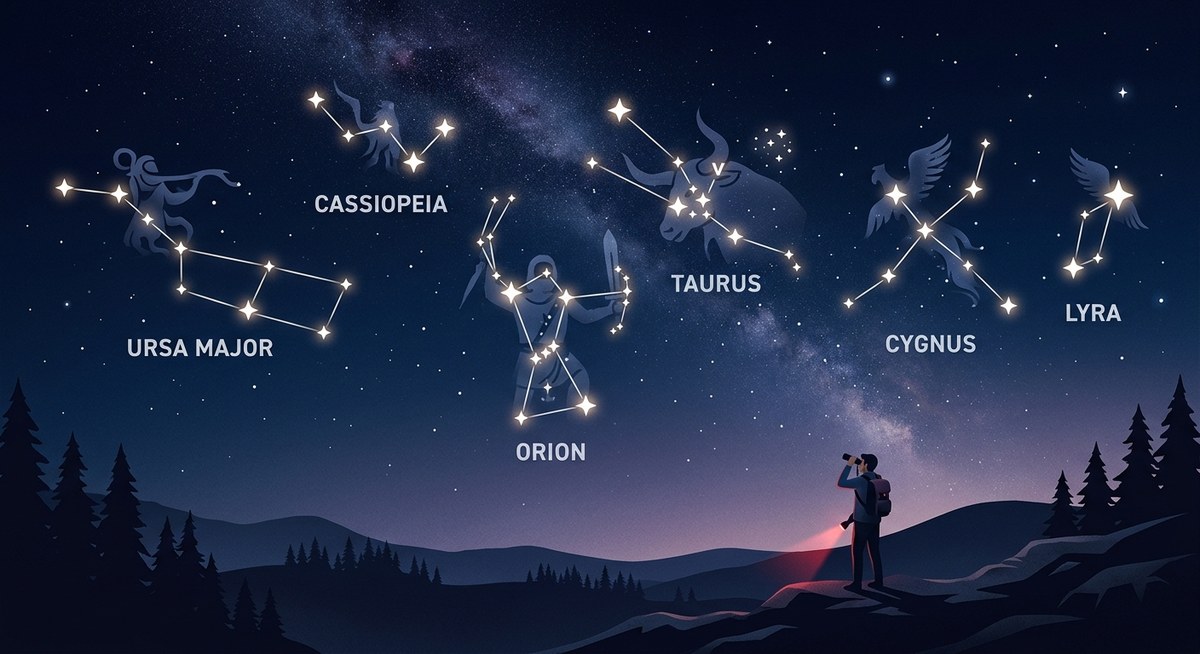
Stargazing is one of those rare hobbies that requires almost nothing but curiosity and a clear night. You do not need a telescope, a star chart, or any special equipment. Just your eyes and a patch of dark sky. For a beginner, the night sky can feel overwhelming. There are thousands of stars, and they all seem to blur together. But learning a few simple constellations changes everything. Once you see one pattern, you can use it to find others. It is like learning the first few letters of an alphabet. The more you practice, the more the sky becomes a map full of familiar landmarks.
You can spot six easy constellations tonight without any telescope: Ursa Major (Big Dipper), Ursa Minor (Little Dipper), Cassiopeia, Orion, Leo, and Cygnus. Start by finding the Big Dipper, then use its pointer stars to locate Polaris. From Polaris, trace the Little Dipper and Cassiopeia. Orion and Leo are best in winter and spring. Cygnus dominates summer skies. Practice 15 minutes per session and you will learn the whole sky.
Why Start With Easy Constellations?
Constellations are ancient patterns that humans have used for navigation, storytelling, and calendars. The easiest ones are large, bright, and unmistakable. They do not require binoculars because their main stars shine brightly even in light polluted suburbs. For a beginner, finding a constellation like Orion or the Big Dipper feels like a small victory. That feeling keeps you coming back for more.
Many newcomers give up because they try to spot faint or seasonal patterns first. Instead, start with the six below. They are visible from most of the United States during different seasons. If you learn these, you can then use them as signposts to deeper sky objects. You can also explore more advanced techniques in our guide to Mastering Astronomy Basics: How to Identify Stars, Planets, and Constellations.
How to Prepare for a Naked Eye Stargazing Session
You do not need much, but a little planning helps. Follow these steps to get the best view:
- Choose a night with clear skies. Check the weather forecast for zero clouds and low humidity. Avoid nights with a full moon because moonlight washes out fainter stars.
- Find a dark location. A backyard away from streetlights is fine. If you can, drive to a local park or a rural area. The darker the sky, the more stars you will see.
- Give your eyes time to adjust. Turn off your phone and any flashlights. Wait at least 15 minutes in the dark. Your pupils will dilate, and your night vision will improve.
- Look up, not at your phone. Use a dim red flashlight if you need to read a chart. White light destroys night vision for 30 minutes.
- Start with one constellation per session. Do not try to see all six in one night. Pick the one that is highest in the sky for your season.
For a deeper look at planning your sessions, check out How to Plan Your First Stargazing Session in 2026.
Common Beginner Mistakes and How to Fix Them
Even easy constellations can be tricky at first. Here is a table of typical mistakes and simple fixes.
| Mistake | Why It Happens | How to Avoid It |
|---|---|---|
| Staring at the wrong area | You expect the constellation to be huge, but it is smaller than you think. | Use a known reference star (like Polaris) to scan outward. |
| Looking straight at a star you want to see | The center of your eye has fewer light sensitive cells. | Look slightly to the side of the star. This uses your peripheral vision. |
| Getting confused by city lights | Light pollution drowns out dimmer stars. | Choose a spot with no direct lights in your line of sight. |
| Thinking a bright planet is a star | Planets outshine most stars and do not twinkle. | Learn which planets are visible in 2026. Venus and Jupiter are often mistaken for stars. |
| Giving up after five minutes | Your eyes need more time to adapt. | Commit to at least 20 minutes outside. |
Avoid these errors, and you will spot your target much faster. For more detailed advice, read our 5 Common Mistakes New Astronomers Make and How to Avoid Them.
Expert Tip: “The best way to learn constellations is to connect them like a dot to dot puzzle,” says Maria Santos, an astronomy educator with 20 years of experience. “Start with the biggest shape you can see, then trace the lines from star to star. Your brain is wired to recognize patterns, so let it do the work.”
The 6 Easiest Constellations for Beginners
Below are the six easiest constellations to find tonight. I have listed them in a logical order: start with the Big Dipper because it is visible year round from most of the US and leads you to Polaris. From Polaris, you can find the Little Dipper and Cassiopeia. Then move on to seasonal favorites: Orion (winter), Leo (spring), and Cygnus (summer).
1. Ursa Major (The Big Dipper)
The Big Dipper is not a constellation itself but an asterism inside Ursa Major. It looks like a large ladle with a handle and a bowl. It is visible every night from most of the United States. In winter it sits low in the north, in summer it is high overhead.
How to find it: Look north. The seven bright stars that form a spoon shape are unmistakable. The two stars at the end of the bowl (Dubhe and Merak) are called the Pointer Stars. Draw an imaginary line through them and it points directly to Polaris, the North Star.
The Big Dipper is a great starting point because it never sets below the horizon for most of the US. If you learn one constellation, make it this one.
2. Ursa Minor (The Little Dipper)
The Little Dipper is smaller and dimmer than the Big Dipper. Its handle ends with Polaris, which marks the north celestial pole. Polaris is a moderately bright star, not the brightest in the sky, but easy to find if you use the Pointer Stars.
How to find it: Once you have found Polaris using the Big Dipper, look for two fainter stars curving away from it. Those form the Little Dipper’s handle. The bowl is a trapezoid of four dimmer stars. Under a dark sky you can see all seven stars. In a city you might only see Polaris and the two handle stars closest to it.
Polaris is special because it stays fixed while the other stars rotate around it. You can use it to tell direction: face Polaris and you are looking north.
3. Cassiopeia
Cassiopeia looks like a big W or M in the sky, depending on its position. It is opposite the Big Dipper across Polaris. When the Big Dipper is high, Cassiopeia is low, and vice versa.
How to find it: Draw a line from Polaris away from the Big Dipper. You will see five bright stars forming a zigzag shape. Cassiopeia is always above the northern horizon in the US, though it may be low in winter. In autumn it is high overhead.
This constellation is easy to recognize even in light polluted skies because its five main stars are bright. Ancient cultures saw it as a queen sitting on a throne. Today you can just enjoy its distinctive shape.
4. Orion
Orion is the winter powerhouse. It dominates the southern sky from December through March. Its three belt stars are an arrow straight line that everyone recognizes. Orion has two very bright shoulders: Betelgeuse (reddish) and Bellatrix. Two fainter feet include Rigel, a brilliant blue white star.
How to find it: In winter evenings, look south. The three belt stars are the easiest to spot. Once you see the belt, the rest of the constellation falls into place. The belt points to Sirius, the brightest star in the sky, which is part of Canis Major.
Orion is a great constellation to study because it contains the Orion Nebula, a fuzzy patch below the belt that you can glimpse with your naked eye on a dark night. If you have binoculars, it becomes obvious.
5. Leo
Leo the Lion is a spring constellation. It looks like a sickle or a backwards question mark for its head and mane, with a triangle of stars forming its hindquarters. The bright star Regulus marks the lion’s heart.
How to find it: In spring evenings, face south. Look for a curved line of stars that resembles a hook. That is the sickle. Regulus is at the bottom of the hook. Then trace a triangle to the east: Denebola is the tail.
Leo is easy because it is large and its shape is distinct. In 2026, Leo is best seen in March and April. If you have a dark sky, you might see the galaxy pair M65 and M66 near the lion’s belly, but those need binoculars or a small telescope.
6. Cygnus (The Northern Cross)
Cygnus is the summer swan that flies along the Milky Way. Its brightest star, Deneb, forms the tail. The cross shape includes a long shaft and a perpendicular bar. The star Albireo is at the head of the cross and is a beautiful double star.
How to find it: From July through September, look overhead. The Milky Way is a faint milky band. Cygnus lies right in the middle of it. Find a bright triangle of stars: Vega (in Lyra), Altair (in Aquila), and Deneb. Deneb is at the top of the cross. The shaft points south.
Cygnus is easy because its cross shape is large and it is visible for most of the night during summer. Even from a city, you can see Deneb and the main cross stars.
Practical Tips for Spotting Each Constellation
Here is a bulleted list of additional tips to make your search easier.
- Use a red flashlight to read a star chart or a notebook.
- Download a planisphere or a free stargazing app for your phone (set it to night mode).
- Try to stargaze from a reclining chair or lie on a blanket so you do not strain your neck.
- Wear warm clothes, even in summer. Nights can be cool.
- Bring a friend to help look; two pairs of eyes are better than one.
- If you do not see a constellation immediately, scan the area slowly.
- Learn the seasonal positions: Orion in winter, Leo in spring, Cygnus in summer, Cassiopeia in autumn.
- Practice finding Polaris first. It will unlock the northern constellations.
For a broader understanding of how stars move and why constellations change with seasons, read Understanding the Night Sky: A Beginner’s Guide to Astronomy Fundamentals.
How to Use These Constellations as a Starting Point
Once you can spot the six constellations above, you can use them to find other celestial objects. For example, the Big Dipper’s handle arcs to Arcturus, a bright star in Boötes. The Orion belt points to Sirius and also to Aldebaran in Taurus. Cassiopeia points to the Andromeda Galaxy, which is visible as a faint smudge on a moonless night.
If you want to go deeper, consider learning to read star charts properly. Our guide on Learn How to Read Star Charts for Beginners will show you how to plan your sessions for any date.
Many beginners also enjoy identifying planets. Planets look like steady bright points of light that do not twinkle. In 2026, Venus is a brilliant evening star in spring, Jupiter shines high in summer, and Saturn is visible in autumn. You can use the constellations you already know to locate them. For instance, Jupiter spent 2025 and 2026 traveling through Taurus and Gemini, near Orion. Check a current sky map to see where the planets are tonight.
If you ever want to upgrade from naked eye viewing, our guide on How to Choose the Perfect Beginner Telescope for Your First Night Sky Adventure will help you pick the right instrument.
Tracking Your Progress and Building a Habit
Learning the night sky is like learning a new language. You need repetition. Here is a simple plan:
- Week 1: Find the Big Dipper and Polaris every night for five minutes.
- Week 2: Add Cassiopeia. Notice how it rotates around Polaris.
- Week 3: Learn Leo in spring or Orion in winter.
- Week 4: Add Cygnus in summer or another seasonal constellation.
- Keep a journal. Note the date, time, weather, and which stars you saw.
Over time, you will recognize patterns instinctively. You will start to notice the stars shift position over weeks. That is the feeling of becoming an astronomer, even without a telescope.
For more structured advice, read How to Start Your Night Sky Observation Journey. It includes a monthly checklist for 2026.
Your First Constellation Is Waiting
The sky is not just a random scatter of lights. It is a map full of stories and science. Tonight, step outside for just 15 minutes. Look for the Big Dipper in the north. Use its pointer stars to find Polaris. Once you have Polaris, trace the Little Dipper and Cassiopeia. If it is winter, swing south for Orion. If it is spring, hunt for Leo. Summer belongs to Cygnus.
Do not worry if you cannot see every star at first. The joy is in the search. Each time you go outside, the sky will feel a little more familiar. Soon you will be pointing out constellations to family and friends. And that is when the real adventure begins.