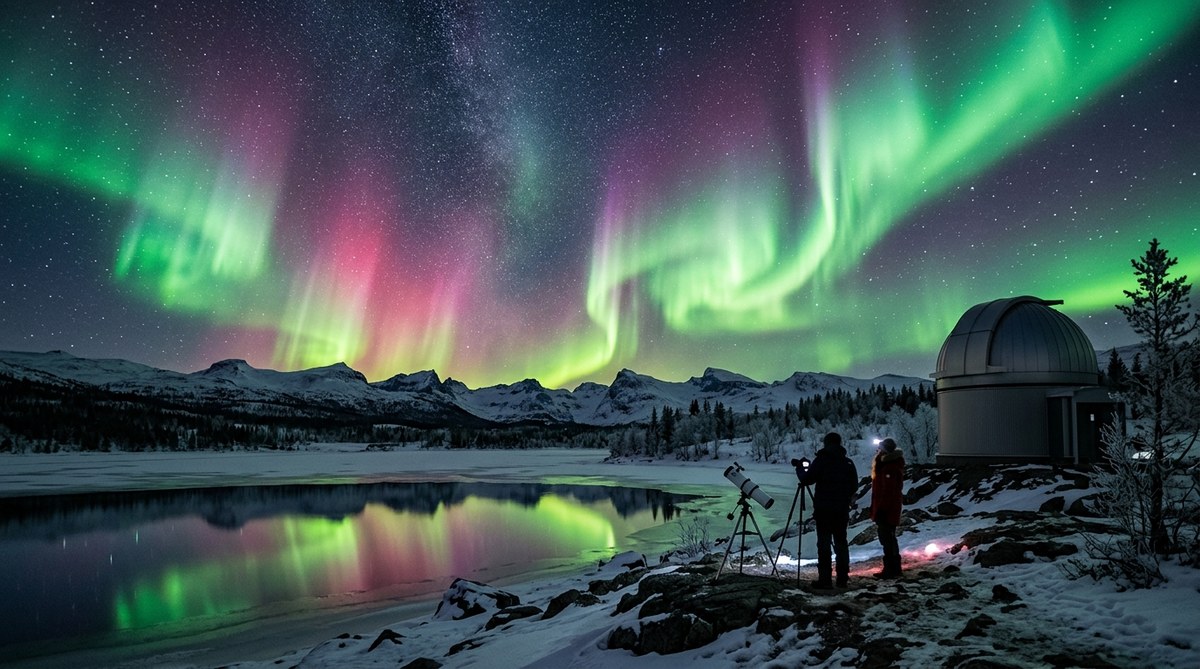
The night sky flickers with green curtains of light. Ribbons of red and purple twist above snowy landscapes. That is the aurora borealis, one of nature’s most spectacular shows. But what causes the northern lights? The answer lies 93 million miles away, on the surface of the Sun.
The Northern Lights happen when charged particles from the Sun collide with gases in Earth’s upper atmosphere. These particles are carried by the solar wind and guided toward the poles by our planet’s magnetic field. The color of the aurora depends on the type of gas and the altitude of the collision. Green is most common, but red, purple, and blue also appear.
It All Starts with the Sun
Every second, the Sun blasts millions of tons of charged particles into space. This stream is called the solar wind. Most of it travels harmlessly past Earth. But sometimes, a solar flare or a coronal mass ejection sends a concentrated burst of particles our way. That is when things get interesting.
Earth is protected by a magnetic field, invisible but powerful. It acts like a shield. The field deflects most of the solar wind. But near the North and South Poles, the magnetic field lines dip down toward the planet. That allows some particles to slip through and enter the upper atmosphere.
A Step by Step Breakdown of How Auroras Form
Let’s walk through the entire process from start to finish. Here is the sequence in order:
- The Sun releases energetic particles during solar storms or steady solar wind.
- These particles travel through space at speeds up to 1 million miles per hour.
- When they reach Earth, our magnetosphere steers them toward the polar regions.
- The particles collide with atoms and molecules of oxygen and nitrogen in the atmosphere.
- The collisions transfer energy, exciting the gas atoms.
- The excited atoms release that energy as visible light, creating the aurora.
This whole chain can take anywhere from one to three days, depending on how fast the particles are moving. The stronger the solar storm, the brighter and more widespread the aurora.
Why Do the Lights Have Different Colors?
The color of an aurora depends on two things: which gas is hit and how high up the collision happens. Oxygen and nitrogen are the main players. Here is a breakdown of what creates each color:
| Color | Gas | Altitude | Why It Happens |
|---|---|---|---|
| Green | Oxygen | 60 to 150 miles | Most common. Oxygen atoms at lower altitudes produce green light when they calm down after being hit. |
| Red | Oxygen | Above 150 miles | Rare. At higher altitudes, the air is thinner, so oxygen stays excited longer and emits red light. |
| Blue / Purple | Nitrogen | Below 60 miles | Nitrogen molecules produce blue and violet. These colors often appear at the bottom edge of a strong aurora. |
| Pink | Nitrogen | Mixed altitudes | A mix of red and blue from nitrogen, sometimes seen as pink fringes. |
The green aurora is the easiest to see with the naked eye. Red requires very strong solar activity. Blue and purple are often visible in photos but harder to detect without a camera.
What About the Southern Lights?
The same process happens near the South Pole. It is called the aurora australis. The science is identical. The only difference is location. If you live in the southern hemisphere, you can see the southern lights in places like Tasmania, New Zealand, and Antarctica. Both auroras occur at the same time, mirroring each other.
Common Myths and Expert Advice
People have told stories about the northern lights for centuries. Some thought they were spirits dancing in the sky. Others believed they predicted war or good fortune. But the science is clear.
“The aurora is not a rare event. It happens every day somewhere on Earth. The key is being in the right place at the right time, under a dark sky.”
* Dr. Sarah Mitchell, space physicist at the University of Alaska Fairbanks
One common mistake is thinking the aurora only appears in winter. In fact, the lights are always happening. But you need darkness to see them. That is why winter months near the Arctic Circle are best. The long nights give you more viewing hours.
Another myth is that you need expensive gear to enjoy the aurora. A good pair of eyes, warm clothes, and patience are enough. A camera can capture colors your eyes might miss, but the experience is unforgettable either way.
How to See the Northern Lights in 2026
If you want to see the aurora this year, here are the most important things to know:
- Choose the right season: September through March is prime time in the northern hemisphere.
- Get away from city lights. Light pollution hides all but the strongest displays.
- Check the aurora forecast. Look for a Kp index of 4 or higher. Many free apps and websites provide real time predictions.
- Be patient. Auroras can appear and disappear within minutes. Plan to stay outside for at least an hour.
- Dress extremely warmly. You will be standing still in freezing temperatures. Layers are your best friend.
Top destinations in 2026 include Fairbanks, Alaska; Tromsø, Norway; Yellowknife, Canada; and Reykjavik, Iceland. All offer dark skies and reliable aurora activity.
If you are new to stargazing, it helps to understand what else you can see in the night sky. Our guide on Understanding the Night Sky covers the basics of planets, stars, and constellations. That knowledge will make your aurora trip even more rewarding.
From Sun to Sky: The Journey of a Solar Particle
We have covered the main ideas, but let’s zoom in on one particle’s journey. Picture a proton leaving the Sun during a solar flare. It rides the solar wind for 18 to 36 hours. It crosses the gap between Sun and Earth. As it nears our planet, Earth’s magnetic field catches it like a funnel. The particle spirals down along a field line toward the North Pole. At 100 miles up, it slams into an oxygen atom. The atom absorbs the energy and then releases it as a photon of green light. That photon travels the last 100 miles to your eye in a fraction of a second. You see a single point of green in the aurora.
Multiply that by billions of particles and billions of collisions, and you get the full display.
Scientists can now predict aurora activity with surprising accuracy. In 2026, we are in the middle of Solar Cycle 25. Solar maximum is expected to peak around 2025, so 2026 still offers excellent chances for strong displays. If you miss it this year, the activity remains high for a few more years before fading.
Equipment, Guides, and Getting Started
You do not need a telescope to see the aurora. But if you want to photograph it, a camera with manual settings is helpful. A tripod is essential. Set a wide aperture and a shutter speed of 5 to 15 seconds. Use a high ISO, but not so high that the image gets noisy. Practice before you go.
If you are interested in learning more about night sky observation, our guide on How to Start Your Night Sky Observation Journey walks you through the first steps. For those who want to identify stars and planets during aurora viewing, check out Mastering Astronomy Basics.
Avoid common mistakes like using autofocus at night. Set your lens to manual and focus on a distant star. Also, remember that the aurora moves, so adjust your composition on the fly.
Make Your Own Northern Lights Adventure
The northern lights are not magic. They are a beautiful result of our Sun and Earth working together. Once you understand the simple mechanics, the wonder only grows. You see the sky differently. Every green arc and red crown tells a story of particles traveling millions of miles.
If you feel ready to plan a trip, start by checking the aurora forecast for your chosen dates. Look at the moon phase as well. A new moon gives darker skies. Pack warm gear, bring a thermos of hot drink, and give yourself plenty of time. The aurora is not guaranteed, but the effort itself is part of the reward. When the sky does light up, you will know exactly why, and that knowledge makes the moment even more incredible.