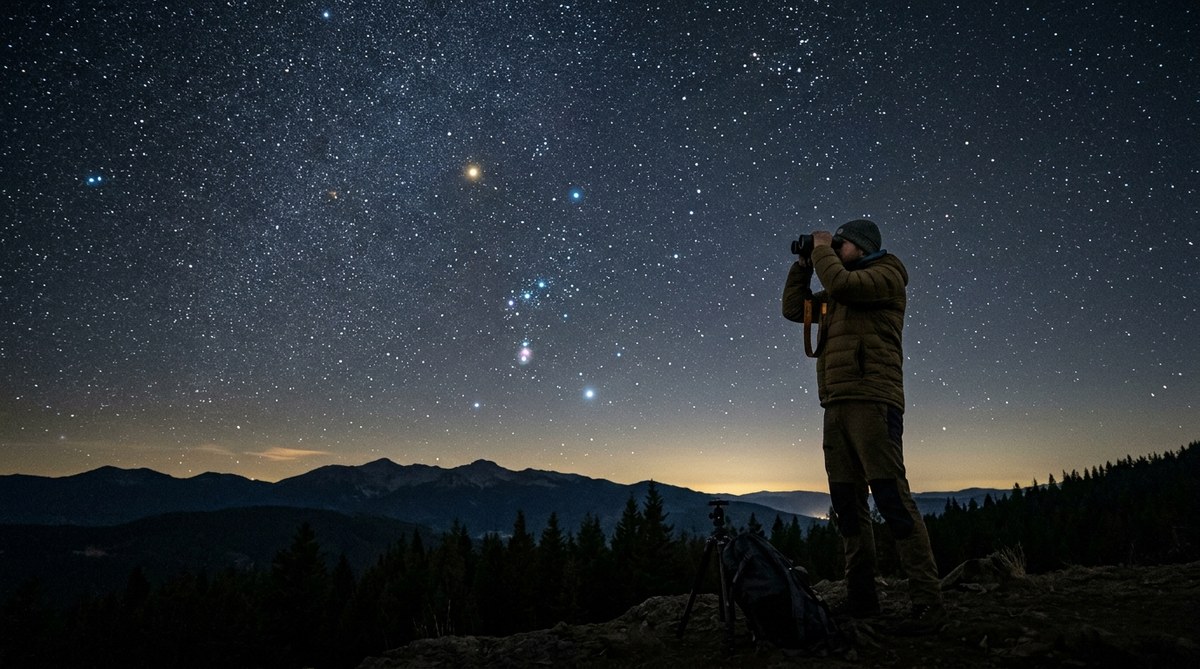
You do not need an expensive telescope to see one of the most stunning deep-sky objects in the universe. The Orion Nebula, a stellar nursery located 1,344 light-years away, is bright enough to catch with a simple pair of binoculars. In 2026, the viewing conditions are especially favorable. The Moon will cooperate during key winter weeks, and Orion sits high in the sky for most of North America. This guide will show you exactly how to see Orion Nebula with binoculars in 2026, starting with your naked eyes and using nothing more than a standard pair of 10x50s.
You can find the Orion Nebula with just your eyes and binoculars by using Orion’s Belt as a pointer. Look for the three stars in a row, then drop down to the middle “star” of the sword, which is actually the nebula. Best viewing in 2026 happens between December and February, during the new Moon phase, between 8 p.m. and midnight local time. A dark sky away from city lights makes all the difference.
Why the Orion Nebula Is Perfect for Binoculars
The Orion Nebula (cataloged as M42) is a diffuse nebula that glows at magnitude 4.0. That is bright enough to be visible to the unaided eye under a dark sky, but it looks like a fuzzy star. Binoculars transform that faint smudge into a distinct, glowing cloud with a heart of four bright stars called the Trapezium.
Many beginners assume they need a telescope to see nebulae. That is not true. The Orion Nebula is one of the few deep-sky objects that actually looks better in binoculars than in a small telescope. A telescope magnifies too much, making the nebula appear dim and hard to frame. Binoculars give you a wide field of view that shows the nebula surrounded by the stars of Orion’s sword. It is a beautiful sight.
If you are new to astronomy, start with a guide on understanding the night sky and astronomy fundamentals. It will help you build confidence before you head outside.
When to See the Orion Nebula in 2026
Timing matters more than equipment. Here are the key windows for 2026.
Best Months
Orion is a winter constellation for the Northern Hemisphere. It rises in the east around sunset from late November through February. In 2026, the optimal viewing window runs from December 1, 2026 through February 28, 2027. During this period, Orion is above the horizon by 8 p.m. local time and reaches its highest point (the zenith) around midnight.
Best Time of Night
The nebula is highest in the sky between 10 p.m. and 1 a.m. local time. When an object is high overhead, you look through less atmosphere. That means sharper views and less twinkling. Plan your session for that window.
Moon Phase
The Moon is your biggest enemy. A full Moon washes out the faint glow of the nebula. Target these new Moon dates in 2026:
- December 4, 2026
- January 2, 2027
- January 31, 2027
The three days before and after each new Moon are also good. The sky will be dark, and the nebula will pop.
Seasonal Note
If you miss the winter window, you can still see the Orion Nebula in early spring. It will be lower in the western sky after sunset. The view will be softer, but still possible with binoculars.
What You Need: Equipment That Works
You do not need fancy gear. Here is what works.
Your Eyes
Your eyes are the first tool. You need to find Orion’s Belt with your naked eyes before you can point binoculars at the nebula. Let your eyes adjust to the dark for at least 15 minutes. Do not look at your phone. Even one glance at a bright screen ruins your night vision for 20 minutes.
Binoculars
Any binoculars will show the Orion Nebula, but some work better than others. The standard recommendation is 10×50 binoculars. The “10” means 10x magnification. The “50” means 50mm objective lenses, which gather enough light to show the nebula clearly.
Here is a simple breakdown of what works:
| Binocular Type | Magnification | Light Gathering | Ease of Holding | Best For |
|---|---|---|---|---|
| 7×35 | Low | Moderate | Easy | Wide field, beginners |
| 8×42 | Medium | Good | Easy | All around, comfortable |
| 10×50 | High | Excellent | Moderate | Nebula detail, steady hands |
| 12×60 | High | Excellent | Hard | Tripod required, serious views |
If you already own a pair of binoculars, try them first. Even cheap 7x35s will show the nebula as a fuzzy patch. Do not buy new gear until you know you enjoy the hobby. If you are shopping for your first telescope, check out our guide to choosing a beginner telescope.
A Star Chart or App
You need a way to confirm what you are seeing. A printed star chart works, but a smartphone app is easier. Use an app with a red-light mode to protect your night vision. Good options include SkySafari, Stellarium, or the free NASA app.
How to Find the Orion Nebula: Step by Step
Follow these steps exactly. Do not skip ahead.
Step 1: Find Orion’s Belt
Go outside on a clear night. Face south (if you are in the Northern Hemisphere). Look for three bright stars in a straight line. They are close together and equally spaced. That is Orion’s Belt. The three stars are Alnitak, Alnilam, and Mintaka.
If you cannot find Orion, look for the brightest star in the winter sky. That is Sirius, which sits below and to the left of Orion. Trace upward from Sirius and you will find the Belt.
Step 2: Locate the Sword
Below Orion’s Belt (toward the south) hangs a line of three faint stars. That is Orion’s Sword. You need dark skies to see all three with your naked eyes. The middle “star” of the sword is not a star at all. It is the Orion Nebula.
If you live in a city, you may only see two stars in the sword. The middle one will look slightly fuzzy. That fuzziness is the nebula.
Step 3: Point Your Binoculars
Keep your eyes on the middle sword star. Slowly raise your binoculars to your eyes while keeping that spot centered. Do not look through the binoculars first and then search. That is a common mistake. Find it with your eyes, then bring the binoculars up.
Once you have the nebula in view, adjust the focus wheel until the edges of the stars look sharp. The nebula itself will look like a soft gray cloud with a brighter center.
Step 4: Identify the Trapezium
With steady binoculars (10×50 or higher), you should see four tiny stars packed together inside the nebula. Those are the Trapezium cluster. They are young, hot stars that make the surrounding gas glow. Seeing them with binoculars is a thrill.
If you cannot see four stars, do not worry. The Trapezium is small. Even a slight wobble in your hands will blur them into a single blob. Rest your elbows on a table or lean against a wall to steady yourself.
Common Mistakes and How to Fix Them
Even experienced stargazers make errors. Here are the most common problems and their solutions.
| Mistake | Why It Happens | How to Fix It |
|---|---|---|
| Cannot find the sword | Light pollution or bright Moon | Wait for new Moon, drive to darker location |
| Nebula looks like a faint star | Binoculars are out of focus | Turn the focus wheel slowly until stars are sharp |
| Nebula is not visible at all | Wrong time of year or too early | Wait until 10 p.m. local time in January |
| Hands shake too much | High magnification without support | Use a tripod or brace against a wall |
| Eyes hurt after 5 minutes | Looking at phone screen before session | Wait 20 minutes in darkness before starting |
Tips for a Better View
These small adjustments make a big difference.
Let Your Eyes Adapt
Dark adaptation is not optional. Your eyes need 20 to 30 minutes to reach full sensitivity. Once you are dark adapted, do not turn on any white lights. Use a red flashlight or your phone in red mode.
Use averted vision
Look slightly to the side of the nebula. The edges of your retina are more sensitive to faint light. You will see more detail in the nebula’s glow. This technique is called averted vision. It works for many deep-sky objects.
Dress for the weather
Winter stargazing is cold. Wear layers, gloves, and a hat. If you are uncomfortable, you will rush and miss the target. Bring a thermos of hot coffee or tea. Make it a relaxing ritual.
“The Orion Nebula is one of the few deep-sky objects that looks better in binoculars than in a telescope. You get the full context of the sword and the surrounding stars. It is a rewarding target for any beginner.” — Thrush Observatory field notes
Use a tripod
If your binoculars have a tripod adapter, use it. A tripod eliminates shaking and lets you see the Trapezium clearly. Even a cheap camera tripod works. If you do not have an adapter, rest the binoculars on a car roof, fence post, or a rolled-up jacket.
What You Will Actually See
Set your expectations correctly. You will not see the colorful photos from the Hubble Space Telescope. Those images are long exposures processed in false color.
Through binoculars, the Orion Nebula looks like a soft, grayish-green cloud. The color is subtle, but some people see a faint greenish tint. The center is brighter, and the edges fade into the black sky. The four Trapezium stars look like tiny diamonds embedded in the glow.
That is exactly what you should see. It is beautiful in its own way. The first time you realize you are looking at a cloud of gas where new stars are being born, it changes how you see the night sky.
What If You Still Cannot Find It?
Some nights nothing works. The sky is hazy. The Moon is too bright. Your neighbor leaves their porch light on. Do not get frustrated.
Try these backup strategies:
- Use a pair of 7×50 binoculars for a wider field. They are more forgiving of shaky hands.
- Drive to a nearby park or rural area. Even 20 miles outside a city can dramatically improve the view. Learn more about choosing a good observatory site.
- Use a smartphone app with a “push to” feature. Some apps let you hold the phone up to the sky and show exactly where the nebula is relative to your position.
- Practice on easier targets first. Find the Andromeda Galaxy with your bare eyes before tackling the nebula. It builds the same skills.
Your 2026 Orion Nebula Checklist
Print this or save it on your phone.
- Check the Moon phase. Aim for new Moon on December 4 or January 2.
- Check the weather. Clear skies with no haze or clouds.
- Dress warmly. Hat, gloves, boots, layers.
- Go outside after 8 p.m. local time.
- Wait 15 minutes for your eyes to adjust.
- Find Orion’s Belt. It is three stars in a row.
- Look below the belt for the sword. Find the middle fuzzy star.
- Point your binoculars at that spot.
- Focus until sharp. Look for the Trapezium.
- Use averted vision to see more detail.
Making It a Regular Habit
The Orion Nebula is not a one-time target. It changes slightly from year to year as new stars form and gas shifts. Come back to it each winter. Compare what you see with your binoculars to what you saw the year before.
If you enjoy this experience, consider building a stargazing routine that fits your life. Even 15 minutes a week under the stars builds skill and confidence. You will start noticing things you never saw before: the subtle colors of stars, the movement of planets, the slow drift of the Milky Way.
Your First Viewing Session
The hardest part is the first time. You might feel unsure. You might worry you are pointing at the wrong spot. That is normal. Every astronomer started exactly where you are now.
Tonight, step outside. Look up. Find the three stars of Orion’s Belt. Let your eyes rest. Then bring your binoculars up and look at the middle star of the sword. That faint, fuzzy glow is a cloud of gas and dust where new suns are being born. You are seeing it with your own eyes, in real time, from your backyard.
That is the magic of amateur astronomy. No telescope required. Just your eyes, a pair of binoculars, and the willingness to look.