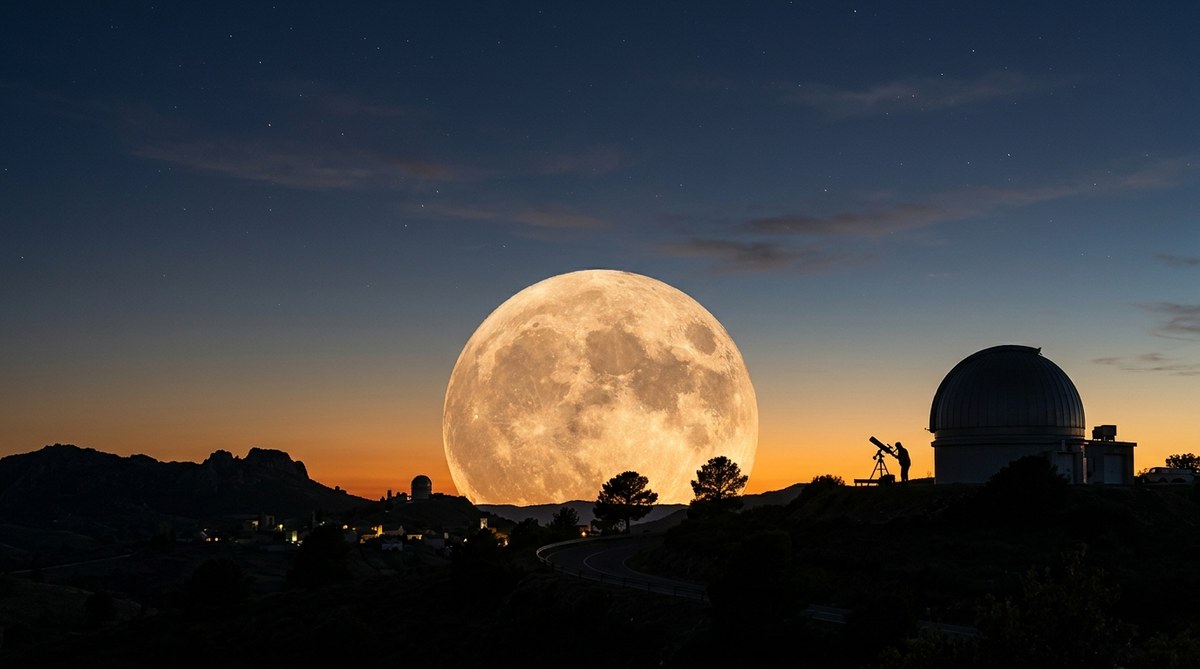
You step outside on a clear evening and catch the full moon rising just above the treeline. It looks enormous. It feels close enough to touch. An hour later, that same moon hangs high overhead and seems smaller, almost ordinary. Your eyes are not tricking you in the way you think. The moon itself stays the same size. The real show happens inside your brain.
The moon illusion is a perceptual trick, not a physical change. Your brain compares the moon to familiar objects on the horizon, making it appear larger. Atmospheric effects like the flattened disk and reddish color add to the drama. You can prove the illusion yourself with simple tools like a ruler or a camera.
What Is the Moon Illusion?
The moon illusion is the name for the visual effect where the moon looks larger near the horizon than it does when it is higher in the sky. People have noticed this for thousands of years. Ancient Greek philosophers wrote about it. Artists painted it. And yet, the moon does not change its actual diameter. It is always about 2,160 miles across, whether it sits on the horizon or at zenith.
The effect is entirely psychological. Your brain processes the same visual information differently depending on the context around the moon.
The Two Leading Theories
Scientists have debated the cause of the moon illusion for centuries. Two main explanations have survived repeated testing.
The Ponzo Illusion and Relative Size
The leading explanation involves a visual trick called the Ponzo illusion. You have seen this before. Think of railroad tracks. The rails appear to converge in the distance. Your brain knows they are parallel, so it interprets the converging lines as depth. When an object sits at the far end of those tracks, your brain thinks it must be larger to appear that wide.
The horizon works the same way. Trees, buildings, and hills provide distance cues. Your brain sees the moon behind those objects and unconsciously scales it up. High in the sky, there are no reference points. The moon floats in an empty field, so your brain treats it as smaller.
The Flattened Sky Dome
A second theory focuses on how you perceive the shape of the sky. Most people imagine the sky as a flattened dome, not a perfect hemisphere. The horizon feels farther away than the point directly overhead. When your brain projects the moon onto that dome, it assumes the horizon moon is farther away. To maintain the same angular size, your brain concludes the moon must be physically larger.
Both theories may work together. Most researchers agree that the moon illusion is a combination of these perceptual mechanisms.
How to Test the Moon Illusion Yourself
You do not need a telescope or any special equipment to prove the illusion is real. Try these three methods the next time you see a big moon on the horizon.
-
Use a small object as a reference. Hold a pencil eraser or a pea at arm’s length next to the horizon moon. Mark the apparent size. Wait two or three hours until the moon is higher, then hold the same object at the same distance. You will see the moon covers the same amount of the object. The moon did not shrink.
-
Take a photograph. Use a camera with a fixed zoom lens. Photograph the moon near the horizon. Photograph it again when it is high overhead. Compare the two images. The moon’s diameter in pixels will be identical.
-
Use a homemade ruler. Cut a small notch in a piece of cardboard. Hold it at arm’s length and slide it until the notch just covers the horizon moon. Measure the distance from your eye to the cardboard. Repeat the process when the moon is overhead. The ratio of notch size to distance will be the same.
Common Misconceptions About the Moon Illusion
Many people believe the atmosphere acts like a magnifying lens. That is not true. The atmosphere does bend light, but it compresses the moon’s image vertically near the horizon. That is why the moon sometimes looks flattened, like an oval. It does not make the moon appear larger.
Another myth is that a supermoon explains the effect. A supermoon occurs when the moon is at perigee, the closest point in its orbit. It can appear about 14 percent larger than a micromoon. But that small difference cannot account for the dramatic change you see from horizon to zenith. The moon illusion makes the moon look two to three times larger.
| What People Think | What Actually Happens |
|---|---|
| The atmosphere magnifies the moon | The atmosphere compresses the moon vertically |
| A supermoon causes the big look | A supermoon adds only 14% size, not 200% |
| The moon physically moves closer | The moon’s distance changes only slightly during a night |
| Cameras show the size difference | Photos prove the angular size stays constant |
Why the Moon Looks Orange or Red on the Horizon
You have probably noticed that the horizon moon often glows orange or deep red. That is a separate effect called atmospheric scattering. When the moon sits low, its light travels through more air. Shorter wavelengths like blue and green scatter away. Longer wavelengths like red and orange pass through. That is the same reason sunsets look red.
The warm color adds to the dramatic appearance. A bright orange moon sitting behind a distant tree line looks even more impressive. But the color has nothing to do with the size illusion. It just makes the whole scene more memorable.
“The moon illusion is one of the oldest known optical illusions in human history. Aristotle wrote about it in the fourth century BCE. It remains a favorite topic for psychologists and astronomers because it is so easy to observe and so hard to explain away.” – Dr. Helen Ross, visual perception researcher
What the Moon Illusion Teaches Us About Vision
The moon illusion reminds you that your eyes are not cameras. Your brain actively constructs what you see. It uses shortcuts and assumptions to make sense of the world. Most of the time, those assumptions help you. They let you judge distance and size automatically. But sometimes they produce a beautiful error.
Understanding this illusion can improve your overall stargazing. When you know that your brain is playing tricks, you can appreciate the view without being confused by it. The next time you see a massive moon rising over a city skyline, you can enjoy the spectacle and smile at the cleverness of your own mind.
How to Photograph the Moon Illusion
If you want to capture the illusion in a photo, you need to include foreground elements. A moon alone in the sky looks small in any photograph. To recreate the illusion for your viewers, frame the moon behind a tree, a mountain, or a building.
Here are a few tips for a successful shot.
- Use a telephoto lens of at least 200mm. A longer focal length makes the moon appear larger relative to the foreground.
- Shoot when the moon is low. You have a narrow window of about 15 to 20 minutes after moonrise.
- Use a tripod. The low light at dusk requires a steady camera.
- Include a recognizable object. A lighthouse, a barn, or a silo gives the viewer a sense of scale.
For more help getting started with night sky photography, check out our guide on how to use your smartphone for night sky astronomy.
Why the Moon Illusion Matters for Amateur Astronomers
If you are new to astronomy, the moon illusion can cause real confusion. You might think your telescope is showing a different moon than what you saw with your naked eye. That is not the case. The telescope reveals the same angular size regardless of the moon’s position.
When you plan a night of lunar observation, remember that the best time to look at the moon through a telescope is not when it is on the horizon. The atmosphere is thicker near the horizon. It blurs details. Wait until the moon is at least 30 degrees above the horizon for a crisp view. That is about the height of three fists stacked at arm’s length.
For more advice on getting the best views, read our guide on choosing the perfect telescope for beginners exploring the night sky.
The Moon Illusion in History and Culture
Ancient cultures around the world noticed the moon illusion. They created myths to explain it. In some Native American traditions, the moon was said to swell with emotion as it rose. In Norse mythology, the moon was chased by wolves, and its changing size reflected the chase.
The Greek astronomer Ptolemy tried to explain the illusion using atmospheric refraction. He was wrong, but his idea persisted for nearly 1,500 years. It was not until the 20th century that psychologists began to study the illusion systematically.
A Simple Experiment You Can Do Tonight
You can prove the moon illusion to yourself in under five minutes. Find a friend. Stand a few feet apart. Have your friend hold a quarter at arm’s length next to the rising moon. Make sure the quarter is at the same distance from your eye as from your friend’s eye. Compare the size of the quarter to the moon. Now wait two hours and repeat the test. The quarter will cover the same portion of the moon both times.
This works because the quarter’s distance and the moon’s angular size stay constant. The only thing that changes is your perception.
For more ways to enjoy the night sky, see our list of 10 night sky phenomena you can see without a telescope in 2026.
Seeing the Moon with Fresh Eyes
The moon illusion is a perfect example of how science and wonder can live together. You now know the moon does not actually grow. You know your brain is constructing a larger image based on visual cues. But that knowledge does not ruin the view. If anything, it deepens it.
The next time you see a huge moon rising over a field or a city, stop and look. Notice the orange glow. Notice the way it sits behind the trees. Notice how your own mind makes it feel larger than life. That moment of awareness is the real magic. The universe is beautiful, and so is the way we see it.