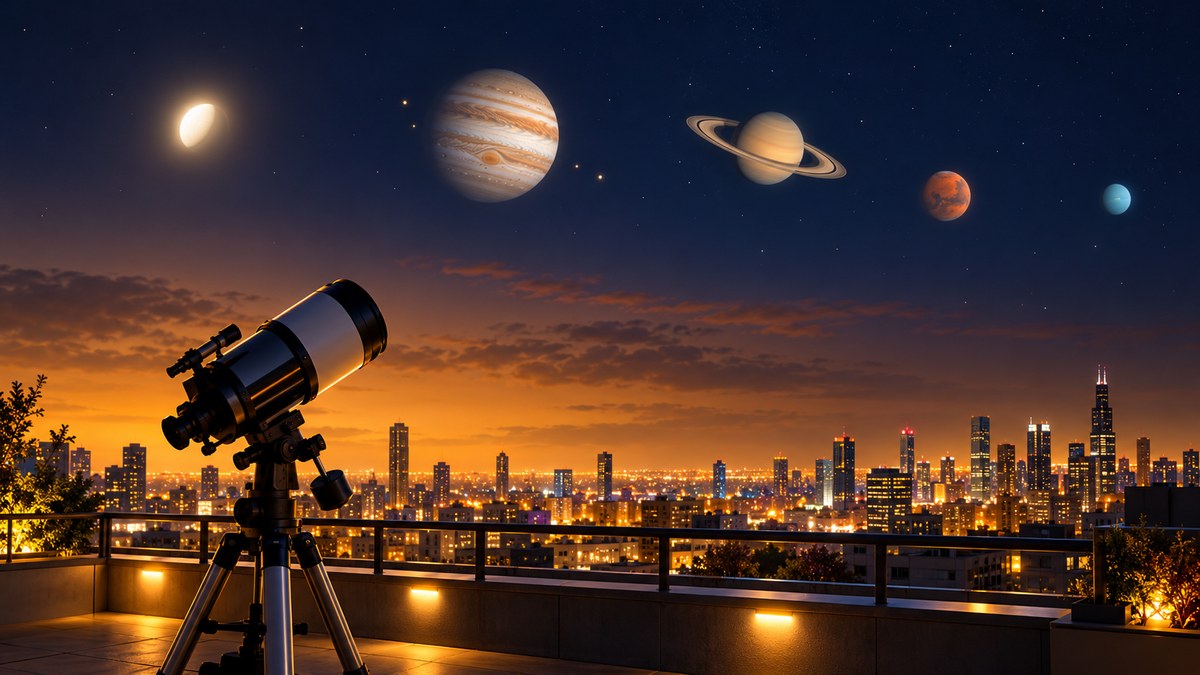
Most amateur astronomers treat light pollution like a curse. We drive hours to find Bortle 1 skies, avoid full moons, and curse the glow of city streetlights. But here is a twist that might change the way you think about your backyard: light pollution can actually make certain planets look better. It sounds backward, but it is true. The same skyglow that drowns out faint galaxies can boost the contrast and sharpness of bright planets like Jupiter, Saturn, and Mars. If you have a telescope in a suburban backyard, you might be in a better position for planet viewing than someone at a remote dark-sky site.
Light pollution does not ruin planetary observation the way it ruins deep-sky imaging. City glow reduces the contrast of faint stars and nebulae, but planets are bright enough to punch through artificial skyglow. In fact, the steady atmospheric conditions often found in urban heat islands can give you sharper, more stable views of Jupiter’s bands, Saturn’s rings, and Mars’ polar caps. Light pollution planets view can be surprisingly good.
Why Bright Planets Beat the Glow
Planets are not faint. Venus, Jupiter, and Mars rank among the brightest objects in the night sky. Their surface brightness is high enough that artificial skyglow does not wash them out the way it washes out a galaxy or nebula. When you look at the Orion Nebula from a city, the background sky is so bright that the nebula’s faint glow disappears. But when you point a telescope at Jupiter, the planet itself is still hundreds of times brighter than the sky around it.
That contrast is the key. Light pollution raises the brightness of the sky background, but it does not dim the planet. The result is a higher relative contrast between the planet and its immediate surroundings. Your eye and camera sensor both benefit from this. You see more detail on the planet’s disk because the background is not competing with it.
The Urban Heat Advantage
Cities are warmer than the countryside. This is called the urban heat island effect. Warm air is less dense, and it creates a more stable boundary layer near the ground. Stable air means less turbulence. Less turbulence means sharper views through a telescope.
At a dark-sky site far from town, the ground cools rapidly after sunset. That cooling creates temperature gradients that cause the air to shimmer. Those shimmering pockets of air make stars twinkle and planets look wobbly. In the city, the pavement and buildings hold heat longer, smoothing out those gradients. The result is steadier seeing.
Steady seeing is the single most important factor for high-magnification planetary observation. You can have a perfect dark sky, but if the air is boiling, you will never see the fine details on Jupiter. A light-polluted sky with calm air will show you Cassini’s division in Saturn’s rings and the Great Red Spot with clarity.
How to Make the Most of Light Pollution for Planets
You do not need a dark-sky site to get great planetary views. You need to work with the conditions you have. Here is a practical process to maximize your light pollution planets view.
- Check the seeing forecast before you go out. Use an astronomy app or website that gives a seeing rating out of 5. If the rating is 3 or higher, you are in good shape even under a bright sky.
- Let your telescope cool down. Set it outside for at least 30 minutes before you observe. A warm telescope in cool air creates its own turbulence. This step matters more in the city because the temperature difference between indoors and outdoors can be large.
- Use a planetary filter. A light pollution filter like a broadband “skyglow” filter can darken the background slightly without dimming the planet. Even a simple yellow or orange filter improves contrast on Jupiter and Mars.
- Observe at the right time. Planets are highest in the sky around midnight during their opposition seasons. Higher altitude means less atmosphere to look through, which means less blurring.
- Wait for a night with high humidity or haze. This sounds wrong, but a thin layer of haze can actually stabilize the air. It reduces the contrast of the skyglow and smooths out thermal currents.
Common Mistakes and How to Fix Them
Many amateur astronomers make the same errors when observing planets from light-polluted locations. Here is a table of the most common mistakes and the corrections.
| Mistake | Why It Hurts | The Fix |
|---|---|---|
| Observing right after sunset | The ground is still radiating heat, causing turbulence. | Wait until at least two hours after sunset. |
| Using too much magnification | High power magnifies atmospheric blur. | Stay at 150x to 200x for most nights. |
| Ignoring collimation | A misaligned telescope cannot deliver sharp images. | Check collimation before every session. |
| Observing over a roof or pavement | Heat rising from these surfaces ruins seeing. | Set up on grass or a lawn. |
| Not using a dew shield | Dew on the lens or corrector plate scatters light and reduces contrast. | Always use a dew shield or a heated dew strap. |
When Light Pollution Helps More Than Hurts
There are specific situations where a light-polluted sky actually outperforms a dark one for planet viewing. These scenarios are not rare. They happen more often than you might think.
- When the moon is full. A full moon is the worst kind of light pollution for deep-sky objects. But for planets, a bright moon does not matter much. In fact, the moon’s glow can make the sky background more uniform, which helps your eye adjust to a single brightness level.
- When you are using a camera for planetary imaging. Planetary cameras work by capturing video and stacking the best frames. A brighter sky background means shorter exposure times. Shorter exposures freeze the atmospheric turbulence better. You end up with a higher percentage of sharp frames.
- When you are observing from a balcony or rooftop. These locations are often above the worst of the ground-level heat haze. Combined with urban warmth, you can get exceptionally steady air at 20 or 30 feet up.
“I have seen more detail on Jupiter from my backyard in downtown Austin than I ever did from a remote site in West Texas. The key is not darkness. It is stability.” — John C., veteran amateur astronomer and contributor to the Austin Astronomical Society
The Best Filters for Urban Planet Viewing
If you are stuck under city lights, a few simple accessories can transform your view. Here is a bulleted list of the most effective filters and tools.
- Neutral density filter. Reduces overall brightness without changing color. Helps with Venus and Jupiter.
- Wratten #8 (light yellow). Boosts contrast on Jupiter’s equatorial bands.
- Wratten #25 (red). Excellent for Mars. Darkens the blue-green surface features and makes the polar caps pop.
- Wratten #80A (blue). Enhances contrast on Saturn’s rings and cloud bands.
- Baader Contrast Booster. A premium filter that works well on all planets in light-polluted skies.
- Variable polarizing filter. Lets you dial in the exact amount of darkening you need.
For a deeper look at how to identify planets and stars in any sky condition, check out our guide on mastering astronomy basics. It covers the fundamental skills that every observer needs, whether you are under dark skies or city lights.
How to Plan Your Session Around Light Pollution
You cannot control the streetlights in your neighborhood. But you can control when and how you observe. Here is a numbered list of steps to plan a successful urban planet-viewing session.
- Check the weather and seeing forecast. Aim for nights with high pressure and light wind. Wind stirs up the air and ruins steadiness.
- Choose a planet that is near opposition. Opposition means the planet is closest to Earth and at its brightest. Jupiter, Saturn, and Mars all reach opposition every year or two.
- Set up your telescope early. Give it time to acclimate. If you have a reflector, make sure the mirror is clean. Dust scatters light and reduces contrast.
- Start with low power. Find the planet and center it. Then increase magnification slowly. Stop when the image starts to soften.
- Take breaks. Your eyes will fatigue after a few minutes of intense staring. Look away, let your eyes relax, then come back. You will see more.
The Surprising Role of Light Pollution in Training Your Eye
There is another benefit to observing planets from a light-polluted location that does not get talked about enough. It trains your eye to see detail under difficult conditions. When the sky background is bright, you have to work harder to pick out subtle features. That effort builds skill.
Observers who learn under bright skies often become better at detecting low-contrast details than those who start under pristine dark skies. They learn to use averted vision, to wait for moments of perfect seeing, and to trust what their eye is telling them. These skills transfer directly to dark-sky observing. You become a more patient and perceptive astronomer.
If you are just starting out, consider reading our beginner’s guide to astronomy fundamentals. It walks you through the basics of what you can expect to see from different sky conditions.
Putting It All Together
Light pollution is not your enemy for planetary observation. It is a different set of conditions that requires a different approach. The next time someone tells you that you need a dark sky to see planets, you can politely disagree. You have the tools, the knowledge, and the techniques to get stunning views from your own backyard.
Set up your telescope. Let it cool. Put on a yellow filter. Wait for the air to settle. Then look at Jupiter and watch its bands rotate into view. You will see detail that surprises you. And you will realize that the sky above your city is not empty. It is full of planets waiting to be seen.
For more ways to adapt your observing routine to your local conditions, take a look at our article on how to adapt to light pollution. It covers additional strategies for getting the most out of your night sky, no matter where you live.