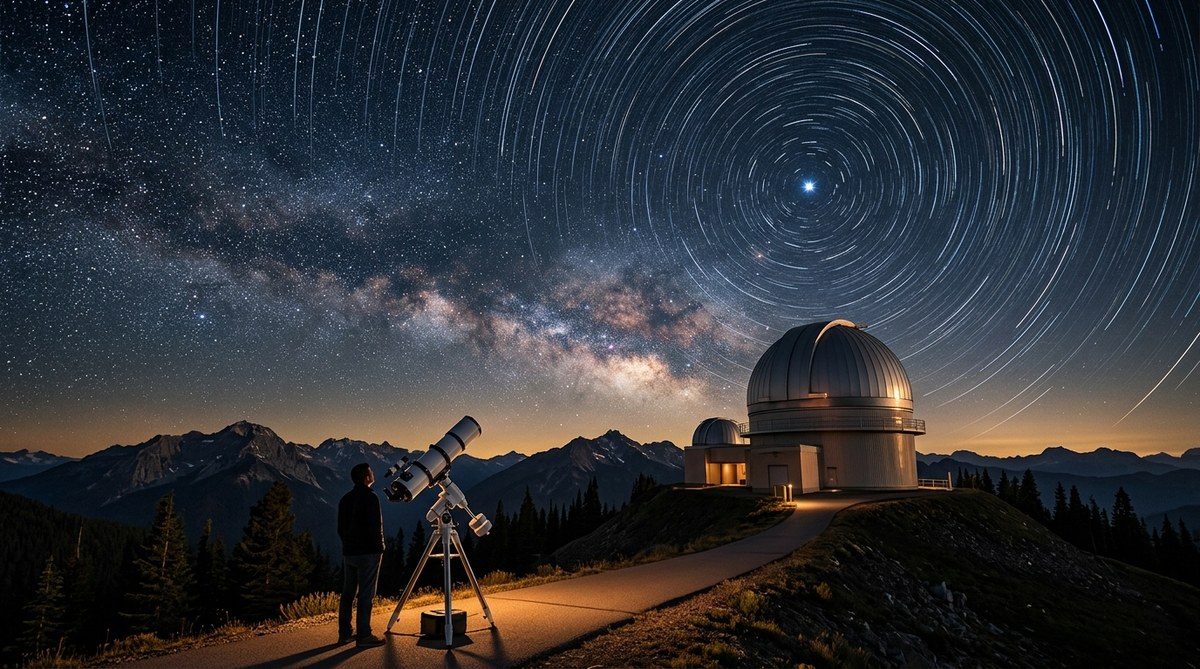
Look up on any clear night, and you will notice something right away. The stars are not frozen in place. Over the course of an hour, they shift. By morning, the entire scene has changed. This motion is one of the first things a new skywatcher notices, and it raises a natural question: Why do the stars seem to move? The answer is simpler than you might think, and once you understand it, the night sky starts to feel like a familiar, predictable friend rather than a confusing jumble of lights.
The stars appear to move because Earth is spinning. As our planet rotates eastward, the entire sky seems to drift westward, just like scenery passing by a car window. Over a single night, stars rise in the east and set in the west. Over months, different constellations become visible because Earth is also traveling around the Sun, changing our nighttime view of the universe.
The Great Spin: Earth’s Rotation
The most immediate reason for the motion you see tonight is that Earth is spinning. You cannot feel it, but our planet rotates once every 24 hours. This rotation happens from west to east. Imagine you are standing on a giant merry-go-round that turns toward the east. The stars are fixed in the distance, like lights on a faraway wall. As you spin east, the lights appear to move west across your field of view.
That is exactly what happens every night. Stars, planets, and the Moon all appear to rise in the eastern sky, climb to a high point, and then set in the west. The Sun does the same thing during the day. This daily motion is called diurnal motion. It is the most basic pattern in the sky, and it is caused entirely by our planet’s spin.
If you live in the United States, you can test this yourself. Find a spot with a clear view of the eastern horizon. Pick a bright star or planet low in the east. Check its position again two hours later. It will be higher in the sky. The same thing works for the western sky: a star near the horizon will sink out of sight as the night goes on.
Why Some Stars Never Set
Not every star rises and sets. If you look toward the north, you will notice a region of the sky that never dips below the horizon. These are called circumpolar stars. In the northern United States, the Big Dipper and Cassiopeia are good examples. They circle around the North Star, Polaris, like a clock hand moving around a center point.
Polaris sits almost directly above Earth’s north pole. As our planet spins, the stars near that pole trace small circles around it. Stars farther away trace larger arcs, eventually dipping below the horizon. The farther north you travel, the more stars become circumpolar. If you stood at the North Pole, every star you could see would circle around the zenith and never set.
This is why the North Star is so useful for navigation. It stays put while everything else moves. For a beginner, finding Polaris is a great first step. It gives you a fixed point to anchor your observations. You can learn more about this in our guide on why the North Star isn’t the brightest star in the sky.
The Slow Dance of the Seasons
If you watch the sky night after night for a few months, you will notice a slower change. The constellations visible in January are different from those visible in July. This happens because Earth is not just spinning. It is also orbiting the Sun.
Think of it like a train ride. You are on a train that travels around a circular track. Your window faces outward. As the train moves, the scenery outside your window changes. The same thing happens with the night sky. As Earth moves along its orbit, the Sun blocks out different parts of space during the day. The part of space that faces away from the Sun at night shifts gradually.
By the time spring turns to summer, you are looking at a completely different set of stars. This seasonal change is why Orion is a winter constellation and Scorpius is a summer one. You can see this shift clearly if you keep a simple star chart. Mark the position of a familiar constellation tonight, then check again three months later. It will be gone, replaced by a new set of stars. For more on this, check out our article on why the night sky changes with the seasons.
A Simple Way to Track Motion
You do not need a telescope to follow celestial motion. Your hands are the best tools you have. Here is a practical process to measure how fast the stars move.
- Find a bright star near the eastern horizon. Use a fixed landmark like a tree or telephone pole as a reference point.
- Hold your hand at arm’s length. Your fist covers about 10 degrees of sky. Your pinky finger covers about 1 degree.
- Note the star’s position relative to your landmark. Measure its height using your fist or fingers.
- Wait 15 minutes. Check the star again. It will have moved about 3.75 degrees upward. That is roughly the width of two fingers held at arm’s length.
- Repeat this every 15 minutes for an hour. You will see the star climb steadily.
This method works because Earth rotates 15 degrees per hour. That means any star near the celestial equator moves about 15 degrees across the sky in 60 minutes. It is a reliable way to get a feel for the pace of the sky.
What About Planets and the Moon?
Planets and the Moon follow the same general east-to-west path as the stars, but they have their own quirks. The Moon moves noticeably against the background stars. In just one hour, you can see it shift eastward by about half a degree. That is roughly the width of the full Moon itself.
Planets like Mars, Jupiter, and Saturn also drift. They travel along a path called the ecliptic, which is the same line the Sun follows. Over weeks and months, planets move slowly from one constellation to the next. Sometimes they appear to stop and reverse direction. This is called retrograde motion. It is an optical illusion caused by Earth overtaking another planet in its orbit.
For a beginner, the easiest planet to spot is Venus. It is very bright and stays close to the Sun. You can see it in the evening or morning sky. Jupiter and Saturn are also easy targets. They are bright and move slowly. Our guide on how to find planets in the night sky without a telescope can help you get started.
Common Misconceptions About Star Motion
Many beginners pick up a few wrong ideas from movies or casual conversations. Let us clear those up with a simple table.
| Misconception | Reality |
|---|---|
| The stars move because they are falling. | Stars are fixed in space relative to us. Their motion is caused by Earth’s rotation. |
| The North Star is the brightest star. | Polaris is actually modestly bright. It ranks 48th in brightness. |
| All stars rise and set. | Circumpolar stars near the poles never set. They circle the pole star. |
| Planets twinkle like stars. | Planets usually shine with a steady light. Stars twinkle due to atmospheric turbulence. |
| The sky looks the same every night. | The sky changes slowly over weeks and months due to Earth’s orbit. |
Understanding these facts will save you a lot of confusion. If you want to avoid other common pitfalls, read our list of 5 common mistakes new astronomers make and how to avoid them.
Tools to Help You See the Motion
You do not need expensive gear to enjoy celestial motion. Here are a few items that make a big difference.
- A simple star chart or planisphere. This rotating wheel shows you which stars are visible at any given time and date.
- A red flashlight. White light ruins your night vision. Red light lets you read charts without losing your dark adaptation.
- A notebook or app. Write down what you see. Note the time, date, and position of objects. Over weeks, you will see the patterns emerge.
- A pair of binoculars. Even cheap binoculars reveal more stars and show you the motion of Jupiter’s moons. Check out our advice on 7 essential skywatching tools you already have at home.
For those ready to step up their game, a beginner telescope opens a whole new world. But you do not need one to appreciate the basic motion of the sky. Your eyes are enough.
How to Observe Celestial Motion Tonight
You can start right now. Here is a bulleted list of steps to follow this evening.
- Go outside about an hour after sunset. Let your eyes adjust for 20 minutes.
- Face east. Note the first bright star you see above the horizon.
- Pick a landmark. A chimney, a streetlight, or a tall tree works well.
- Record the star’s position. Draw a quick sketch or take a photo with your phone.
- Come back outside two hours later. Look at the same spot in the east. That star will be higher up.
- Now look west. A star that was high in the sky earlier will be closer to the horizon.
- Repeat this for three nights in a row. You will see the entire sky shift slightly earlier each night.
This simple routine builds your intuition. Within a week, you will start to feel the rhythm of the sky. It becomes a habit. For more structured guidance, read our article on how to plan your first stargazing session in 2026.
Why the Stars Move: A Final Thought
The motion you see is not random. It is the direct result of living on a spinning planet that is racing around a star. Every time you look up, you are witnessing Earth’s rotation in real time. That is a powerful thing to feel.
“The stars are not moving. You are. The sensation of motion is the same as when you sit in a parked car and the car next to you rolls backward. Your brain interprets the relative motion as your own movement. With the sky, the opposite happens. You feel still, but you are not.”
Once you internalize this, the night sky becomes a clock, a calendar, and a compass all in one. You can tell time by the position of the stars. You can know the season by which constellations are overhead. You can find north by looking for Polaris. These are skills that connect you to the universe in a very real way.
From Beginner to Confident Skywatcher
You do not need to memorize every constellation or learn complex math. Start with the simple idea that Earth spins. Watch the stars rise and set. Notice how the sky changes from month to month. That is enough to build a solid foundation.
If you want to go deeper, there are plenty of resources here at Thrush Observatory. You can learn how to read the sky like a map without a telescope or discover 6 easy constellations to find tonight with just your eyes. Each small step makes the sky more familiar.
The stars have been moving in these same patterns for thousands of years. Ancient travelers used them to navigate. Farmers used them to know when to plant. Now you can use them to feel connected to something bigger. Step outside tonight, look up, and watch the sky do its slow, steady dance. You are part of it.