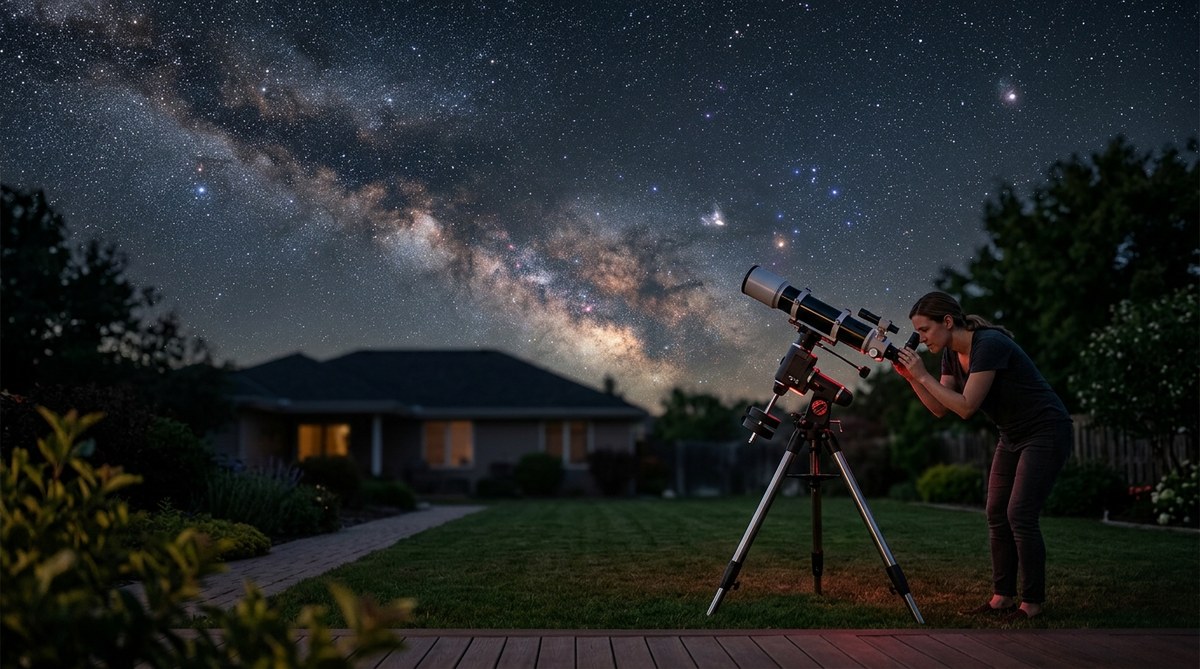
Step outside after sunset tonight and look up. The sky above your backyard is a live map of our solar system and the galaxy beyond. You do not need a degree in astrophysics or a thousand dollar telescope to read it. You just need to know where to look and what to expect. This guide shows you exactly what is visible tonight, how to find the brightest planets, and which stars are worth your time.
Tonight the sky offers a free show. Venus blazes low in the west after sunset, Jupiter rises in the east by late evening, and Saturn sits high in the south alongside the dim but lovely ring pattern of Aquarius. The Summer Triangle still hangs overhead, while Orion climbs in the east before dawn. No telescope needed. Just your eyes, a dark spot, and this guide.
Start with the Planets
Planets are the easiest objects to spot because they do not twinkle. Stars flicker due to atmospheric turbulence, but planets shine with a steady glow. Look for them along the ecliptic path, the same arc the Sun follows during the day.
Venus: The Evening Star
Venus is impossible to miss. It is the third brightest object in the sky after the Sun and the Moon. Tonight, catch it low in the west about 30 minutes after sunset. It looks like a brilliant white diamond. If you have a pair of binoculars, you can see its crescent phase, just like a tiny moon.
Jupiter: The Bright King of the Night
Jupiter rises in the east around 9 p.m. local time tonight. It is the brightest point of light in that part of the sky. Even with the naked eye, you can notice it outshines every star around it. With a small telescope or even steady binoculars, you will see its four largest moons lined up like tiny dots on either side.
Saturn: The Ringed Jewel
Saturn is higher in the south, sitting in the constellation Aquarius. It is not as bright as Jupiter, but it has a calm, yellowish glow. To see its rings, you need at least a small telescope at 25x magnification. Without one, just enjoy knowing you are looking at a planet with rings that span 170,000 miles across.
Mars: The Red Wanderer
Mars is visible in the early morning sky before dawn. It rises around 3 a.m. and sits near the bright star Pollux in Gemini. Mars has a distinct orange tint. If you have a telescope, you might spot the white polar cap at its north pole.
How to Find Constellations Tonight
Constellations shift with the seasons. In October 2026, the sky offers a mix of summer holdouts and winter arrivals.
- Face north and find the Big Dipper. It is low in the sky this time of year. Use its handle to arc to Arcturus, then speed to Spica, a trick known as “arc to Arcturus and spike to Spica.”
- Look overhead for the Summer Triangle. Three bright stars form a huge triangle: Vega, Deneb, and Altair. Vega is the brightest of the three and sits almost directly overhead.
- Turn to the east and spot the Great Square of Pegasus. It is a large square made of four stars. Use it as a guide to find the Andromeda Galaxy, which looks like a faint smudge just above the square.
- Check the south for Fomalhaut. It is the only bright star in that region and marks the mouth of the Southern Fish.
Expert tip: Start with the brightest stars first. Vega, Arcturus, and Capella are your anchor points. Once you lock onto them, the fainter patterns fall into place. Do not try to memorize all 88 constellations at once. Learn three per season and build from there.
The Moon Phases This Week
The Moon changes its position and brightness every night. This affects what else you can see. A full Moon washes out faint stars and the Milky Way. A new Moon gives you the darkest skies.
| Moon Phase This Week | Best For | What to Avoid |
|---|---|---|
| Waxing crescent (first few days) | Seeing earthshine on the dark side | Faint deep sky objects |
| First quarter (around Oct 9) | Crater detail along the terminator line | Late night planetary viewing |
| Waxing gibbous (Oct 10-16) | Bright planets near the Moon | Milky Way photography |
| Full Moon (Oct 17) | Moon itself through a telescope | Everything else |
Tonight the Moon is in its waxing gibbous phase. It will set after midnight, leaving the later part of the night darker for deep sky viewing.
What You Can See Without Any Equipment
You do not need a telescope to enjoy tonight’s sky. Here is a checklist of things visible with just your eyes:
- The Milky Way band. Look south after 10 p.m. in a dark location away from city lights. You will see a faint river of light crossing the sky.
- Satellites. About 20 to 30 minutes after sunset, watch for moving points of light. The International Space Station is one of the brightest. Check a satellite tracking app for exact times.
- Meteors. October brings the Orionid meteor shower, peaking around October 21. You might see 10 to 20 meteors per hour in the early morning.
- The Andromeda Galaxy. Under dark skies, it looks like a fuzzy star near the constellation Andromeda. It is 2.5 million light years away, the most distant object you can see with your naked eye.
Common Mistakes and How to Avoid Them
Many beginners give up after one frustrating night. Here are the most common errors and how to fix them.
| Mistake | Why It Happens | The Fix |
|---|---|---|
| Looking too early | Sky is still too bright | Wait at least 45 minutes after sunset |
| Using phone flashlight | Ruins night vision | Use a red light or cover your phone screen with red plastic |
| Expecting Hubble views | Unrealistic expectations | Start with naked eye, then binoculars, then a small telescope |
| Ignoring light pollution | City lights hide faint objects | Drive 20 minutes outside town or face away from streetlights |
If you want a deeper look at the fundamentals, our guide on mastering astronomy basics covers how to identify stars, planets, and constellations step by step.
How to Plan Your Stargazing Session
A little preparation makes the difference between a cold, confusing night and a rewarding one. Follow these steps before you go outside.
- Check the weather. Cloud cover is the biggest obstacle. Use a clear sky chart or a weather app with cloud cover data.
- Let your eyes adjust. It takes 20 to 30 minutes for your eyes to reach full dark adaptation. Avoid looking at white light during that time.
- Dress for the temperature. Nights in October can drop 20 degrees from the daytime high. Bring a jacket, hat, and gloves.
- Bring a star chart or app. A paper chart or a red light friendly app like Stellarium or SkySafari helps you identify objects in real time.
- Set a goal. Do not try to see everything. Pick three objects: a planet, a constellation, and one deep sky object.
For a full walkthrough on setting up your first session, read our guide on how to plan your first stargazing session in 2026.
What About Light Pollution?
If you live in a city or suburb, light pollution washes out the fainter parts of the sky. But you can still see plenty.
- Planets cut through light pollution. Venus, Jupiter, and Saturn are bright enough to see from downtown.
- The Moon is unaffected. Even in a bright city, the Moon looks spectacular.
- Use a narrowband filter. If you have a telescope, a light pollution filter helps bring out nebula and galaxy details.
- Find a local dark sky site. Many state parks and astronomy clubs host public viewing nights at darker locations.
Our article on is light pollution ruining your view offers practical ways to adapt without moving to the countryside.
Tools That Make It Easier
You already own the best tool: your eyes. But a few simple items improve the experience.
- Binoculars. A pair of 7×50 or 10×50 binoculars shows you dozens of star clusters, the moons of Jupiter, and the craters on the Moon.
- A red flashlight. Red light preserves night vision. You can buy one or tape red cellophane over a regular flashlight.
- A reclining lawn chair. Looking straight up for 20 minutes strains your neck. A chair lets you relax and enjoy the show.
- A star wheel or planisphere. This rotating paper chart shows you what is visible at any date and time.
For a full list of everyday items that help, check out 7 essential skywatching tools you already have at home.
Why Tonight Matters
Every night the sky tells a different story. Tonight you can watch Jupiter rise opposite the setting Sun. You can trace the Summer Triangle as it slowly sinks toward the horizon over the coming weeks. You can see a planet that has rings made of ice and rock, and a galaxy that holds a trillion stars. None of it requires a membership or a ticket. It is all there, waiting.
Step outside tonight. Give your eyes time to adjust. Look for Venus in the west, Jupiter in the east, and Saturn high above. Let the sky remind you that you are part of something much larger.