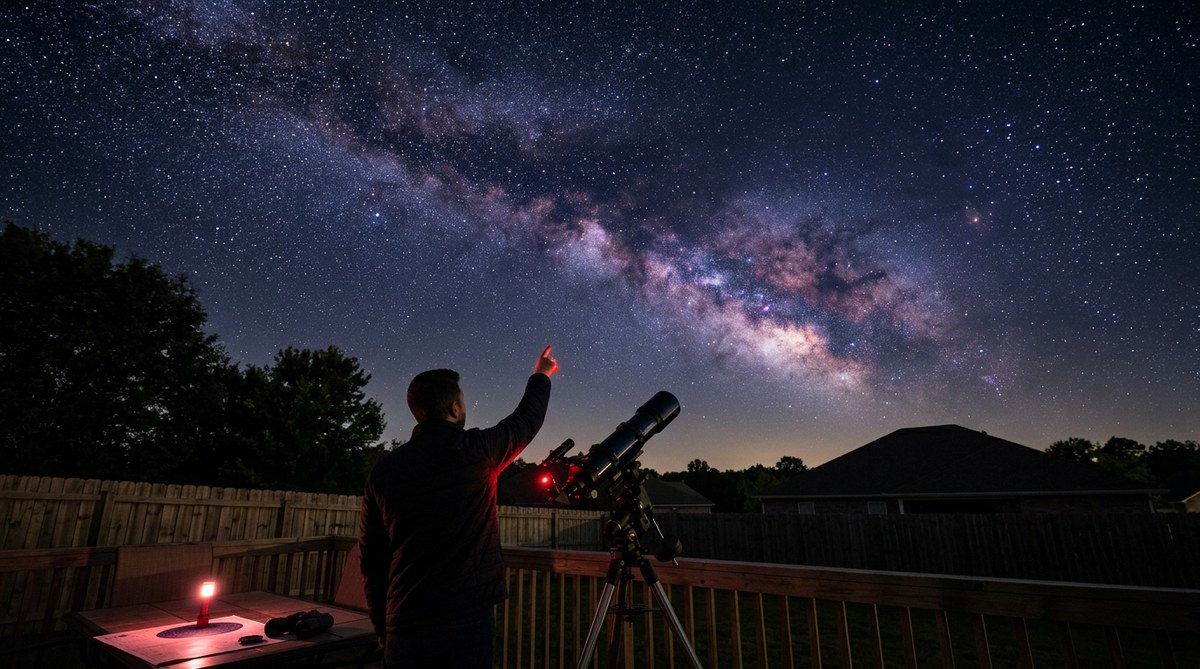
You do not need a dark sky park or a telescope to see the Milky Way. Many backyard stargazers assume you have to drive hours away from city lights. That is not true. With the right timing and a few simple tricks, you can spot the Milky Way from your own yard in 2026. The key is knowing when to look and where. Let me walk you through it.
You can see the Milky Way from a suburban or rural backyard without equipment. The best window in 2026 is between late May and September, during a new moon, two to three hours after sunset. Face south, let your eyes adjust for 20 minutes, and look for a soft glowing band. Dark adaptation and moon phase matter more than your location.
When to Spot the Milky Way in 2026
The Milky Way is visible from Earth because we live inside it. But we can only see its bright core during certain times of the year. That core is what gives you that breathtaking river of stars.
The core is best seen from late spring through early autumn. In 2026, that means May through September. During these months, the galactic center rises above the horizon at night. In winter, the Milky Way runs low across the sky near sunrise and sunset, making it much harder to see.
Time of night matters just as much as season. Aim for two to three hours after sunset. That is when the sky is fully dark and the core is at a good altitude. For example, in mid-July 2026, astronomical twilight ends around 10:30 p.m. local time. The Milky Way core will be high in the south by midnight.
Moon phase is your biggest friend or enemy. A bright moon washes out the faint glow of the galaxy. Plan your session around a new moon or a crescent moon that sets early. In 2026, these new moon windows are ideal:
- Late May (May 15-20)
- Late June (June 13-18)
- Late July (July 13-18)
- Late August (August 11-16)
- Late September (September 9-14)
If you have never checked moon phases before, read our guide on 7 Must-Know Moon Phases for Better Stargazing. It will help you plan every session.
Where to Look in Your Backyard
Your backyard might have trees, houses, or streetlights. That is okay. You just need a clear view of the southern sky. The Milky Way core rises in the south and moves across the southwest as the night goes on.
Find a spot that blocks nearby light sources. A corner of the yard shielded by a fence or a tree can help. If you have a porch light, turn it off. Ask neighbors to dim outdoor lights if possible.
Position yourself so your eyes face away from direct light. Even a dim light in your peripheral vision will ruin your night vision. Use a chair or lie down on a blanket. You want to look up comfortably for a long time.
The Milky Way will appear as a faint, cloudy band of light angling from the southern horizon up toward the overhead sky. It is not a rainbow. It is a subtle, pale glow that looks like a luminous cloud. If you are in a suburban area, it might look like a faint haze at first. Give your eyes time.
How to Prepare Your Eyes
Dark adaptation is the single most important technique. It takes about 20 to 30 minutes for your eyes to fully adjust. During that time, avoid any white light. Do not check your phone. If you need light, use a red flashlight or a headlamp with red mode.
Red light preserves your night vision. Most smartphones have a red filter or a night mode. Use it sparingly. Even a quick glance at a bright screen resets the clock.
If you wear glasses, clean them. Smudges scatter light and reduce contrast. Same thing for contact lenses.
After 20 minutes, you will start to notice more stars. The Milky Way will become clearer. Do not stare directly at one spot. Use averted vision: look to the side of the area you want to see. The edges of your retina are more sensitive to low light. This trick makes dim objects pop.
For a deeper look at the night sky basics, check out our guide on Understanding the Night Sky: A Beginner’s Guide to Astronomy Fundamentals.
What the Milky Way Actually Looks Like
Do not expect the bright, colorful images you see online. Those are long exposure photographs. With your naked eye, the Milky Way looks like a soft, whitish band. It might have patches of darker and lighter areas. The center region is brighter and slightly thicker.
From a dark rural site, you will see the band distinctly. You may even notice the dark dust lanes that split the glow. From a suburban yard, it will be fainter. But still visible if the moon is absent and the sky is clear.
The band stretches across the sky. It is not a straight line. It curves because we are looking through the disk of our galaxy. In the summer, it arches from south-southeast to north-northwest.
Do not mistake the Milky Way for a passing cloud. Clouds move. The Milky Way stays fixed relative to the stars. If the patch does not drift after a few minutes, you are seeing the galaxy.
Common Mistakes and How to Fix Them
Here is a quick reference table for the most frequent errors people make when trying to spot the Milky Way in their backyard.
| Mistake | Why It Happens | How to Fix It |
|---|---|---|
| Looking during a full moon | Moonlight drowns the faint galaxy | Check moon phase before you go out |
| Not waiting for dark adaptation | Eyes need 20+ minutes to adjust | Use a red light and avoid phones |
| Staring directly at the band | Central vision is less sensitive | Use averted vision |
| Light from nearby houses | Light pollution ruins contrast | Block lights with your body or a shield |
| Going out too early or late | Core not high enough | Calculate rise time using an app |
| Expecting bright colors | Naked eye sees only gray tones | Lower your expectations; enjoy the subtle glow |
For a deeper list of pitfalls, read our article on 5 Common Mistakes New Astronomers Make and How to Avoid Them.
A Step by Step Plan for Your Backyard Session
Follow these steps to give yourself the best chance of seeing the Milky Way tonight.
-
Pick your date. Use the new moon windows I listed above. If you cannot wait, a waning crescent moon that rises after midnight is also good. Avoid the week around a full moon.
-
Check the weather. Clear skies are essential. Look for low humidity and no cloud cover. Even thin haze can block the faint glow.
-
Find your spot. Walk your yard after dark. Note any lights from neighbors, streetlights, or your own house. Choose a location where you can face south with minimal light in your line of sight.
-
Set up a comfortable seat. Use a reclining chair, a hammock, or a blanket on the ground. You will be there for at least 30 minutes. Cold ground saps body heat, so bring a pad and a jacket.
-
Turn off all white lights. That includes your phone, porch light, and indoor lights shining through windows. Close curtains if needed.
-
Wait 20 minutes. Do not look at anything bright. Chat with a friend in the dark. Listen to music. Let your eyes adjust.
-
Scan the southern sky. Start low near the horizon and move upward. Look for a faint hazy band. Use averted vision by looking slightly to the left or right of where you suspect the band is.
-
Be patient. The band will become more obvious as your eyes adapt further. Some nights it appears stronger than others due to atmospheric clarity.
-
Use an app if needed. A star chart app like Stellarium or SkySafari can show you exactly where the Milky Way is. Use it only in red mode. Our guide on How to Use Your Smartphone for Night Sky Astronomy offers tips for doing that without ruining your night vision.
-
Enjoy the moment. Once you see it, take a mental snapshot. The experience is worth more than any photo.
Using Apps and Tools to Help
You do not need expensive gear. But a few free tools make planning easier. Here are the ones I recommend:
- Stellarium Mobile (free version). Shows the Milky Way band in real time. You can set your location and see exactly when the core rises.
- Dark Sky Meter or Clear Outside for checking sky darkness and cloud cover.
- PhotoPills (paid) if you want to plan Milky Way photography later.
If you want to understand star charts without an app, read Learn How to Read Star Charts for Beginners. It is a useful skill when your phone battery dies.
Adapting to Light Pollution Where You Live
Your backyard might have more light pollution than you think. Even small towns have streetlights and security lights. Do not let that stop you. The Milky Way has a surface brightness that can push through moderate light pollution.
Use a light pollution map (like the Bortle scale) to know your sky class. Most suburbs are Bortle 5 or 6. That is still enough to see the Milky Way on a moonless night. In Bortle 7 and above, the core becomes very faint. But you can still sometimes catch it on the clearest nights.
If light pollution is a constant problem, you can adapt by using a hood or a towel over your head to block stray light. Some observers build a simple viewing tent. Others drive to a nearby park with darker skies. But the backyard method works for many.
For more specific advice on dealing with light pollution, check out our article Is Light Pollution Ruining Your View? Here’s How to Adapt.
Expert Tip: “Do not rush. The Milky Way is faint; it rewards patience. Sit back, breathe, and let your eyes do the work. Once you see it for the first time, you will instantly understand why ancient peoples built temples to the sky.” – Linda Olson, amateur astronomer and author of Backyard Skies
Making the Milky Way a Regular Backyard Guest
Once you have seen it, you will want to see it again. The Milky Way appears at the same time each year, but each season offers a different perspective. In early summer, the core is low and dramatic. In late summer, it arches higher and appears broader.
Mark your calendar for the new moon windows each month from May to September. Plan a family night or a solo session. Invite a friend. Share the view.
You do not need a telescope. You do not need a dark sky preserve. You just need a clear night, a dark yard, and twenty minutes of patience. That is all it takes to spot the Milky Way in your backyard this season.
Now go outside tonight. Pick a date from the list above. Turn off the lights. Look south. Let the galaxy appear.