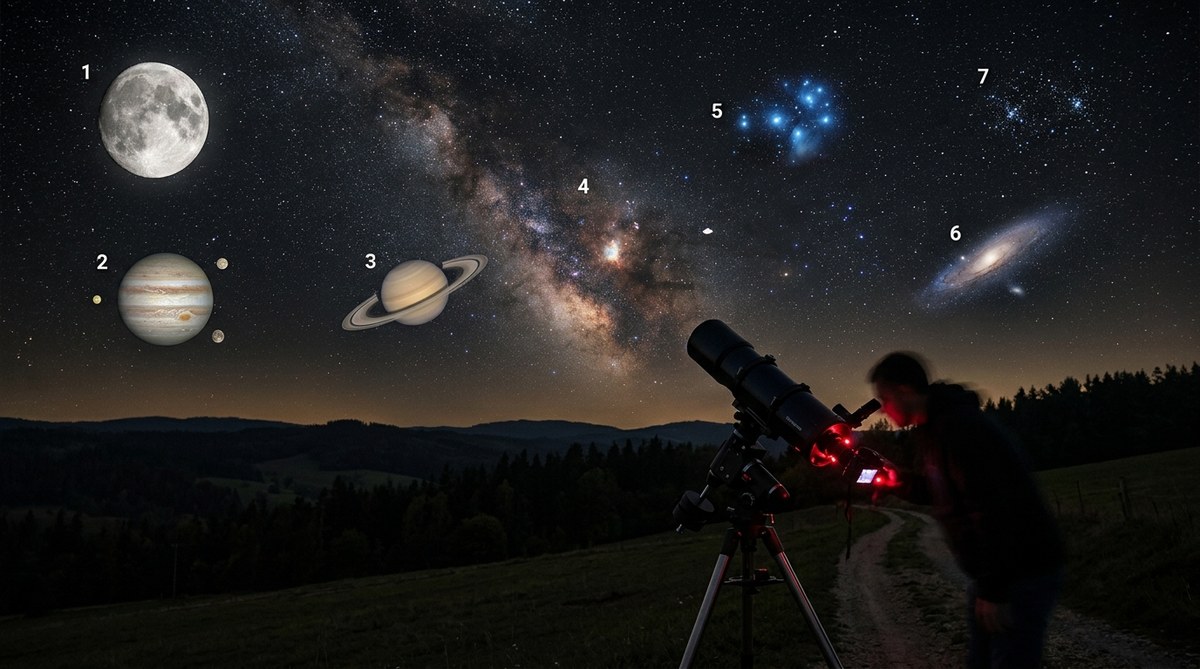
You just unboxed your first telescope. You set it up in the backyard, aimed it at the sky, and then… what? The night is huge, and every star looks the same through a finderscope. It’s easy to feel lost.
Don’t worry. The best part about amateur astronomy is that you don’t need a PhD to see incredible things. A few well-chosen objects will show you why that telescope was worth every penny. These seven night sky targets are bright, easy to find, and guaranteed to give you that “wow” moment on your first night out.
Start with the Moon, then move to planets like Jupiter and Saturn, and finally try deep-sky objects such as the Orion Nebula, Pleiades, Andromeda Galaxy, and the Double Cluster. These easy night sky targets for beginners work in any season, with any moderate telescope, and require very little star-hopping skill to find.
Why Some Targets Are Easier Than Others
Not all celestial objects are beginner-friendly. The easiest targets share three traits: they are bright, they have a large apparent size in the sky, and they stand out against the background. The Moon is the obvious champion, but several planets and star clusters also fit the bill.
A good rule of thumb: start with objects that you can already see with your naked eye. If you can spot it without a telescope, you can definitely find it with one.
Seven Beginner-Friendly Objects
1. The Moon
The Moon is the perfect first target. It is huge, bright, and full of detail. Even a small scope at 30x magnification will show craters, mountain ranges, and the smooth dark plains called maria.
Best time to observe: any night except full Moon. A full Moon is so bright that it washes out contrast. Look for the terminator line, where day meets night. That’s where shadows are longest and craters pop out in 3D.
Telescope tip: use a low-power eyepiece (25mm or 30mm) to get the whole Moon in view. Then switch to a higher power (10mm) to zoom in on craters like Copernicus and Tycho.
2. Jupiter
Jupiter is the king of planets for beginners. It is very bright and stays high in the sky during winter and spring evenings in 2026.
Through a telescope, you will see the planet’s banded clouds. On a steady night, you can spot the Great Red Spot, a giant storm. You will also see its four largest moons: Io, Europa, Ganymede, and Callisto. They look like little stars lined up next to Jupiter.
Tip: start with your lowest power eyepiece. Jupiter is small in the field, but it’s easy to center. Once you have it, bump up the magnification to 100x or more if the air is steady.
3. Saturn
Saturn is the showstopper. Its rings are visible even in a small telescope. You won’t see the Cassini Division (the gap between rings) without a larger scope, but the ring shape itself is unmistakable.
Saturn appears much smaller than Jupiter. Use at least 100x magnification. In 2026, Saturn is best seen in the late summer and early fall evenings.
Common mistake: beginners often try to see Saturn’s rings by looking through the finderscope. Don’t. Use the main telescope. Center the faint yellowish dot, then put in your highest power eyepiece.
4. Orion Nebula (M42)
The Orion Nebula is a cloud of gas and dust where new stars are born. It is visible to the naked eye as a fuzzy star below Orion’s Belt. Through a telescope, it looks like a glowing misty patch with a trapezium of four stars at its center.
Best viewing: winter evenings in the northern hemisphere. You need a dark sky away from city lights, but even from a suburban backyard you can see it.
Telescope tip: use a medium power eyepiece (15mm to 20mm). The nebula is big, so too much magnification will make it too dim.
5. Pleiades (M45)
The Pleiades, also called the Seven Sisters, is a star cluster that looks like a tiny dipper. In a telescope, the view is stunning: dozens of blue-white stars scattered across the eyepiece.
This target is easy to find. Look for the cluster high in the sky from November to March. Use a low power eyepiece to get the whole cluster in one field of view. The stars are bright enough to cut through moderate light pollution.
6. Andromeda Galaxy (M31)
The Andromeda Galaxy is the most distant object you can see with your naked eye. It is a spiral galaxy over 2.5 million light years away. Through a telescope, you won’t see the beautiful spiral arms from photos. You will see a soft, oval glow with a brighter core.
Expectation check: it will look like a faint cloud, not a bright picture. But knowing what you’re looking at makes it magical.
Find it: from a dark site, look for a fuzzy patch near the star Mirach in the constellation Andromeda. Use a wide field eyepiece (25mm or 32mm).
7. Double Cluster (NGC 869/884)
The Double Cluster in the constellation Perseus is two open star clusters side by side. They look like two sparkling handfuls of diamonds. Even a small telescope shows dozens of stars in each cluster.
This is a great target for late fall and winter. Use low power to see both clusters in the same field. They are visible from moderately dark skies.
Common Mistakes and How to Fix Them
Below is a table that describes what beginners often get wrong with each target and what to do instead.
| Target | Common Mistake | Better Approach |
|---|---|---|
| Moon | Using high power on a full Moon | Observe near the terminator; use low power first |
| Jupiter | Expecting to see bands with small finderscope | Use the main telescope at 50x or more |
| Saturn | Thinking the rings will look like a photograph | Accept a small but clear ring shape; adjust focus slowly |
| Orion Nebula | Trying to view during full Moon | Wait for Moon-free evenings; use light pollution filter if needed |
| Pleiades | Using too much magnification | Use a wide eyepiece (25mm+) to see the whole cluster |
| Andromeda | Expecting a bright spiral | Know it will look like a dim, elongated cloud; use averted vision |
| Double Cluster | Searching on moonlit nights | Pick a night with no Moon for best contrast |
Expert advice: “Patience is your best tool. Let your eyes adjust to the dark for at least 20 minutes. Breathe. Look away from the target and use averted vision. The faint details will appear.” — experienced amateur astronomer and regular contributor to Thrush Observatory.
Set Up Your Session the Right Way
Follow these steps to make your first night a success:
- Check the weather forecast for clear skies and stable air.
- Set up your telescope at least 30 minutes before sunset. This lets the optics cool to outside temperature.
- Let your eyes dark adapt. Avoid looking at phone screens or white lights.
- Align your finderscope during daylight on a distant object like a tree or a cell tower.
- Start with the Moon or a bright star to practice focusing.
- Move to Jupiter or Saturn while they are still high above the horizon.
- End with deep-sky targets like the Orion Nebula or Andromeda Galaxy.
Essential Gear to Bring
- Red light flashlight (preserves night vision)
- A star chart or a planetarium app set to night mode
- A notebook and pencil to sketch what you see
- A comfortable chair (observing while standing gets tiring)
- Spare eyepieces (low, medium, high power)
- A jacket, even in summer
For a deeper look at reading star charts, check out our guide on how to read star charts for beginners. It will help you navigate the sky with confidence.
Keep Your Telescope Pointed at the Sky
You now have seven easy night sky targets for beginners that you can find tonight. Start with the Moon, then work through the planets. Once you feel comfortable, try the deep-sky objects. Each one will teach you something new about navigating the sky.
The best part? You can repeat these targets every year. The Moon changes phase, Jupiter’s moons shift, and Saturn’s rings tilt. There is always something new to see.
One last tip: join a local astronomy club for a star party. You’ll get hands-on help and meet others who share your excitement. And if you run into trouble, read our common mistakes new astronomers make and how to avoid them. It will save you frustration.
The universe is waiting. Go outside, look up, and enjoy the view.