You step outside on a clear night, tilt your head back, and see a handful of stars. Maybe a planet. But the sky feels quiet. Not the kind of quiet that comes from stillness. The kind that comes from bad timing.
The truth is that the night sky is not always ready for you. Some nights it hides its best objects behind moonlight. Other nights it offers a window so dark that the Milky Way spills across the sky like a river of milk. The difference between a boring view and a breathtaking one often comes down to one simple factor: when you choose to look up.
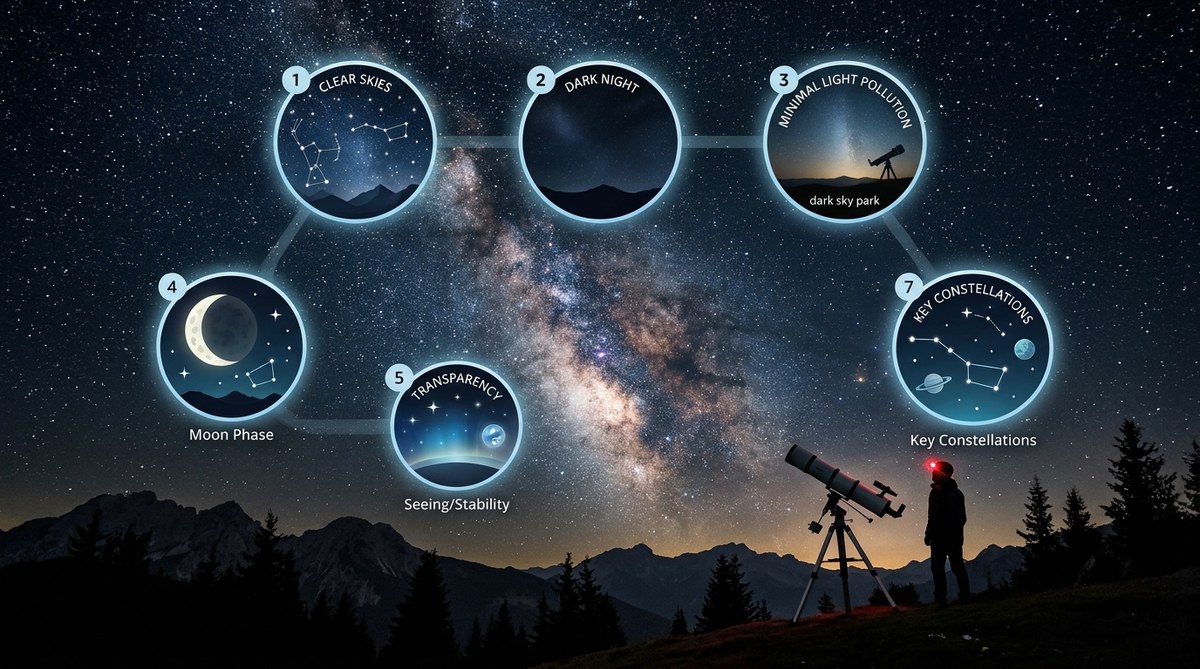
The best time to stargaze is during a new moon phase, when the sky is darkest, and during the hours after midnight before dawn breaks. Seasonal shifts matter too. Winter offers the longest nights and crispest air, while summer brings the galactic core of the Milky Way into view. Avoid full moons and city light pollution for the clearest results.
The Moon Is Your Biggest Ally and Your Worst Enemy
The moon reflects sunlight. A lot of it. When the moon is full, it washes out faint stars, nebulae, and the delicate band of the Milky Way. You can still see bright planets and major constellations, but the deep sky disappears.
The calendar of moon phases is the single most reliable tool for planning a stargazing session. Here is how each phase affects your view:
- New moon: The sky is at its darkest. The moon is invisible. This is the prime time for deep sky objects.
- Waxing crescent: A thin sliver sets early, leaving most of the night dark. Good for early evening sessions.
- First quarter: The moon is visible in the evening and sets around midnight. The second half of the night is dark.
- Waxing gibbous: Bright and lingering. The window for dark skies shrinks.
- Full moon: Avoid if you want to see anything beyond the brightest stars and planets.
- Waning gibbous: Rises late. The early evening is dark, but the moon dominates after midnight.
- Last quarter: Rises around midnight. Morning hours before sunrise are excellent.
- Waning crescent: Thin and rising just before dawn. The early part of the night is wonderfully dark.
If you only remember one rule, let it be this: schedule your stargazing within three days on either side of a new moon. That gives you about a week of excellent darkness each month.
The Season Changes Everything You See
The Earth orbits the Sun. That means the night side of our planet points in a different direction every season. Your view of the cosmos rotates like a slow carousel.
Winter (December to February)
Winter nights are long. The air tends to be drier and crisper, which means less atmospheric turbulence. Orion dominates the southern sky. The Orion Nebula, the Pleiades, and the bright stars Sirius and Betelgeuse are easy targets. If you live in a cold climate, bundle up. The clarity is worth the extra layers.
Spring (March to May)
The nights get shorter. The winter constellations sink toward the west. The Big Dipper climbs high overhead. This is a good season for galaxy hunting. The Virgo Cluster of galaxies becomes visible through binoculars or a small telescope. The春季 sky is less flashy than winter, but it rewards patience.
Summer (June to August)
Short nights, but the Milky Way core is on full display. From a dark location, you can see the dense star clouds of the galactic center stretching from Sagittarius to Cygnus. Meteor showers like the Perseids peak in August. This is the season for lying on a blanket and scanning the sky with your naked eyes.
Fall (September to November)
The nights grow longer again. The Summer Triangle lingers in the west. Andromeda Galaxy rises high and is visible to the naked eye under dark skies. The Orionid and Geminid meteor showers occur during this season. Fall offers a nice balance between comfortable temperatures and decent darkness.
The Best Hour of the Night Is Not What You Think
Most beginners head out at 9 or 10 PM. That is fine for casual viewing. But the sky gets darker as the night goes on. Why? Because the Sun sinks further below the horizon, and the moon (if present) also sets or moves lower.
The sweet spot is usually between midnight and 3 AM. That is when your local sky is farthest from the sun’s glow. If you are after the faintest objects, set an alarm for 1 AM.
“The hour before dawn is often the most stable atmosphere of the entire night. The ground has cooled, the wind dies down, and the stars appear to hold still.” — experienced observer’s tip
How to Plan a Stargazing Session in 2026
Follow these steps to pick the perfect night.
- Check the moon phase. Use a calendar app or a site like timeanddate.com. Target the new moon window.
- Look at the weather forecast. You need clear skies. High humidity or passing clouds will ruin the view. Aim for less than 30 percent cloud cover.
- Pick a location away from city lights. Use a light pollution map. Find a spot marked green, blue, or gray. Even a local park on the edge of town helps.
- Choose a target for the season. In winter, look for Orion. In summer, aim for the Milky Way core. In fall, try the Andromeda Galaxy.
- Let your eyes adapt. Turn off all white lights for at least 20 minutes. Use a red flashlight to preserve night vision.
- Bring the right gear. A reclining chair, warm clothes, a star map, and binoculars if you have them. Check out our guide on choosing the perfect beginner telescope for your first night sky adventure if you want to upgrade.
- Stay out late. The best views happen after midnight. Plan to stay for at least two hours.
Common Timing Mistakes and How to Fix Them
| Mistake | Why It Hurts | The Fix |
|---|---|---|
| Stargazing during a full moon | Washes out faint objects | Wait for the new moon phase |
| Going out at sunset | Sky is still bright | Wait at least 90 minutes after sunset |
| Ignoring the season | Wrong targets for the time of year | Check a seasonal star chart |
| Staying in the city | Light pollution hides everything | Drive 20 minutes to a darker area |
| Using a white flashlight | Destroys night vision for 30 minutes | Use a red light or cover a flashlight with red cellophane |
The One Pattern That Predicts Everything
The night sky follows a predictable rhythm. Learn to read it, and you will never guess again.
The pattern: New moon plus clear weather plus midnight equals the best time to stargaze.
That is the formula. It works every month. It works in every season. The only variable is your location and your willingness to stay up late.
For a deeper look at the patterns that repeat across the year, read our post on 7 night sky patterns that tell you when to stargaze. It breaks down the visual cues you can spot without any equipment.
Why Dawn Is a Secret Weapon
Most people think of stargazing as a late night activity. But the hour before sunrise has its own magic. The air is often calmest. The moon is usually low or absent. Planets like Venus and Jupiter shine brightly in the east. If you are an early riser, try a dawn session. You might catch the zodiacal light, a faint cone of sunlight reflecting off interplanetary dust.
That said, dawn sessions require even more planning. Check the sunrise time. You want to be outside at least 90 minutes before the sun comes up. And remember that the sky brightens fast in the last 30 minutes.
Put It All Together and Make a Plan
You do not need a telescope. You do not need a degree in astronomy. You just need the right timing.
Start with the next new moon. Look up the date for 2026. Mark it on your calendar. Check the weather two days ahead. Pick a spot away from streetlights. Pack a chair, a red light, and a thermos of coffee. Then go outside at midnight and look up.
The stars will be waiting.
For more help identifying what you see, check out how to read the sky like a map without a telescope. It pairs well with the timing tips in this guide.
The night sky is generous. It shows its best face to anyone who shows up at the right moment. Now you know when that moment is. Go enjoy it.