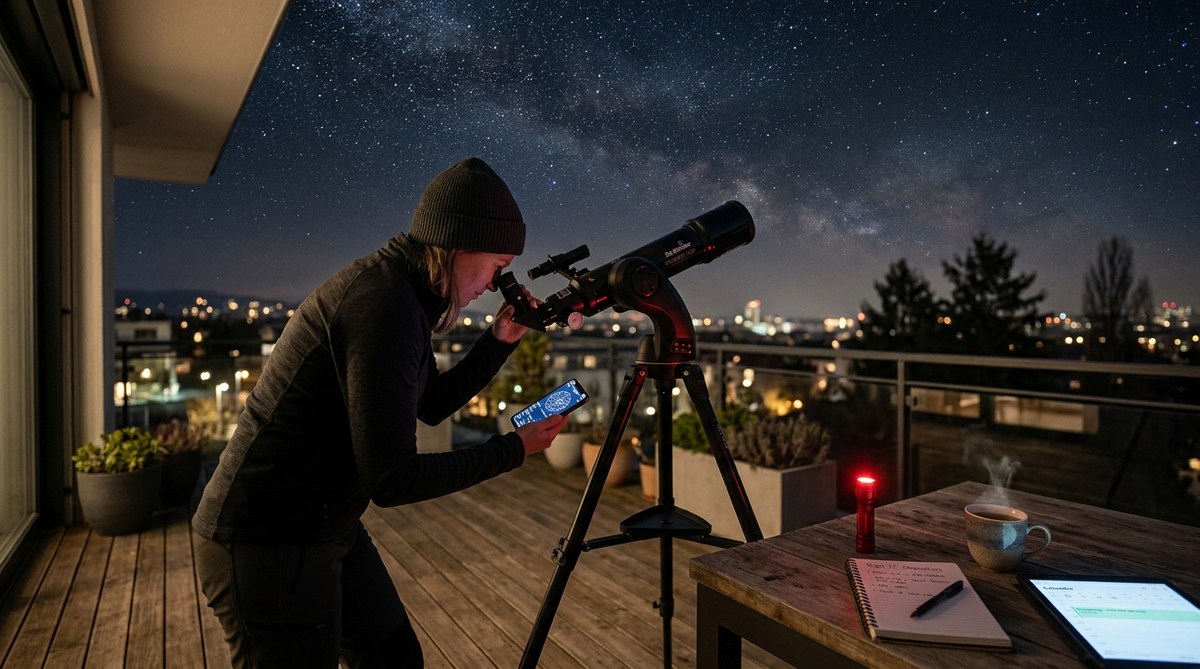
You want to look up at the stars more often. You just don’t have hours to spare. Between work, family, and everything else, the idea of setting up a telescope and learning the sky feels like another chore. It doesn’t have to be. A beginner stargazing routine can be short, simple, and fit into the cracks of your day. The trick is to stop treating it like a project and start treating it like a pause.
A beginner stargazing routine does not require a telescope, a dark sky site, or an hour of free time. You can start with your eyes, a smartphone app, and ten minutes before bed. The goal is consistency, not perfection. By learning a few bright stars and one new constellation each week, you will build lasting sky knowledge without burning out.
Why a Routine Beats Random Nights
Most people try stargazing once. They drive somewhere dark, set up gear, and feel overwhelmed by the thousands of stars. Then they don’t try again for months. That is the opposite of a routine.
A routine works because it removes the friction. You do not have to decide when to go out. You do not have to pack a bag. You step outside at the same time, look at the same patch of sky, and notice what changed. Over a few weeks, you will start recognizing patterns. That is how you actually learn the night sky.
If you want to understand the fundamentals behind what you are seeing, our guide on understanding the night sky for beginners is a great next step.
The Five Minute Method
You do not need a full hour. You need five minutes. Here is the simplest way to build a beginner stargazing routine that sticks.
-
Pick a trigger. Attach your stargazing to something you already do. Maybe it is after you brush your teeth at night. Maybe it is while you wait for your coffee to brew in the morning. The trigger makes the habit automatic.
-
Step outside or to a window. You do not need a dark field. A balcony, a driveway, or even a south-facing window works. Your eyes will adjust to the darkness in about 30 seconds.
-
Look for one thing. Do not try to see everything. Pick a single target. The moon. A bright planet. One constellation. That is all.
-
Use a free app. Apps like Stellarium or SkySafari show you exactly what is overhead. Open the app, point your phone at the sky, and let it identify what you see. This replaces the need for paper star charts.
-
Log one sentence. Open a notes app and write one line. “Saw Jupiter tonight.” “First quarter moon.” “Clouds blocked everything.” That log becomes your personal sky journal.
What to Look for in Your First Month
You do not need to know every constellation. Focus on the brightest, easiest targets. These never fail.
-
The moon. It is impossible to miss. Watch it change phases over a week. Our article on 7 must-know moon phases for better stargazing will help you predict the best nights.
-
Planets. Venus and Jupiter are often brighter than any star. They do not twinkle. If you see a steady, bright light low in the sky, it is probably a planet.
-
The Big Dipper. This is not a constellation, but an asterism. It is visible every night from most of the United States. Once you find it, you can use it to find the North Star.
-
Orion. In winter and early spring, Orion is the easiest constellation to spot. The three stars of his belt are a dead giveaway.
-
The International Space Station. It looks like a bright, moving star. NASA has a free service that texts you when it will pass overhead. Our guide on how to spot the International Space Station in your night sky tells you exactly when to look.
Common Beginner Mistakes and How to Fix Them
Many new stargazers give up because they make the same few errors. Here is how to avoid them.
| Mistake | Why It Happens | The Fix |
|---|---|---|
| Trying to see too much | You want to get your money’s worth | Pick one object per session |
| Buying a telescope too soon | You think gear equals progress | Use your eyes for two months first |
| Stargazing during a full moon | The sky is washed out | Check moon phase before going out |
| Staying inside because of light pollution | You assume you need darkness | Bright planets and the moon cut through city lights |
| Skipping nights because you are tired | You think it requires energy | A two minute look counts |
“The biggest mistake new stargazers make is thinking they need perfect conditions. The best sky is the one you actually look at.” – Dr. Carolyn Porco, planetary scientist
If you are already battling light pollution, our guide on how to adapt when light pollution ruins your view has practical solutions.
Gear You Already Own
You do not need to buy anything. Here is what you already have that works for stargazing.
-
Your eyes. They are the best tool for wide sky views. Binoculars are a step up, but your eyes are enough for months.
-
A smartphone. The camera can capture the moon. The apps replace star charts. The compass helps you find north.
-
A chair. Sitting down makes you stay outside longer. A simple lawn chair or a step stool is perfect.
-
A blanket. If you are cold, you will go inside. Keep a blanket by the door.
-
Red light. A regular flashlight covered with red tape preserves your night vision. Your phone has a red light mode in most astronomy apps.
When to Stargaze Without Changing Your Schedule
You do not have to stay up late. The best times are often built into your existing day.
Right after sunset. This is the easiest time. The brightest planets and the moon appear first. You can step out while dinner is cooking.
Before bed. A quick look at the sky can replace scrolling on your phone. It calms your mind and teaches you the sky.
During your morning commute. If you leave early enough, you can catch Venus in the morning sky. It is called the Morning Star for a reason.
Weekend mornings before sunrise. These are golden hours for seeing planets and the moon in a dark sky. You are already awake early for other reasons.
How to Stay Motivated Without Burnout
Stargazing should feel like a break, not a chore. Here are ways to keep it fun.
-
Set a micro goal. Learn one new constellation each month. That is twelve per year. After three years, you will know more than most casual stargazers.
-
Watch the calendar. Certain nights are easy wins. Meteor showers like the Perseids in August or the Geminids in December are spectacular with zero effort. Our cosmic calendar events for 2026 lists the best ones.
-
Share it. Show a family member or a friend what you found. Teaching someone else reinforces your own knowledge.
-
Skip without guilt. If you miss a week, it does not matter. The sky will be there next week. Consistency over the long term matters more than perfection.
Building Your Routine Around Seasons
The night sky changes with the seasons. That is part of the fun. Here is what to expect.
-
Winter (December to February). Orion dominates. The sky is dark early, which helps. Bundle up and keep sessions short.
-
Spring (March to May). The Big Dipper is high overhead. Look for Leo and Virgo. The weather is milder, so you can stay out longer.
-
Summer (June to August). The Milky Way is visible if you have dark skies. The Perseid meteor shower peaks in mid August. Warm nights make stargazing easy.
-
Fall (September to November). The sky is often clear after summer humidity drops. Look for the Andromeda Galaxy with binoculars.
Understanding why the sky changes with the seasons helps you plan ahead. Our guide on why the night sky changes with the seasons explains the science behind it.
Your First Week Plan
Here is a concrete plan for your first seven days.
-
Day 1. Step outside at night. Look up. Count the stars you can see. That is your baseline.
-
Day 2. Find the moon. Note its shape.
-
Day 3. Download a free astronomy app. Point it at the brightest object in the sky.
-
Day 4. Look for a planet. Venus and Jupiter are the easiest.
-
Day 5. Find the Big Dipper. Use it to find the North Star.
-
Day 6. Watch a meteor shower if one is active. Otherwise, repeat a previous target.
-
Day 7. Write one sentence about what you saw this week.
The One Tool That Changes Everything
If you want to buy one thing, buy a pair of 7×50 binoculars. They cost less than a dinner out and show you more than any telescope under two hundred dollars. You will see the moons of Jupiter, the craters on the moon, and dozens of star clusters. But wait until you have used your eyes for at least a month. That way you will appreciate what the binoculars add.
If you decide to buy a telescope later, our guide on choosing the perfect beginner telescope will help you pick the right one.
Stargazing Without Leaving Your Neighborhood
Light pollution is real, but it is not a dealbreaker. You can still see plenty from a city backyard or an apartment balcony.
-
The moon. It is bright enough to cut through any light pollution.
-
Bright planets. Venus, Jupiter, and Mars are visible from downtown areas.
-
The International Space Station. It passes over every city.
-
Meteors. The brightest ones punch through city lights.
-
Satellites. You will see dozens of them drifting across the sky.
If you want to know exactly what is visible from your location tonight, check out what your backyard sky reveals about the universe tonight.
The Night Sky as a Daily Reset
Stargazing is not just about learning astronomy. It is a way to disconnect. Five minutes under the stars slows your breathing and changes your perspective. You stop thinking about emails and start thinking about the scale of the universe. That is valuable.
A beginner stargazing routine does not require expertise. It requires showing up. Step outside, look up, and notice one thing. Do it again tomorrow. Over time, the sky will become familiar. You will recognize the winter constellations. You will know when Jupiter is rising. You will feel connected to something larger than your daily schedule.
Start tonight. Just five minutes. You already have everything you need.