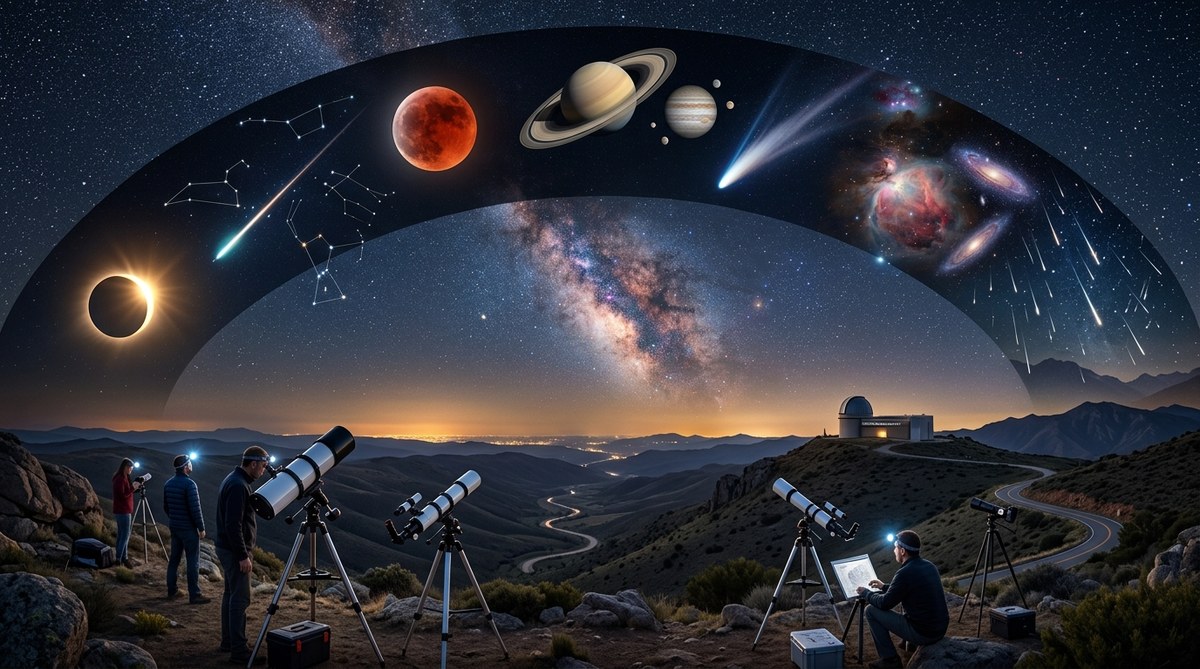
The night sky in 2026 is putting on a show that casual stargazers and seasoned astronomy enthusiasts will remember for years. From a total solar eclipse that will plunge parts of Europe into daytime darkness to a Christmas supermoon that will light up the holiday sky, the calendar is packed with moments worth planning for. Whether you are a content creator looking for stunning visuals or someone who just wants to share a magical view with family, knowing what is coming and when to look up makes all the difference. This guide covers the most spectacular celestial events of 2026, with practical advice on how to see each one.
The 2026 skywatching calendar features a total solar eclipse on August 12, a total lunar eclipse on March 3, and a rare triple conjunction of Jupiter, Venus, and Mercury on June 9. Meteor showers peak in August, November, and December. Mark these dates now to avoid missing the year’s biggest celestial events.
The Total Solar Eclipse on August 12
The crown jewel of astronomical events 2026 is the total solar eclipse on August 12. This eclipse will trace a path of totality across Greenland, Iceland, and northern Spain. If you live in the United States, you will see a partial eclipse from the northeastern states. The closer you are to the path, the more of the Sun the Moon will cover. For viewers in New York City, about 70 percent of the Sun will be blocked near midday. This is a rare chance to witness the corona, the Sun’s outer atmosphere, with your own eyes. If you can travel to the path of totality, do it. Totality lasts over two minutes in some locations. Remember to use certified solar viewing glasses at all times during the partial phases. Never look directly at the Sun without proper protection. For more on safe viewing, check out our guide on how to plan your first stargazing session in 2026.
The Blood Moon Total Lunar Eclipse on March 2-3
Before the solar eclipse, the year gives us a total lunar eclipse on the night of March 2 into March 3. This event is visible across North and South America. The Moon will pass through Earth’s shadow and take on a deep red hue, often called a blood moon. Unlike a solar eclipse, this one is completely safe to watch with your naked eyes. No special glasses needed. The total phase lasts about 85 minutes, giving you plenty of time to enjoy the view. Set an alarm for around midnight Eastern Time. The best views happen when the Moon is high in the sky. If you want to photograph this event, a tripod and a telephoto lens will help you capture the red glow. For beginners who want to improve their night photography, our guide on how to use your smartphone for night sky astronomy offers some helpful tips.
The Triple Conjunction of Jupiter, Venus, and Mercury on June 9
On June 9, three planets will gather in the western sky just after sunset. Jupiter, Venus, and Mercury will form a tight triangle visible to the naked eye. Venus will be the brightest of the three, shining like a beacon low on the horizon. Jupiter will be slightly higher and dimmer, and Mercury will be the faintest. This kind of conjunction is rare because all three planets have to line up in the same part of the sky. The best viewing window is about 30 minutes after sunset. Find a spot with a clear view of the western horizon, free from trees and buildings. A pair of binoculars will reveal all three planets in the same field of view. This is a perfect event for content creators who want to capture a wide landscape shot with the planets clustered together. If you are new to identifying planets, our guide on how to find planets in the night sky without a telescope is a great place to start.
The Perseid Meteor Shower Peaks on August 12
The Perseid meteor shower peaks on the same night as the total solar eclipse. This coincidence is a gift for skywatchers. After the eclipse ends and the Sun sets, the Perseids will put on a show. Under dark skies, you can expect to see up to 60 meteors per hour. The best time to watch is after midnight when the radiant point in the constellation Perseus is high overhead. The Moon will be in a waning crescent phase, so it will not wash out the fainter meteors. Bring a reclining chair, a blanket, and some patience. Meteors come in bursts, so give your eyes at least 20 minutes to adjust to the dark. Avoid looking at your phone during the watch, as the screen light will ruin your night vision. For more on what to look for, read our article on top 10 celestial phenomena every amateur astronomer should know.
The Christmas Supermoon on December 24
A supermoon occurs when the full moon coincides with the Moon’s closest approach to Earth. On December 24, the Christmas supermoon will rise. It will appear about 14 percent larger and 30 percent brighter than a typical full moon. This is a fantastic event for families and casual observers. You do not need any equipment to enjoy it. Just step outside after sunset and look east. The Moon will rise around dusk, so you can catch it low on the horizon where it looks especially large due to the moon illusion. This is also a great time to take photos of the Moon with landmarks or holiday decorations in the foreground. If you want to understand why the Moon sometimes appears orange or large, check out our guide on why the moon sometimes appears orange: the science of moon color.
Saturn at Opposition on October 4
Saturn reaches opposition on October 4, meaning it will be directly opposite the Sun from Earth. This is the best time to view the ringed planet all year. Saturn will rise at sunset and set at sunrise, so it is visible all night long. Through a telescope, you can clearly see the rings and even the Cassini Division, a gap between the rings. Even a small telescope with 50x magnification will show the rings. If you do not own a telescope, a pair of 10×50 binoculars will show Saturn as an elongated oval shape. For those ready to invest in a scope, our guide on how to choose the perfect beginner telescope for your first night sky adventure can help you pick the right one.
The Geminid Meteor Shower on December 13-14
The Geminid meteor shower is often the best meteor shower of the year. In 2026, it peaks on the night of December 13 into December 14. Under ideal conditions, you can see over 100 meteors per hour. The Geminids are known for producing bright, slow-moving fireballs. The radiant point is near the bright star Castor in the constellation Gemini. The Moon will be a thin crescent, setting early in the evening, so skies will be dark for most of the night. The best viewing time is between midnight and dawn. Dress warmly, as December nights can be cold. Bring hot coffee or tea. Lie back and scan the sky. Meteors will appear all over, not just near the radiant. For a checklist of what to bring, see our guide on 7 essential skywatching tools you already have at home.
How to Prepare for Each Event
Getting ready for a night of skywatching does not require a lot of gear, but a little planning goes a long way. Here are three steps to follow for any event.
- Check the weather forecast for your location a few hours before the event. Cloud cover can ruin the view. Have a backup plan, such as a nearby dark sky site or a friend’s house in a clearer area.
- Let your eyes adapt to the dark. Avoid white light for at least 20 minutes before you start observing. Use a red flashlight or a phone app with a red filter to preserve night vision.
- Set up your viewing spot in advance. For meteor showers, bring a reclining chair and a blanket. For eclipses and conjunctions, find a spot with a clear horizon. Arrive 30 minutes early to get comfortable.
Common Mistakes Beginners Make
Even experienced skywatchers can slip up. Here are the most common errors and how to avoid them.
| Mistake | Why It Happens | How to Avoid It |
|---|---|---|
| Looking at the wrong time | Events have narrow windows. Check exact times for your time zone. | Use an astronomy app or website to get local times. |
| Using a telescope without a finder scope | You spend minutes trying to aim at the target. | Learn how to align your finder scope during daylight. |
| Forgetting to dress for the weather | You get cold and leave early. | Check the nighttime low and dress in layers. |
| Staring at a phone screen | Your night vision is ruined for 30 minutes. | Use red screen filters or paper maps. |
| Not checking the Moon phase | A bright moon washes out faint objects. | Plan around the lunar cycle. New moons are best for deep sky. |
“The sky is free, but your time is not. Pick two or three events a year and commit to them. That is how you build lasting memories, not just a checklist.” — Thrush Observatory team
Planning Your Year with a Cosmic Calendar
The best way to enjoy astronomical events 2026 is to build them into your regular schedule. Here is a bulleted list of the year’s top events to help you plan.
- March 2-3: Total lunar eclipse (blood moon) visible from the Americas
- May 5-6: Eta Aquarid meteor shower, best before dawn
- June 9: Triple conjunction of Jupiter, Venus, and Mercury after sunset
- August 12: Total solar eclipse (path across Greenland, Iceland, Spain)
- August 12: Perseid meteor shower peaks at the same night
- August 27-28: Partial lunar eclipse visible from Europe, Africa, and Asia
- October 4: Saturn at opposition, visible all night
- November 14-15: Conjunction of Jupiter and Mars before sunrise
- December 13-14: Geminid meteor shower peaks
- December 24: Christmas supermoon
For a deeper understanding of the night sky, take a look at our guide on understanding the night sky: a beginner’s guide to astronomy fundamentals. It covers the basics of how to read star charts, identify constellations, and track planetary movements.
Why 2026 Is a Special Year for Skywatchers
The combination of a total solar eclipse, a total lunar eclipse, and a triple planetary conjunction in the same year is unusual. Add in the Christmas supermoon and two major meteor showers, and you have a calendar that rewards anyone who takes the time to look up. Whether you are a content creator filming the eclipse or a parent showing your kids the rings of Saturn, 2026 offers something for everyone. The key is to prepare. Know the dates. Know the times. Know what to expect. Then step outside and let the universe do the rest.
Make the Most of Every Clear Night
The sky does not wait for anyone. Clouds can move in. Schedules can shift. But the events themselves are predictable. Mark your calendar for the big ones. Set a reminder a few days ahead. Check the weather. Pack a chair and a thermos. Invite a friend. The best moments in astronomy are the ones you share. So grab your gear, step outside, and look up. The cosmos is waiting.