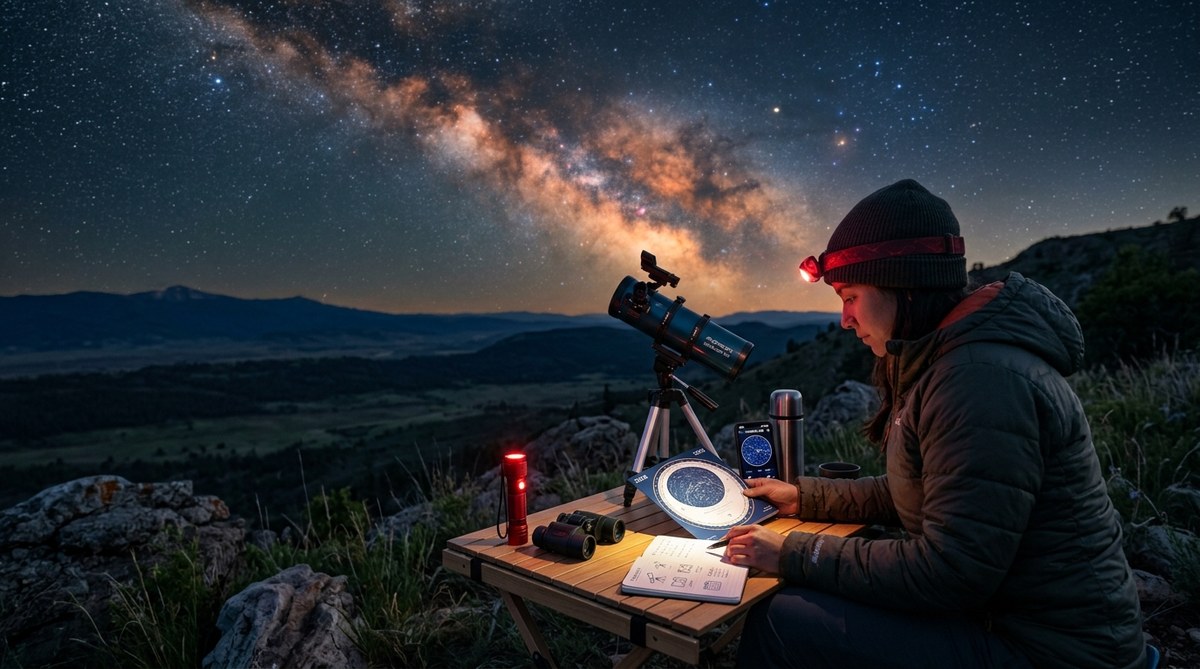
The night sky has a way of making you feel small and connected at the same time. Maybe you have looked up during a camping trip or on a clear winter evening and felt that pull. You want to know more. You want to be able to name the stars and spot a planet. The good news is that 2026 is a fantastic year to start. An annular solar eclipse in February, a deep total lunar eclipse in March, and strong showings of the Perseids and Geminids mean there is always something to aim for. This guide will walk you through everything you need for your first stargazing session, from picking a safe spot to knowing what to bring and what to look for.
A successful stargazing session starts before sunset. Choose a dark location away from city lights, let your eyes adapt for at least 20 minutes, and use a red light to preserve your night vision. Bring a star chart or a good app, dress warmly, and target one or two bright objects first. The 2026 sky offers plenty for beginners, including the February annular eclipse and the August Perseid meteor shower.
Pick the Right Spot
Your location is the most important factor. You do not need to drive hours into a national park. A backyard with minimal streetlight glare works fine. But the darker the sky, the more you will see. Look for a place with a clear view of the southern horizon (if you are in the northern hemisphere) and few trees or buildings blocking the sky.
If you live in or near a city, try a local park that closes after dusk. State parks and nature preserves often have designated dark sky areas. Websites like the Dark Sky Finder show zones near you. For your first outing, choose a spot that feels safe and familiar.
Pro tip from Thrush Observatory: “Your first session should be comfortable, not an expedition. Pick a location you know, bring a camp chair, and plan to stay for only an hour. You can always go longer once you get the hang of it.”
What to Bring for a Night Under the Stars
You do not need a telescope to start. In fact, many beginners enjoy the sky more with just their eyes and a pair of binoculars. Here is a checklist of items that make a difference:
- A red flashlight or a regular flashlight covered with red cellophane. White light ruins your dark adaptation.
- A reclining chair or a blanket to lie on.
- Warm clothes in layers. Even summer nights can feel chilly when you are sitting still.
- A star chart or a stargazing app. Paper charts are great, but apps like Stellarium or SkySafari are easier for beginners.
- Binoculars (7×35 or 10×50 are ideal) if you have them. They reveal the moons of Jupiter and the Pleiades star cluster beautifully.
- A notebook and pen to record what you see.
- Snacks and hot drink in a thermos.
Leave your phone in airplane mode. Notifications and screen glare will pull you out of the moment. If you must use a phone for an app, turn down the brightness and switch to red night mode.
How to Prepare Your Eyes for the Dark
Your eyes need time to adjust. The process is called dark adaptation. It takes about 20 to 30 minutes for your pupils to fully dilate and for the light sensitive cells in your retina to become active. During this time, avoid looking at any white light. Check your phone, car dashboard, or flashlight only with a red filter.
Once adapted, you will see many more stars than you could before. Try this: look slightly to the side of a faint star rather than directly at it. Your peripheral vision is more sensitive to dim light. This trick alone will help you spot dozens of extra stars.
What to Look For in the 2026 Night Sky
Beginners should start with easy targets. The Moon is always a great first object. Then move to planets. In 2026, Venus will be brilliant in the evening sky during spring and early summer. Jupiter and Saturn will be visible in the evening during the fall and winter. Mars will appear close to Saturn in early 2026, making a nice pair.
Meteor showers are perfect for beginners because you do not need any equipment. Just lie back and watch. The Perseids peak on August 12, 2026, with a waning moon that will rise after midnight, leaving dark skies for the early part of the night. The Geminids peak on December 13, 2026, under a nearly new moon, promising great viewing.
Here is a table of common beginner mistakes and how to avoid them:
| Mistake | How to Avoid |
|---|---|
| Using a big telescope right away | Start with your eyes or binoculars. Telescopes can be frustrating to aim. |
| Staying too long outside | Plan short sessions (30-60 minutes) to stay comfortable and focused. |
| Forgetting to check the weather | Always check the forecast and cloud cover before heading out. |
| Rushing to see everything | Pick one or two objects per session. The sky is vast; patience pays off. |
| Not dressing warmly | Your body cools down fast when sitting still. Add more layers than you think you need. |
Using Star Charts and Apps
Paper star charts are timeless, but they can be tricky for a beginner. A better option is to download a free planetarium app. Point your phone at the sky, and the app shows you exactly what you are looking at. This makes matching patterns to real stars much easier.
Start by learning how to read star charts for beginners. A basic chart shows the constellations, the brightest stars, and the path of the planets. Once you can find the Big Dipper, you can use it to locate Polaris (the North Star) and then other constellations like Cassiopeia and Orion. For more detail, our guide on understanding the night sky walks through the major patterns season by season.
If you want to identify specific celestial objects in 2026, we have a dedicated resource that highlights the best targets each month. The February annular eclipse and the March total lunar eclipse are two can’t miss events for your first year.
Step by Step: Your First Stargazing Session
Follow these numbered steps for a smooth experience:
- Check the sky forecast. Use a site like ClearDarkSky or a weather app that predicts cloud cover and transparency.
- Set up before sunset. Arrive at your spot at least 30 minutes before true darkness so you can get comfortable in the daylight.
- Turn off all white lights. Switch your flashlight to red mode and put your phone away.
- Let your eyes adapt. Sit back, relax, and do not look at any screens for 20 minutes.
- Start with the brightest object. On most nights, that will be the Moon, Venus, or Jupiter. Use your app to identify it.
- Scan with binoculars. Once you have a bright target, use binoculars to see details like Jupiter’s moons or the Moon’s craters.
- Find a constellation. Use the Big Dipper or Orion as a starting point, then hop to nearby constellations.
- Look for a meteor. Spend at least 10 minutes just watching a dark patch of sky. During a meteor shower, you might see several per minute.
- Pack up with care. When you are done, use your red light to gather your gear. Do not rush to turn on car headlights; wait a minute for your eyes to readjust.
Choosing Your Gear for the Long Term
After a few sessions, you may want to invest in a telescope. For beginners, a Dobsonian reflector (6 to 8 inches) offers the best value. It is easy to use and shows deep sky objects like galaxies and nebulas. Avoid cheap department store telescopes with flimsy tripods. Instead, read our guide on how to choose the perfect beginner telescope to find a model that fits your budget and goals.
Binoculars are a lower cost option that last a lifetime. A pair of 10×50 binoculars will show you more detail on the Moon, the moons of Jupiter, and the Andromeda Galaxy. Many experienced amateur astronomers still use binoculars for quick sessions.
The Joy of Shared Observation
Stargazing does not have to be a solo activity. Bring a friend or family member. Kids especially love spotting the first star and tracking the Moon across the sky. You can also join a local astronomy club. Club members often host star parties where you can look through large telescopes and learn from seasoned observers. Check the Night Sky Network for clubs near you.
If you want to deepen your knowledge, consider building a simple observing plan. Set a goal to find all five naked eye planets within your first three months. Or commit to learning five new constellations each season. The more you practice, the more the sky becomes a familiar map.
Your Next Steps Under the Stars
The first time you lie back and see the Milky Way stretch from horizon to horizon, you will understand why people have been staring up for thousands of years. 2026 is a wonderful year to begin. The February eclipse gives you a daytime event, the meteor showers offer dramatic shows, and the planets put on a steady performance throughout the year.
Grab a chair, a red light, and a sense of wonder. Go outside. Look up. Let the universe welcome you.