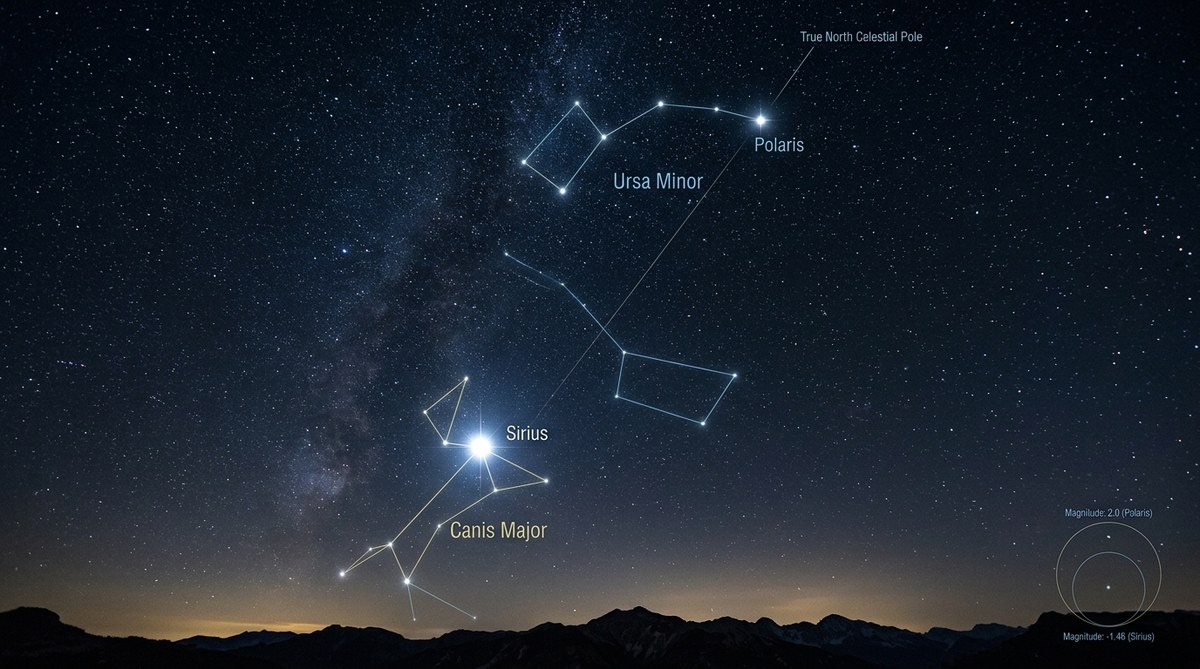
Most people assume the North Star must be the most brilliant diamond in the night sky. After all, it holds a special job: a fixed point that guides travelers, sailors, and photographers. But the truth surprises many. Polaris, the current North Star, is not even in the top 40 brightest stars. It sits at number 48 on the official brightness list. That gap between reputation and reality fuels a common astronomy myth that deserves a clear explanation.
Polaris is not the brightest star because its intrinsic luminosity is modest (a yellow supergiant of magnitude 1.98) and it lies 433 light-years away. The true sky champion is Sirius, which is both intrinsically brighter and much closer. Polaris earns its fame from its fixed position above Earth’s north pole, not from its light output. Knowing this helps you appreciate the real hierarchy of stellar brilliance.
Why the Myth Exists
Cultural stories and elementary school lessons often give Polaris top billing. The idea that the North Star must be “the brightest” feels logical. If you are lost at sea, you would look for the most obvious light. But nature does not work that way. Polaris is actually a modest yellow supergiant that puts out about 2,500 times the light of our Sun. That sounds like a lot until you compare it to Sirius.
Sirius, the true brightest star in the night sky, is a white main-sequence star that shines with a magnitude of -1.46. It is just 8.6 light-years from Earth. Polaris is 433 light-years away. Distance matters. A star that is intrinsically fainter but much closer can outshine one that is powerful but remote.
Another reason people assume Polaris is bright: it sits in a relatively empty patch of sky. The area around the Little Dipper contains few other bright stars. So Polaris stands out by contrast. Compare that to the constellation Orion, where several bright stars compete for your attention.
How Brightness Is Measured
Astronomers use the magnitude scale to rank star brightness. The lower the number, the brighter the star. A difference of 5 magnitudes equals exactly 100 times in brightness. Sirius is magnitude -1.46. Polaris is magnitude 1.98. That is a difference of about 3.4 magnitudes, which means Sirius is roughly 24 times brighter than Polaris.
Here is a simple table showing where Polaris ranks among common stars:
| Star Name | Apparent Magnitude | Distance (light-years) | Notes |
|---|---|---|---|
| Sirius | -1.46 | 8.6 | Brightest overall |
| Canopus | -0.72 | 310 | Second brightest |
| Vega | 0.03 | 25 | Bright in summer |
| Capella | 0.08 | 43 | Bright winter star |
| Rigel | 0.13 | 860 | Very luminous but far |
| Polaris | 1.98 | 433 | 48th brightest |
Notice that Rigel is intrinsically far more luminous than Polaris, but its distance drops it to a lower apparent brightness. Polaris is not even close to the top.
What Makes Polaris Special
If brightness is not the reason, why do we care about Polaris? Because it is a pole star. Earth’s axis points almost directly at Polaris. As our planet rotates, all other stars appear to circle around Polaris. The star barely moves. That property makes it an excellent navigational tool. To find north, you simply locate Polaris and you know which way is true north.
The position is not permanent. Due to the precession of Earth’s axis, the title of North Star passes to different stars over thousands of years. In 2026, Polaris holds the title. In about 13,000 years, Vega will become the North Star. But for now and for many future generations, Polaris is the anchor.
The Real Brightest Stars: A Bulleted List
Do you want to know which stars actually dominate the night sky? Here are the five brightest, starting with the king:
- Sirius (-1.46) – Located in Canis Major, visible in winter from the Northern Hemisphere.
- Canopus (-0.72) – Found in Carina, best seen from southerly latitudes, but visible from southern parts of the US.
- Alpha Centauri (-0.27) – Actually a triple star system, the closest to our Sun.
- Arcturus (-0.05) – An orange giant in Boötes, prominent in spring and summer.
- Vega (0.03) – Part of Lyra, a blue-white star that is the brightest in the summer triangle.
Polaris does not appear on that list. It sits far down, fainter even than stars like Altair (magnitude 0.76) and Aldebaran (0.87). So why do people keep thinking it is number one? Blame the legend.
Common Misconceptions About Polaris
Many beginners make these mistakes when learning about the North Star:
- Believing it is the brightest. The most common error. As we have seen, it is not even close.
- Thinking it is directly overhead. Polaris is located about 35 degrees above the northern horizon for someone in the central US. Only at the North Pole does it sit directly overhead.
- Expecting it to be easy to spot. Polaris is not hard, but you need to know how to find the Big Dipper first. The two outermost stars of the Big Dipper (Merak and Dubhe) point directly to Polaris.
- Assuming it never changes. Earth’s axis wobbles slowly, so the North Star shifts over centuries.
For a deeper understanding of such celestial patterns, check out our guide on
How to Find Polaris in Three Steps
If you want to see the North Star for yourself, follow this numbered process:
- Locate the Big Dipper. Look north and find the familiar seven-star ladle shape. The Big Dipper is part of Ursa Major and is visible year-round in most of the Northern Hemisphere.
- Identify the pointer stars. Focus on the two stars that form the outer edge of the bowl: Merak (the lower one) and Dubhe (the upper one). They are called the pointer stars.
- Draw an imaginary line. Trace a line from Merak through Dubhe and continue about five times the distance between them. The line will hit Polaris, which sits at the end of the Little Dipper’s handle.
That technique works every time, even under moderate light pollution. For beginners wanting to learn more about identifying constellations, our guide on https://thrushobservatory.org/mastering-astronomy-basics-how-to-identify-stars-planets-and-constellations/ is a great next step.
How Polaris Compares to Orion’s Stars
Orion is a constellation loaded with bright stars. Betelgeuse, the red supergiant, varies in brightness but usually sits near magnitude 0.5. Rigel is magnitude 0.13. Both outshine Polaris easily. Even Bellatrix, the third-brightest star in Orion, is magnitude 1.64, still brighter than Polaris. So if you can see Orion, you are looking at multiple stars that beat the North Star.
“The North Star is not a showoff; it is a sturdy workhorse. It does not need to be brilliant to be useful.” ~ Old astronomy saying, often shared by amateur stargazers.
That blockquote captures the spirit. Polaris does not need to be the brightest. Its value lies in its constancy.
Why This Myth Hurts Beginner Astronomers
When a new stargazer expects to see an overwhelming diamond and finds a rather ordinary-looking dot, the experience can feel anticlimactic. They might think astronomy is overhyped. That is a shame. If instead you know that Sirius, Venus, or even Jupiter will dramatically outshine Polaris, you can adjust your expectations. You will learn to appreciate the real brightest stars and enjoy the hunt for them.
Our article on https://thrushobservatory.org/5-common-mistakes-new-astronomers-make-and-how-to-avoid-them/ lists this exact misconception as one of the top errors. Another common mistake is confusing planets with stars. Planets like Venus can be dazzling, but they do not twinkle as much.
A Practical Comparison Table
To reinforce the difference between Polaris and Sirius, here is a side-by-side:
| Feature | Polaris | Sirius |
|---|---|---|
| Apparent magnitude | 1.98 | -1.46 |
| Distance (ly) | 433 | 8.6 |
| Spectral type | F7Ib (yellow supergiant) | A1V (white main sequence) |
| Luminosity (solar) | ~2,500 | ~25 |
| Role | North Pole anchor | Brightest night star |
| Visibility | Year-round north of 30°N | Winter and spring evenings |
Notice that Sirius is only 25 times brighter than the Sun, but it is close. Polaris is 2,500 times brighter than the Sun but far away. Distance wins.
How to Observe Polaris Properly
Even though it is faint, Polaris is worth observing. You can track its slow motion across the sky. Over a night, it barely moves. Over centuries, it drifts. If you have a telescope, Polaris is a double star. Its companion, Polaris B, is a magnitude 9.2 star that is visible with modest equipment. That is a fun challenge for a beginner with a small telescope.
For guidance on setting up equipment, read our article on
The Impact of Light Pollution
City lights wash out fainter stars. Polaris, being magnitude 1.98, is still visible in most suburban skies, but it can be tricky in urban centers. If you live in a city, try to find a park or an area with fewer streetlights. The Big Dipper will be easier to spot. From there, the pointer method works.
For a list of celestial sights that survive light pollution, see our guide on
A Final Reality Check
Let us summarize the truth: Polaris is not the brightest star because it is neither exceptionally luminous up close nor extremely powerful far away. It is a nice, steady yellow supergiant that happens to align with Earth’s axis. Sirius, Canopus, and many others leave it in the dust. The myth persists because of cultural storytelling and the human tendency to equate importance with brightness.
Now that you know the real answer to “why is Polaris not the brightest star,” you can share that knowledge with friends. Next time someone points to the North Star and says “Is that the brightest one?” you can smile and explain the magnitude scale, the role of distance, and the beauty of a star that is far more valuable for its position than its glow.
Your Night Sky Challenge
Go outside on the next clear evening around 9:00 PM local time. Use the Big Dipper to find Polaris. Then, look toward the constellation Orion (if it is winter or early spring) and compare. Notice how much brighter Rigel and Betelgeuse appear. That visual experience is the best teacher. You will never again wonder why the North Star is not the brightest. You will see the difference with your own eyes. And if you want to record your observations, our guide on https://thrushobservatory.org/how-to-use-your-smartphone-for-night-sky-astronomy/ will help you capture the scene.
Stargazing is a journey of discovery, not a race to find the shiniest object. Polaris taught us that a steady guide is worth more than a dazzling flash. Enjoy the sky. It is full of surprises.