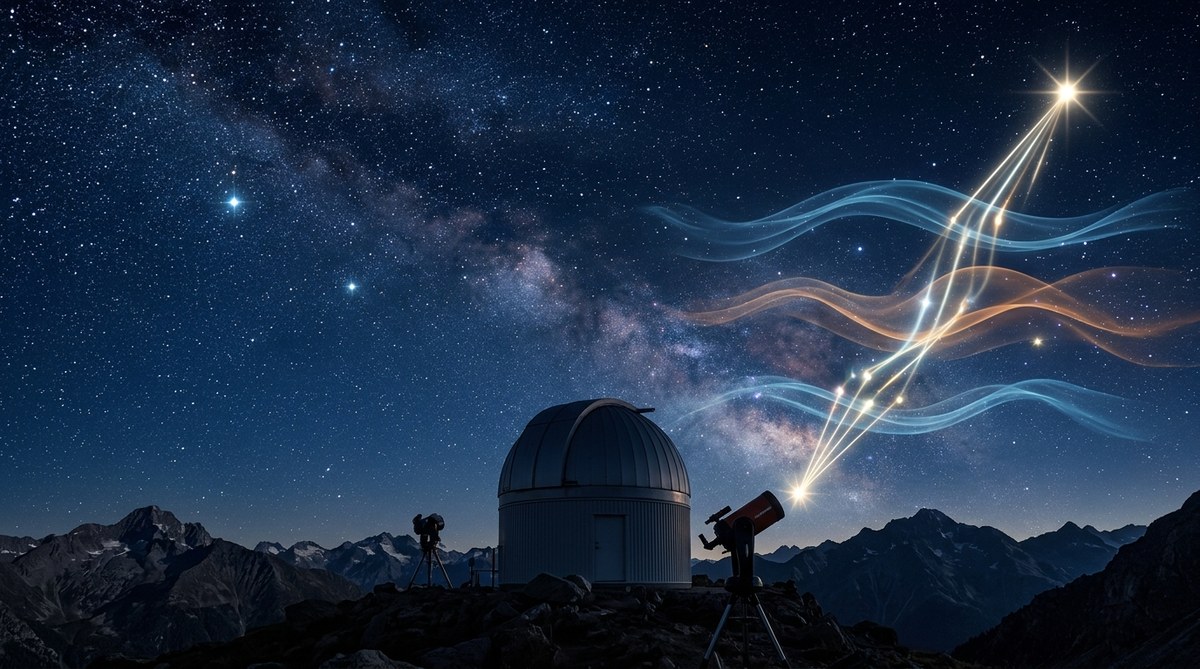
Have you ever looked up at a starry night sky and noticed how some points of light seem to pulse and shimmer while others stay steady? It is one of the most common questions in astronomy. The answer is simpler than you might think, but it reveals a lot about our planet and the universe. Twinkling is not a property of the stars themselves. It is a trick played by the air above us.
Stars twinkle because their light passes through turbulent layers of Earth’s atmosphere. As pockets of warm and cold air shift, they bend the light slightly, causing the star’s image to jitter and change brightness. The scientific name is stellar scintillation. Planets usually appear steadier because their discs are larger, averaging out the atmospheric wobble.
The Atmospheric Dance: How Air Makes Stars Flicker
Think of starlight as a messenger traveling across vast distances. It arrives at our planet as a nearly parallel beam of light. But Earth’s atmosphere is not a uniform window. It is a thick, churning blanket of air, full of tiny temperature differences, pressure changes, and pockets of moisture. When the beam hits this chaotic layer, it gets bent or refracted. The amount of bending depends on the temperature and density of the air.
As these pockets of air drift across your line of sight, they act like shifting lenses. One moment the light is concentrated toward your eye, making the star seem brighter. The next moment it is diverted away, making the star appear dimmer. This rapid fluctuation in brightness and position is what we call twinkling.
The scientific term is scintillation. The same principle makes distant lights on a hot road appear to shimmer.
Why Don’t Planets Twinkle? The Size Matters
You have likely noticed that planets like Jupiter or Venus shine with a steady glow while nearby stars flicker. The reason is angular size. Stars are so incredibly far away that they appear as point sources of light, even through a telescope. A point source is very sensitive to atmospheric bending.
Planets, on the other hand, are nearer and appear as tiny discs, not points. The light coming from different parts of the disc experiences slightly different amounts of refraction. These variations average out across the disc, so the overall brightness remains stable. A planet’s image might wobble slightly through a telescope (we call that “seeing”), but to the naked eye, it usually looks calm.
This simple observation can help you tell planets from stars. If a light in the sky twinkles strongly, it is almost certainly a star. If it shines steadily, you might be looking at a planet.
Scintillation Versus Seeing: What’s the Difference?
Amateur astronomers often use two related terms that describe different aspects of atmospheric disturbance:
| Concept | What it affects | Naked eye result | Through a telescope |
|---|---|---|---|
| Scintillation | Brightness and color | Twinkling (star flickers) | Rapid changes in star brightness |
| Astronomical seeing | Sharpness of image | Blurring of star disc | Wobbly, distorted views of planets and stars |
Scintillation is the fluctuation in intensity. Seeing is the smearing of detail. Both are caused by the same atmospheric turbulence. A night with poor seeing often means strong twinkling, but it is possible to have good scintillation (stars twinkle a little) and terrible seeing, or vice versa.
How to Observe Twinkling: A Step by Step Guide
- Find a dark spot away from city lights. Light pollution can overwhelm subtle twinkling, but the effect is still visible under moderate skies.
- Choose a star low on the horizon. Stars near the horizon twinkle more because their light passes through a thicker slice of atmosphere, which contains more turbulence.
- Compare it to a star overhead. The same star will appear steadier when it is high in the sky, because the path through the atmosphere is shorter.
- Look for color flashes. On a very turbulent night, you might see brief red and green tints as different wavelengths of light are refracted differently.
- Watch for a few minutes. The intensity of twinkling changes with wind and weather patterns.
For a deeper understanding of how to read the night sky, see our guide on to Read the Sky Like a Map Without a Telescope].
Common Mistakes New Observers Make
- Thinking twinkling means the star is dying. Not true. Twinkling is purely an atmospheric effect. A star’s actual brightness is constant over human timescales.
- Believing that all stars twinkle the same amount. Bright stars twinkle less than faint ones because their light is stronger and the fluctuations are less noticeable. Also, stars near the horizon twinkle more.
- Confusing twinkling with a satellite. Satellites move steadily across the sky and do not twinkle. They may brighten and dim slowly as they rotate, but that is different.
- Blaming the telescope for twinkling. Even through the finest telescope, stars will twinkle. The atmosphere is the culprit.
What Affects Twinkling Intensity?
Several factors determine how much a star appears to dance:
- Altitude above the horizon: Lower altitude equals more atmosphere.
- Weather: Cold fronts, wind, and high humidity increase turbulence.
- Time of night: Early evening often has more turbulence; after midnight, conditions sometimes settle.
- Latitude: Observers in tropical regions experience more pronounced twinkling near the horizon.
If you are planning a stargazing session, consider learning about Common Mistakes New Astronomers Make and How to Avoid Them] to get the best view.
“The twinkling of a star is not a sign of its life, but of our atmosphere’s restless motion. It is a reminder that we are looking at the cosmos through a living, moving ocean of air.” — Dr. Sarah Collins, atmospheric physicist and astronomy educator
How to Reduce Twinkling for Better Observations
Amateur astronomers use a few tricks to minimize the effect of scintillation when they want to observe fine details:
- Wait for the star to rise higher in the sky.
- Observe on nights with stable, high pressure and low wind.
- Use a telescope with a larger aperture. A bigger mirror or lens collects more light, which helps average out some of the rapid fluctuations.
- Use a narrowband filter that isolates a specific wavelength of light, reducing chromatic distortion.
Remember, even the best equipment cannot eliminate twinkling entirely. Do not let it discourage you. Part of the beauty of stargazing is accepting that the atmosphere is an active participant in the show.
Why the Twinkle Myths Persist
Cultural stories sometimes claim that twinkling means a star is singing or that it is a soul watching over us. These are poetic, but the real explanation is grounded in physics. The effect was first correctly described by Sir Isaac Newton, who noted that “the twinkling of the stars is caused by the agitation of the air.” In 2026, modern atmospheric science has confirmed his insight.
Yet many people still think twinkling is a star’s intrinsic property. That is partly because star images in children’s books often have starburst points, reinforcing the idea that stars are naturally sparkly. Understanding the truth makes the observation even more fascinating: you are witnessing the dynamic nature of our own planet.
Your First Step to a Clearer Sky
Now that you know the science, you can use this knowledge to improve your night sky experiences. When you see a star twinkle, you are watching Earth’s atmosphere in action. That shimmering light traveled for years across space, only to be gently jostled by a breeze above your head.
Start by using the five step guide above to observe twinkling tonight. Then pick a planet like Jupiter or Saturn to see the difference. Soon you will be able to tell a planet from a star at a glance. For more tips on identifying celestial objects, check out Tips for Beginners to Identify Celestial Objects in 2026].
Finally, if light pollution is affecting your view, read our article on Light Pollution Ruining Your View? Here’s How to Adapt]. A little knowledge and a dark sky can turn any curious observer into a confident stargazer.