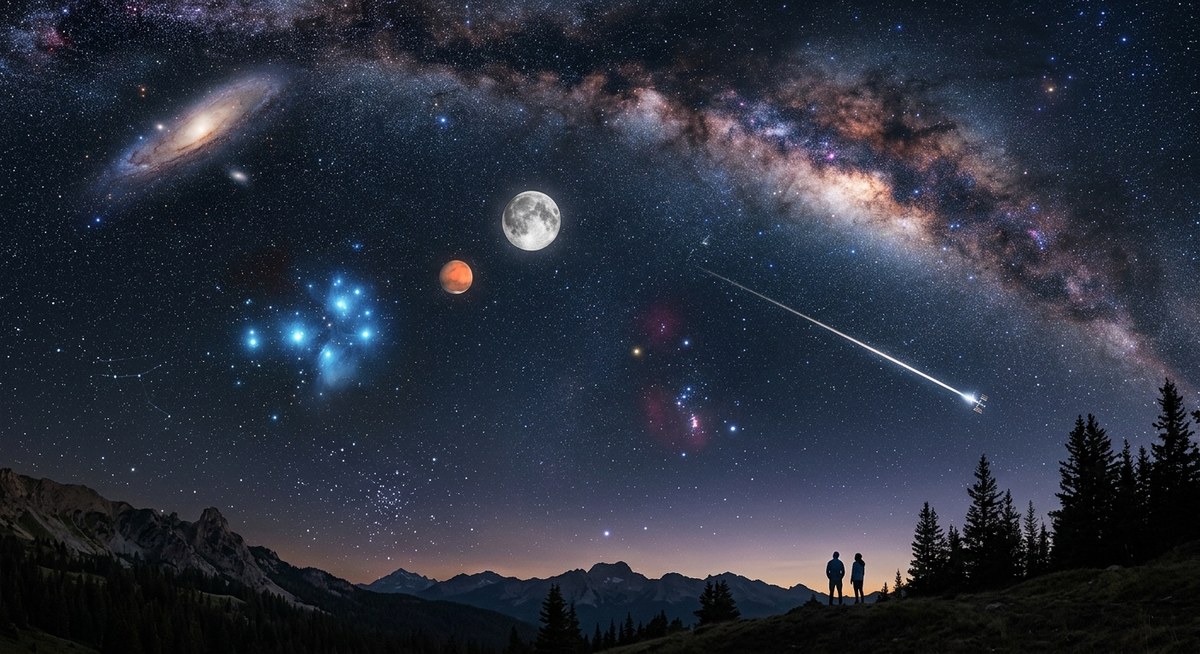
The night sky is full of surprises. You step outside, look up, and think you see just a scattering of stars. But hidden among those twinkling lights are objects that can amaze you without any equipment. The great thing about stargazing in 2026 is that you don’t need a telescope to see planets, distant galaxies, or even the International Space Station. All you need are your eyes, a clear night, and a little bit of knowledge.
You don’t need a telescope to enjoy astronomy. With just your eyes, you can see five planets, the Moon’s craters, star clusters like the Pleiades, and even a galaxy like Andromeda. The key is knowing where and when to look. This guide helps you spot the brightest naked eye night sky objects from your own backyard.
What You Can See with Just Your Eyes
When you ask “What can you see with the naked eye tonight?” the answer is more than you might expect. The brightest objects in the sky are often mistaken for stars but are actually planets. Beyond that, there are star clusters, nebulae, and even a galaxy that appears as a faint smudge. Here is a look at the most rewarding targets for a beginner.
The Five Bright Planets
Five planets are regularly visible to the naked eye: Mercury, Venus, Mars, Jupiter, and Saturn. Venus is the brightest and appears as a brilliant “evening star” or “morning star.” Jupiter shines steadily and is often the second brightest object after Venus. Mars has a distinct orange hue and can be spotted when it is near opposition. Saturn appears as a steady, pale yellow point of light. Mercury is trickier because it hugs the horizon, but you can catch it just after sunset or before sunrise.
The Moon: A World of Detail
The Moon is not just a featureless disk. Even without a telescope, you can see the dark plains called maria (seas) and lighter highlands. During a crescent phase, the terminator (the line between day and night) shows shadows that make the surface pop. A full moon is bright but washes out other objects. The best time to look is during first quarter or last quarter phases. You can also watch the Moon pass in front of planets during an occultation.
Star Clusters You Can Spot
The Pleiades, or Seven Sisters, is a beautiful cluster that looks like a tiny dipper. In dark skies you can see six or seven stars, but with averted vision you might spot more. The Hyades cluster near Aldebaran in Taurus forms a V shape. The Beehive Cluster (M44) in Cancer appears as a faint patch of light. Each one is a group of stars born from the same gas cloud.
The Andromeda Galaxy
From a dark location away from city lights, the Andromeda Galaxy (M31) appears as a faint, elongated smudge. It is the most distant object you can see with the naked eye. To find it, locate the constellation Cassiopeia and then look for a dim patch near the Andromeda constellation. It takes patience, but seeing a galaxy two and a half million light years away is unforgettable.
The Milky Way Band
On a moonless night in a rural area, the Milky Way stretches across the sky like a river of milk. This band of light is the combined glow of millions of stars in our galaxy. The summer months offer the best view in the Northern Hemisphere. Let your eyes adjust for at least 20 minutes and you will see its subtle structure.
Satellites and the ISS
Artificial satellites look like moving stars gliding across the sky. The International Space Station is the brightest and easiest to spot. You can find pass times using apps or websites. It moves steadily and is brighter than any star. Iridium flares are less common now but you may still catch a bright flash from other satellites.
Meteor Showers
Shooting stars are tiny bits of debris burning up in our atmosphere. Major showers like the Perseids in August and Geminids in December produce dozens of meteors per hour. You don’t need any equipment. Just lie back, look up, and wait. The best viewing is after midnight when your part of Earth is facing into the meteor stream.
Timing and Conditions Matter
The success of your naked eye stargazing depends on three things: time, location, and sky darkness. Light pollution is the biggest enemy. Use a light pollution map to find a spot with a Bortle class of 4 or lower. Plan your session when the Moon is not dominant. New moon is ideal. Also consider the season. Some objects are only visible at certain times of the year.
Common Stargazing Mistakes and How to Fix Them
| Mistake | Why It Hurts | How to Fix |
|---|---|---|
| Not letting eyes adapt | You miss faint objects | Wait 20 to 30 minutes in the dark. Avoid phone screens. |
| Looking straight at dim objects | Faint details vanish | Use averted vision. Look slightly to the side. |
| Stargazing near city lights | Glare drowns out dim sky | Drive to a dark park or rural area. |
| Using a flashlight or phone | Ruins night vision | Use a red light filter or cover. |
| Not checking weather | Clouds block the view | Check clear sky charts or forecast. |
| Ignoring moon phase | Moon washes out most objects | Choose New Moon or before rise/set. |
Practical Steps for Your First Naked Eye Session
Follow these steps to get the most out of your time under the stars.
- Pick a date with a new moon or crescent moon. Check the moonrise and moonset times.
- Find a location away from streetlights. A local park or a friend’s backyard in the suburbs works.
- Let your eyes adjust. Sit in total darkness for at least 20 minutes. Do not look at any white light.
- Use a star chart or a mobile app set to red mode. Learn two or three constellations first.
- Start with the brightest objects. Venus or Jupiter are easy targets. Then move to fainter ones like the Andromeda Galaxy.
- Dress warmly. Bring a blanket or reclining chair. Stay comfortable so you can stay outside longer.
- Keep a log of what you see. Note the date, time, and how the object looked. Over time you will train your eye to see more.
“The best telescope is the one you use often. But the best observer is the one who looks up with patience and curiosity. Your eyes are powerful instruments. Give them time to adapt and you will be amazed.” – Advice from veteran amateur astronomer Laura Whittaker, quoted in our guide on understanding the night sky.
Tools to Help You See More
Your smartphone can be a powerful assistant. Use an app like Stellarium or SkySafari in night mode to identify objects. A red flashlight preserves your night vision. Consider buying a green laser pointer to point out objects to friends (use responsibly away from airports). A pair of binoculars is a great next step, but you will already see a lot with your eyes alone.
Start Your Journey Tonight
You do not need a telescope to connect with the universe. Tonight, step outside and look for the brightest star in the west. That might be Venus. Or find the Big Dipper and follow the arc of its handle to Arcturus. With each session, your eyes learn to see fainter details. The night sky becomes a familiar friend. For more guidance on identifying stars and planets, read our guide to mastering astronomy basics. And if you want a structured start, check out how to start your night sky observation journey. The universe is waiting. All you have to do is look up.