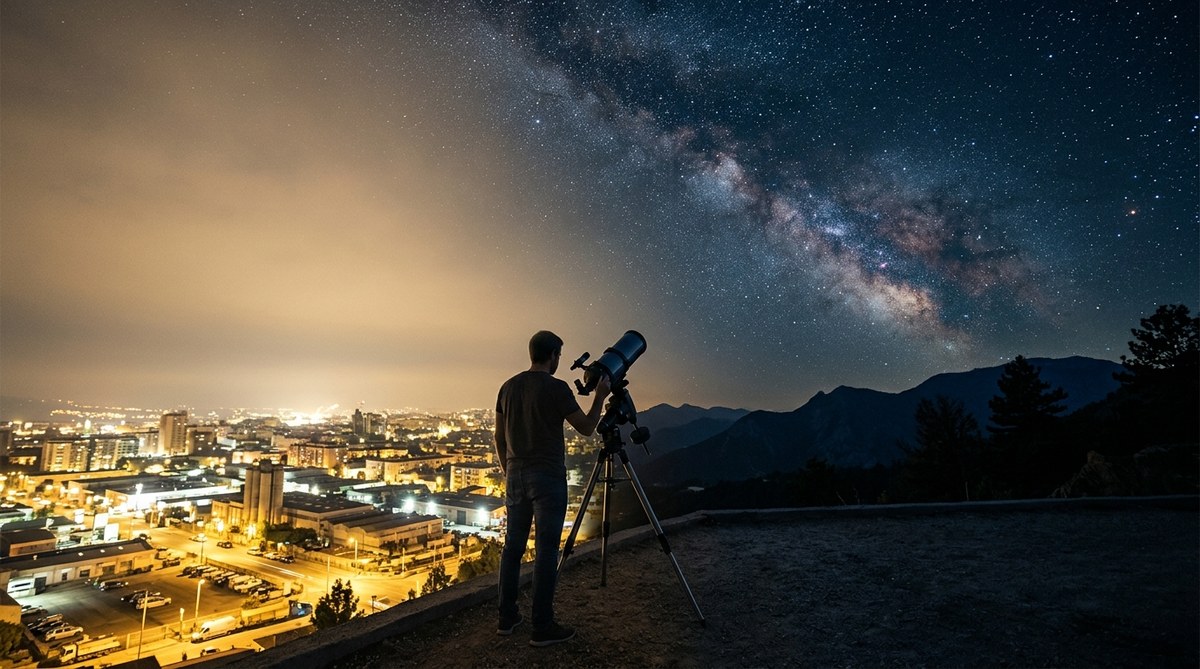
If you have ever stepped outside hoping to see the Milky Way and found only a dull orange glow above your neighborhood, you know the frustration. The stars that once guided travelers now vanish behind a curtain of wasted light. That glow is not just an annoyance. It quietly rewrites the natural world. It scrambles the migration routes of birds, tricks sea turtle hatchlings into crawling toward danger, and disrupts your own sleep cycle. For anyone who cares about the night sky or their own well being, understanding light pollution effects is the first step to fighting back.
Light pollution does more than hide stars. It harms wildlife by disrupting migration and reproduction. It affects human health by confusing our circadian rhythms and reducing melatonin. It wastes billions of dollars in energy each year. The good news: you can adapt your stargazing with filters, dark adaptation, and smart planning. You can also make simple changes at home to help reclaim the night.
The Ripple Effect of Light Pollution: More Than a Lost Star
When we talk about light pollution effects, most people picture a washed out sky. But the real cost runs deeper. Artificial light at night alters ecosystems. It tricks nocturnal animals into changing their feeding times. It interferes with the breeding cycles of frogs and the navigation of moths. For humans, constant exposure to blue rich light after sunset suppresses melatonin production. That hormone tells your body it is time to rest. Without it, sleep suffers.
Here are some major light pollution effects backed by science:
- Disrupted bird migration: Many songbirds fly at night using star patterns. City lights confuse them, causing fatal collisions with buildings.
- Deformed sea turtle hatchlings: Baby turtles follow natural light over the ocean. Bright beachfront lights lure them inland instead.
- Insect decline: Artificial light draws and kills countless insects, removing a key food source for birds and bats.
- Human sleep disorders: Studies link outdoor light at night to increased rates of insomnia, depression, and even certain cancers.
- Energy waste: The International Dark Sky Association estimates that at least 30 percent of outdoor lighting in the United States is wasted, costing over three billion dollars per year.
How Light Pollution Effects Your Stargazing Session
The most direct impact for amateur astronomers is lost contrast. When skyglow bounces off particles in the air, the faint light from a nebula or galaxy gets swamped. A telescope that should show the spiral arms of the Whirlpool Galaxy instead reveals a gray blur. Even the brightest planets suffer if the sky background is too bright.
To give you a clear picture, here is how different conditions affect what you can see:
| Condition | What You See | Common Mistake | Better Approach |
|---|---|---|---|
| Bortle 9 inner city | Only the moon, planets, and brightest stars (down to magnitude 3 or 4). | Trying to observe deep sky objects without a filter. | Use a narrowband or line filter (like an O III) to cut through the glow. |
| Bortle 5 suburban | Many stars to magnitude 5.5; Milky Way barely visible overhead. | Starting observation right after stepping out of a lit house. | Wait 20 minutes for dark adaptation. Use a red headlamp. |
| Bortle 3 rural | Milky Way visible with good contrast; faint nebulae visible without aid. | Using a wide field eyepiece that lets in too much light pollution. | Stick to higher magnification for small, bright objects. |
Step by Step: Adapting Your Observing Routine
You cannot move to a dark sky site every night. But you can change how you observe to get better results despite the glow. Follow these steps for your next session.
- Check a light pollution map first. Websites like ClearDarkSky and mobile apps show Bortle scale readings for your exact location. If your backyard rates Bortle 7 or higher, plan for lunar, planetary, or double star targets instead of deep sky.
- Let your eyes fully dark adapt. That means 20 to 30 minutes without any white light. Cover your phone screen with a red filter. Use a red flashlight for notes. The difference in what you see is dramatic.
- Choose the right filter. A broad spectrum light pollution reduction filter helps with some city glow. For specific emission nebulae, an O III or H beta filter can make them pop even from a light polluted backyard.
- Shield your telescope from local glare. A neighbor’s porch light or a streetlamp can ruin your session. Set up a portable shield or drape a dark cloth over your head while looking through the eyepiece.
- Observe in the early morning hours. Between midnight and dawn, many communities dim their streetlights. The air also tends to be cleaner, reducing scatter.
- Use averted vision. Look slightly to the side of a faint object. Your peripheral vision is more sensitive to low light. This simple trick can reveal detail in nebulae and galaxies that seem invisible at first.
Choosing Gear That Fights Back
The right equipment makes a huge difference. A telescope with a larger aperture collects more light, which helps overcome a bright sky background. But aperture alone is not enough. A quality narrowband filter can cost less than a good eyepiece yet transform your view.
If you are just starting out, check our guide on how to choose the perfect beginner telescope for your first night sky adventure. For more seasoned observers, consider upgrading to a dedicated narrowband filter set. Models like the Astronomik UHC or Lumicon O III are trusted favorites in 2026.
Also, do not underestimate the power of a simple red headlamp. It preserves your night vision and helps you read star charts without resetting your adaptation. Some models allow you to dim the brightness to the lowest useful level.
“The single best thing you can do for light polluted skies is to give your eyes time to adapt. I tell every student: sit in the dark for twenty minutes before you even touch the telescope. You will see two full magnitudes deeper.”
Dr. Maria Torres, astronomy educator and dark sky advocate
A Simple Guide to Common Pitfalls
Even experienced observers fall into these traps. Here is a quick look at mistakes many amateur astronomers make and how to fix them.
- Mistake: Using a red light that is too bright.
Fix: Hold the light at arm’s length. If it feels too bright, cover the bulb with red tape or dim it. - Mistake: Observing from a driveway that floods with white light when a car passes.
Fix: Pick a spot shielded by trees, a fence, or a car. Even a cardboard box can act as a temporary wall. - Mistake: Pointing the telescope at low altitude near a bright city horizon.
Fix: Observe objects when they are at least 30 degrees above the horizon. Light pollution is densest near the ground. - Mistake: Not using a dew shield.
Fix: A simple dew shield (or even a rolled up yoga mat) keeps moisture off the front lens and improves contrast.
What You Can Do as an Advocate for Dark Skies
Improving your own observing is one thing. Reducing light pollution effects for your whole community is another. Start with your own home. Replace any unbounded outdoor fixtures with fully shielded models that point light downward. Use warm colored bulbs (2700K or lower) which emit less blue light. Install motion sensors so lights are only on when needed.
Then take it a step further. Talk to your neighbors about their porch lights. Many people are unaware that their fixtures waste energy. Show them how a downward facing shield can both save money and still light the driveway. If your town is planning to upgrade streetlights, advocate for shielded fixtures with warm color temperatures. Some cities have already adopted “dark sky friendly” lighting after citizen campaigns.
For deeper guidance, read our article on how to plan your first stargazing session in 2026. It includes practical tips for scouting dark sites near you.
The Bigger Picture: Light Pollution Effects on Wildlife and Your Health
We have touched on a few examples, but the scale is staggering. According to a 2026 report from the journal Science Advances, light pollution is growing at nearly 10 percent per year globally. That means the area of the sky that is artificially bright doubles roughly every seven years.
For birds, the consequences are deadly. During spring and fall migration, artificial light at night disorients millions of birds. Many fly in circles around brightly lit buildings until they collapse from exhaustion. The “Lights Out” movement asks building owners to turn off unnecessary lights during migration windows. Chicago and New York have seen significant reductions in bird deaths after adopting these programs.
On the health side, researchers have linked nighttime light exposure to higher risks of breast cancer and prostate cancer. The World Health Organization has classified shift work that disrupts circadian rhythms as a probable carcinogen. While your backyard stargazing session is not the same as working a night shift, cumulative exposure to light at home still matters.
Finding Your Night Sky Again
You do not need to move to a remote mountaintop to enjoy astronomy in 2026. By understanding light pollution effects and taking small, smart steps, you can still see the Pleiades, track Jupiter’s moons, and even glimpse the Andromeda Galaxy on a clear suburban night. The key is preparation: use filters, protect your dark adaptation, and choose targets wisely.
Let tonight be the night you reclaim your patch of darkness. Step outside, look up, and give your eyes time to remember the stars. They are still out there.