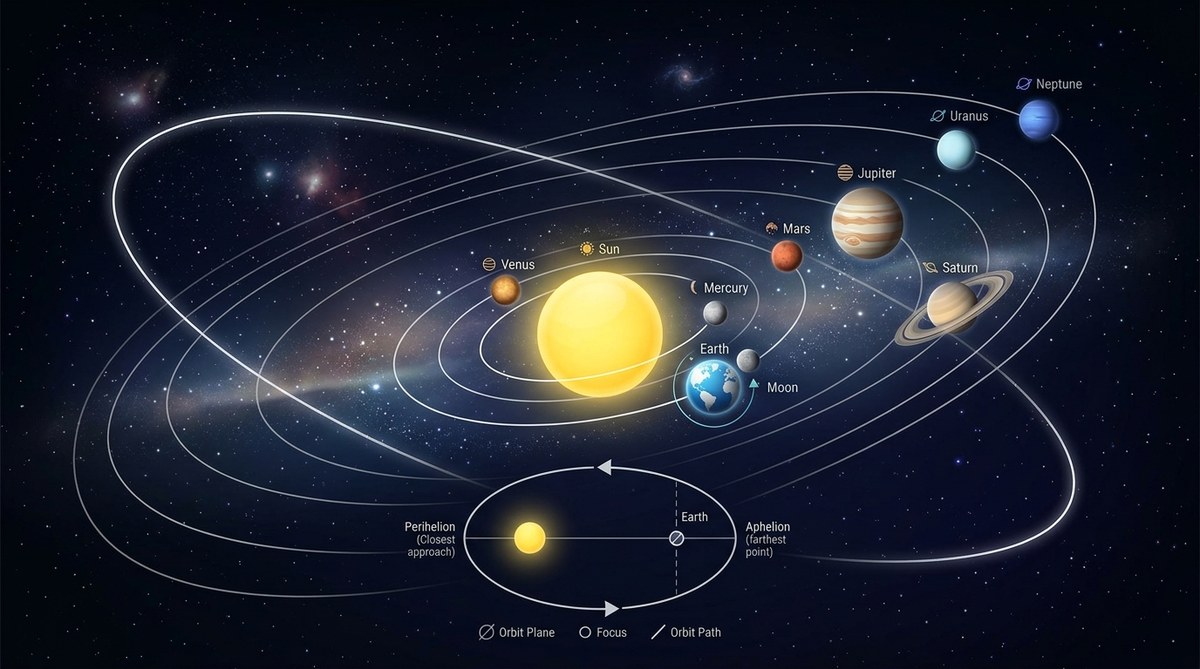
Getting a grip on how planets move around the Sun can seem complex at first. But once you understand the key concepts behind planetary orbits, you’ll see that it’s more straightforward than it appears. This guide is designed to introduce beginners to the fascinating mechanics of planetary motion, breaking down the science into easy-to-understand ideas. Whether you’re a student, an amateur astronomer, or just curious about space, you’ll find plenty of insights here.
Understanding planetary orbits involves grasping how planets move in elliptical paths around the Sun, governed by gravitational forces. Kepler’s laws describe these motions, revealing that most orbits are nearly circular with slight eccentricities. By learning these basics, you gain a clearer picture of how our solar system functions and how planets dance through space in predictable patterns.
How planets travel around the Sun
Planets don’t move in perfect circles. Instead, they follow elliptical orbits, which are slightly stretched circles. The Sun sits at one focus of these ellipses, not at the center. This shape is called an ellipse. The degree of stretch or how elongated an orbit is measured by a property called eccentricity.
Most planets in our solar system have orbits that are close to circles, with low eccentricity values. Think of an orbit with an eccentricity of zero as a perfect circle. As eccentricity increases, the orbit becomes more elongated. For example, Mercury has a more elongated orbit than Earth, which is why it sometimes gets closer or farther from the Sun during its journey.
Kepler’s laws and planetary motion
Johannes Kepler formulated three laws that describe how planets move around the Sun. These laws help us understand the shape, speed, and timing of planetary orbits.
Kepler’s First Law
Planets orbit the Sun in ellipses with the Sun at one focus. This means their distance from the Sun varies throughout their journey. When a planet is closer to the Sun, it moves faster; when it is farther away, it moves slower.
Kepler’s Second Law
A line connecting a planet and the Sun sweeps out equal areas during equal times. This explains why planets speed up as they approach the Sun and slow down as they move away.
Kepler’s Third Law
The square of a planet’s orbital period is proportional to the cube of its average distance from the Sun. This relationship allows us to compare how long planets take to orbit with their distance from the Sun.
How to visualize planetary orbits
Visualizing orbits can help make the science clearer. Imagine a stretched circle with the Sun at one focus. The planet moves along this path, speeding up near the Sun and slowing down farther away. Many astronomy apps and simulations can show these motions in real time, making the concept easier to grasp.
Practical steps to understand planetary motion
- Learn about the shape of orbits: Understand what an ellipse is and how it differs from a circle.
- Study Kepler’s laws: Focus on how they describe the speed and shape of orbiting planets.
- Use visual tools: Try online simulations that show planets moving in their orbits. These can clarify how eccentricity affects shape and speed.
- Observe planetary positions: Use a telescope or binoculars to see planets in the night sky. Note their relative positions and how they change over time.
- Read about gravity: Understand how the Sun’s gravity keeps planets in their paths and determines their speed.
Practical process for beginners:
- Start with basic diagrams of planetary orbits.
- Watch animations illustrating Kepler’s laws.
- Use space apps like Stellarium to see real-time planetary movements.
- Track planets over weeks to notice changes.
- Connect observations with the science behind the motion.
Common misconceptions and mistakes
| Technique | Mistake to avoid |
|---|---|
| Assuming all orbits are perfect circles | Believing planets move at constant speed in their orbits |
| Ignoring eccentricity | Thinking planetary orbits are always circular |
| Overlooking the Sun’s role | Forgetting gravity’s influence on orbital shape and speed |
An expert once said, “Understanding the shape and motion of planetary orbits is like learning the rhythm of a cosmic dance. Once you see the patterns, everything in our solar system makes more sense.”
How understanding planetary orbits enhances your space knowledge
Grasping these concepts opens the door to deeper space science. It helps you appreciate why planets appear in certain positions, how spacecraft are navigated, and even how other star systems might behave. Knowing the basics of orbits also makes it easier to understand phenomena like eclipses, seasons, and planetary transits.
Final thoughts on planetary motions
Getting familiar with the way planets move around the Sun is a rewarding journey. It combines simple shapes with elegant laws that describe complex motions. By starting with visualizations and basic principles, you’ll find yourself gradually understanding the grand choreography of our solar system. Keep observing, stay curious, and let the universe teach you its secrets.
Keep exploring the universe of planetary orbits
Understanding planetary orbits isn’t just about memorizing facts. It’s about seeing the universe as a harmonious system where everything moves with purpose and rhythm. As you continue your space journey, remember that each orbit tells a story of gravity, motion, and time. Keep studying, experimenting, and observing, and you’ll uncover even more awe-inspiring cosmic truths.